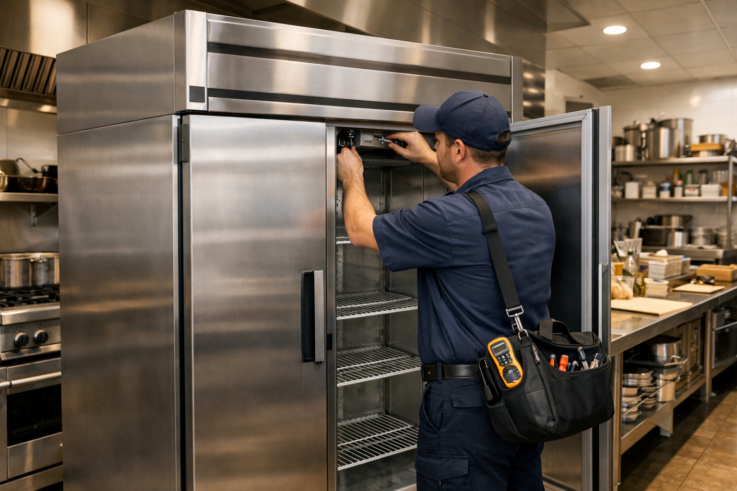
Reach-In Refrigerator Not Cooling in Massachusetts: Troubleshooting
Reach-In Refrigerator Not Cooling? Start Here
Short answer: If your reach-in refrigerator is running but not getting cold, the cause is often restricted airflow, dirty condenser coils, a failing evaporator or condenser fan, a bad thermostat, a refrigerant leak, an iced evaporator, damaged door gaskets, or compressor trouble. Massachusetts restaurants, stores, hotels, and commercial kitchens should protect product immediately and call a commercial refrigeration technician if temperatures keep rising.
A reach-in cooler not cooling is one of the most stressful refrigeration problems for a food business. Unlike a small nuisance repair, a warm reach-in can threaten prep ingredients, beverages, grab-and-go items, dairy, meat, seafood, desserts, and other temperature-sensitive inventory. For a restaurant in Boston, a convenience store in Cambridge, a hotel kitchen in Waltham, or a grocery operation in Worcester County, the problem needs fast triage and a clear plan.
Royal Cooling provides commercial refrigeration support for Massachusetts businesses that depend on reach-in refrigerators, walk-in coolers, walk-in freezers, wine coolers, freezers, and preventive refrigeration maintenance. This guide explains what to check before you request service, when the issue becomes urgent, what a technician typically inspects, and how to think about repair versus replacement.
If your unit is already above safe operating temperature, product is at risk, or you smell burning electrical components, call Royal Cooling at 781-899-4441 or request help through our contact page.
Why Is My Reach-In Refrigerator Running But Not Getting Cold?
When a reach-in refrigerator is running but not getting cold, it means at least part of the system still has power. You may hear the compressor, fans, or relays trying to operate. However, running is not the same as cooling. Commercial refrigeration depends on a chain of components working together: airflow across the evaporator coil, heat rejection at the condenser, correct refrigerant charge, accurate controls, tight doors, and enough compressor capacity to remove heat from the cabinet.
In Massachusetts foodservice environments, reach-ins often work hard through breakfast prep, lunch rush, dinner service, and late-night restocking. Doors are opened repeatedly, hot product may be loaded too soon, vents get blocked by pans or boxes, and condenser coils can collect flour dust, grease, lint, cardboard fibers, and kitchen debris. In convenience stores and liquor stores, reach-in refrigerators may be close to customer traffic, glass doors may be opened frequently, and units may be pushed too close to walls with poor ventilation.
Common reasons a reach-in refrigerator runs but does not cool include:
- Dirty condenser coils: If the condenser cannot reject heat, the system may run constantly while cabinet temperature climbs.
- Blocked interior airflow: Overfilled shelves, pans pushed against rear vents, or product stacked too tightly can prevent cold air circulation.
- Failed evaporator fan: The evaporator coil may get cold, but the cabinet will not cool evenly if air is not moving across it.
- Failed condenser fan: The compressor may overheat or short-cycle if the outdoor or mechanical-side heat rejection process is compromised.
- Thermostat or temperature control failure: The system may not call for cooling correctly, or it may read the wrong cabinet temperature.
- Iced evaporator coil: Ice blocks airflow and reduces heat transfer, often due to door leaks, defrost problems, fan issues, or low refrigerant.
- Damaged door gaskets or hinges: Warm, humid kitchen air enters the box and forces the unit to run without reaching setpoint.
- Refrigerant leak: Low refrigerant can cause poor cooling, icing, longer run times, and compressor stress.
- Compressor or start component failure: The compressor may hum, click, run hot, or fail to pump refrigerant properly.
What to Check Before Requesting Emergency Reach-In Refrigerator Repair
Before requesting emergency refrigeration repair in Massachusetts, there are several quick checks a manager, chef, or facility contact can perform safely. These steps may help you identify a simple operating issue, provide better information to the technician, and reduce product loss while service is being arranged.
1. Confirm the actual cabinet temperature
Use a reliable thermometer, not only the digital display on the refrigerator. A faulty sensor or display can mislead staff. Check temperatures in multiple areas: top shelf, lower shelf, near the door, and toward the back of the cabinet. If food temperatures are rising, follow your internal food safety procedures and move product to another working refrigerator or walk-in cooler if available.
2. Check power and basic controls
Verify that the unit is plugged in, the breaker has not tripped, and the switch is on. Confirm the temperature setpoint has not been changed by mistake. If the unit is connected to a GFCI or shared circuit, note any repeated trips. Do not keep resetting a breaker that trips repeatedly, because that may indicate a wiring, compressor, motor, or moisture-related problem.
3. Look for blocked vents and overloaded shelves
A commercial reach-in refrigerator service call often starts with airflow. Make sure boxes, sheet pans, produce cases, beverage crates, or containers are not covering the internal air supply and return openings. Leave room between product and walls so cold air can circulate. A unit can appear to be failing when the real problem is heavy loading after a delivery.
4. Inspect door gaskets and door closing
Run your hand around the closed door to feel for warm air entering. Look for torn gaskets, food debris, warped magnetic strips, loose hinges, sagging doors, or doors that do not self-close. In busy Massachusetts restaurants and commercial kitchens, gasket wear is one of the most common contributors to temperature problems.
5. Check the condenser area
If you can safely access the condenser coil, look for dust, grease, lint, and restricted ventilation. Do not remove panels unless you are trained and authorized. Make sure the unit is not pushed tight against a wall and that surrounding boxes, trash barrels, or storage items are not blocking airflow. Dirty coils can turn a normal reach-in into a constant-run, high-temperature problem.
6. Note ice, water, noise, and odor symptoms
Before you call, look for ice buildup on the evaporator area, water leaking inside or outside the unit, clicking noises, humming, rattling fan blades, hot compressor surfaces, or burning smells. These details help a commercial refrigeration technician prioritize the problem and bring likely parts or tools.
Symptoms, Likely Causes, and Urgency Level
The table below can help Massachusetts business owners decide whether a reach-in cooler not cooling is a quick operational check, a priority service call, or a true emergency refrigeration repair issue.
| Symptom | Likely Cause | What You Can Check | Urgency |
|---|---|---|---|
| Unit runs constantly but cabinet stays warm | Dirty condenser, low refrigerant, bad door seal, overloaded cabinet, weak compressor | Check product loading, door gaskets, and condenser airflow | High if temperature keeps rising |
| Fans run but air is not cold | Compressor issue, refrigerant leak, thermostat problem, failed start components | Confirm setpoint and listen for compressor cycling | High to emergency |
| Ice on interior coil or back wall | Defrost issue, air leak, fan failure, low refrigerant, blocked drain | Look for open doors, torn gaskets, and blocked airflow | High |
| Top shelf warm, lower shelf cold | Air circulation problem, blocked vents, weak evaporator fan | Rearrange product and clear vents | Moderate to high |
| Clicking, humming, or breaker trips | Electrical issue, start relay, compressor problem, motor fault | Do not repeatedly reset breaker; note sounds and timing | Emergency if persistent |
| Door will not seal or self-close | Worn gasket, damaged hinge, uneven cabinet, warped door | Inspect gasket and check for debris on sealing surface | Moderate, high if temperature unsafe |
When Should a Restaurant Call a Technician for a Reach-In Cooler Problem?
A restaurant should call a technician for a reach-in cooler problem when the unit cannot maintain its required temperature, the temperature continues rising after basic checks, the cabinet has ice buildup, fans are not operating, the compressor is hot or noisy, electrical components smell hot, the breaker trips, or product has to be moved to prevent loss. For restaurant refrigerator repair, waiting too long can turn a manageable repair into a more expensive compressor, refrigerant, or inventory problem.
Call Royal Cooling promptly if any of the following apply:
- The reach-in is above your required holding range and not recovering.
- You have already cleared vents and confirmed the door is closing, but temperatures remain high.
- The unit is serving a high-volume line, prep station, bar, banquet kitchen, or grab-and-go case.
- You see heavy frost or ice buildup around the evaporator section.
- The compressor clicks, hums, short-cycles, or feels unusually hot.
- The breaker or GFCI trips more than once.
- You suspect a refrigerant leak or notice oil residue near refrigeration lines.
- The failure affects service in a restaurant, hotel, grocery store, liquor store, convenience store, or commercial kitchen.
For businesses in Boston metro, Suffolk County, Middlesex County, Worcester County, and nearby Massachusetts communities, fast diagnosis matters. A reach-in refrigerator is often tied directly to service speed and daily revenue. If your kitchen in Quincy, Newton, Framingham, Lowell, Springfield, Cambridge, Worcester, Waltham, or Boston cannot safely operate around the failed unit, it is time to request commercial kitchen refrigeration repair.
What a Commercial Refrigeration Technician Checks
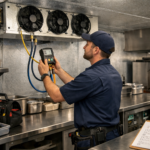
Professional reach-in refrigerator repair in Massachusetts involves more than replacing a thermostat or adding refrigerant. A trained technician looks at the entire system and the operating environment. The goal is to identify the root cause, not just force the unit to cool temporarily.
During commercial reach-in refrigerator service, Royal Cooling may evaluate:
- Cabinet temperature and temperature split: The technician compares return air, supply air, and product-area readings to understand cooling performance.
- Condenser coil condition: A clogged condenser is cleaned or documented as part of the repair recommendation.
- Evaporator coil condition: Frost pattern, ice buildup, airflow, and coil temperature can reveal fan, refrigerant, or defrost issues.
- Fan motors and blades: Weak motors, seized bearings, broken blades, or motors running intermittently can cause uneven cooling.
- Door gaskets, hinges, and closers: Air infiltration is a major cause of warm cabinets and iced coils.
- Thermostat, sensors, and controls: Controls are checked for accuracy, calibration, failed relays, and improper settings.
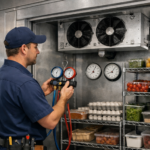
- Compressor operation: Amp draw, start components, run behavior, short cycling, overheating, and pressure readings may be reviewed.
- Refrigerant circuit: If symptoms point to low charge or restriction, the technician may check for leaks, restrictions, pressure concerns, and proper refrigerant handling requirements.
- Drain and defrost system: Blocked drains, failed defrost heaters, timers, sensors, and termination controls can all lead to icing and water problems.
- Installation conditions: Poor clearance, hot kitchen locations, nearby cooking equipment, and inadequate ventilation can shorten equipment life.
Because Royal Cooling works with commercial refrigeration systems, the service approach considers the demands of restaurant kitchens, convenience stores, supermarkets, grocery stores, hotels, and facility-managed properties. If the problem connects to a larger refrigeration plan, the technician may also discuss preventive maintenance, walk-in cooler repair, walk-in freezer service, freezer repair, or wine cooler service where relevant.
Can a Reach-In Refrigerator Be Repaired the Same Day in Massachusetts?
Many reach-in refrigerator problems can be diagnosed quickly, and some repairs may be completed during the initial visit when the issue is straightforward and parts are available. However, no responsible contractor should promise same-day repair for every situation. Compressor failures, specialty control boards, refrigerant leaks, severely iced coils, damaged doors, or model-specific parts can require additional time.
The best way to improve the chances of a fast repair is to provide clear information when you call. Have the unit brand and model number ready if possible. Share the cabinet temperature, when the issue started, whether the compressor is running, whether there is ice, whether fans are spinning, and whether product has been moved. This helps Royal Cooling prepare for the service call and prioritize emergency refrigeration repair Massachusetts requests based on risk and operating impact.
Repair vs. Replace: How to Think About the Decision
Not every warm reach-in needs to be replaced. Many issues, such as a worn door gasket, dirty condenser, bad fan motor, failed temperature control, clogged drain, or start component problem, are often repairable. For a newer or well-maintained commercial reach-in, repair is frequently the practical first step.
Replacement may be worth discussing when the cabinet is very old, has repeated compressor problems, has severe corrosion, uses difficult-to-source parts, has damaged doors or insulation, or costs more to operate than a modern unit. A reach-in refrigerator that repeatedly fails during peak service can also be a business risk even if each individual repair seems manageable.
Factors to consider include:
- Age and overall condition of the reach-in refrigerator
- Frequency of previous service calls
- Cost and availability of parts
- Condition of doors, gaskets, shelves, insulation, and cabinet structure
- Energy use and runtime
- Whether the unit is critical to daily service
- Whether a backup cooler or walk-in cooler is available
A commercial refrigeration technician can explain whether the current repair is likely to restore reliable operation or whether the reach-in is becoming a recurring liability.
Maintenance Tips to Prevent a Reach-In Cooler Not Cooling
Preventive maintenance is one of the most effective ways to reduce emergency restaurant refrigerator repair calls. Massachusetts businesses experience seasonal humidity, hot kitchens in summer, cold loading dock conditions in winter, and heavy service cycles year-round. A unit that is barely maintained may work during slow periods and then fail during a weekend rush, catering event, holiday, or large delivery.
Use these practical habits to reduce risk:
- Clean condenser coils regularly: Grease, dust, and lint reduce heat rejection and raise compressor stress.
- Keep vents clear: Train staff not to block air openings with pans, boxes, or stacked product.
- Check door gaskets weekly: Clean food debris from gaskets and report tears early.
- Avoid loading hot product: Let product cool according to your approved food safety process before placing heavy heat loads into the reach-in.
- Do not overfill shelves: Cold air needs room to move through the cabinet.
- Monitor temperatures daily: Record readings so you can spot slow performance changes before a failure.
- Listen for new noises: Rattling, scraping, clicking, or fan vibration can be early warning signs.
- Schedule preventive refrigeration maintenance: A planned visit can include cleaning, inspection, temperature checks, electrical checks, fan review, and early repair recommendations.
If your business manages multiple pieces of equipment, such as reach-in refrigerators, undercounter coolers, prep tables, walk-in coolers, walk-in freezers, and wine coolers, a preventive maintenance program can help prioritize service and reduce surprise downtime. Learn more about Royal Cooling service coverage on our service area page.
Massachusetts Reach-In Refrigerator Repair for Restaurants, Stores, and Commercial Kitchens
Royal Cooling supports commercial refrigeration needs for businesses across Massachusetts, including Boston metro, Worcester County, Middlesex County, and Suffolk County. We work with restaurant owners, chefs, commercial kitchens, convenience stores, liquor stores, grocery stores, supermarkets, hotels, facility managers, and property managers that rely on refrigeration every day.
Whether your reach-in refrigerator is part of a prep line in Boston, a beverage cooler in Cambridge, a back-of-house hotel kitchen in Newton, a market in Quincy, a store in Framingham, a facility in Waltham, or a food operation serving Worcester, Lowell, or Springfield, the right response starts with protecting product and identifying the cause. A technician should evaluate airflow, coils, fans, controls, refrigerant, compressor operation, drainage, defrost, and installation conditions before recommending a repair.
If your reach-in cooler is not cooling and your staff has already checked power, doors, vents, and product loading, do not wait for the cabinet to warm further. Call 781-899-4441 for commercial reach-in refrigerator service or request service through the Royal Cooling contact page. For urgent temperature problems, mention the current cabinet temperature, product risk, equipment type, and your Massachusetts location so the issue can be handled appropriately.
Frequently Asked Questions
Why is my reach-in refrigerator running but not getting cold?
A reach-in refrigerator can run without cooling if airflow is blocked, condenser coils are dirty, a fan has failed, the thermostat is inaccurate, the evaporator is iced, refrigerant is low, or the compressor is not pumping properly. If temperatures do not recover after basic checks, call a commercial refrigeration technician.
When should a restaurant call a technician for a reach-in cooler problem?
Call a technician when the reach-in cannot hold temperature, temperatures keep rising, product is at risk, ice is forming, fans are not running, the compressor is noisy or hot, or breakers trip. Restaurants should not wait if the unit affects service or food storage.
What should I check before requesting emergency reach-in refrigerator repair?
Check the actual cabinet temperature, power, setpoint, door gaskets, blocked vents, overloaded shelves, condenser airflow, ice buildup, water leaks, unusual noises, and breaker trips. Move product to working refrigeration if needed and share these details when calling for service.
Can a reach-in refrigerator be repaired the same day in Massachusetts?
Some reach-in refrigerator repairs can be completed during the initial visit if the issue is straightforward and parts are available. Same-day repair cannot be guaranteed for every problem, especially compressor failures, refrigerant leaks, specialty parts, or severe icing.
Do dirty condenser coils make a reach-in cooler run warm?
Yes. Dirty condenser coils prevent the unit from rejecting heat, which can make the compressor run longer, raise cabinet temperature, increase energy use, and shorten equipment life. Coil cleaning is an important part of preventive refrigeration maintenance.
Is a warm reach-in refrigerator always a refrigerant leak?
No. Low refrigerant is only one possible cause. Warm reach-ins can also result from bad door gaskets, blocked airflow, dirty coils, fan motor failures, thermostat issues, defrost problems, electrical faults, or compressor trouble. A technician should diagnose the system before adding refrigerant.
Who services commercial reach-in refrigerators in Boston metro and Worcester County?
Royal Cooling provides commercial refrigeration service for Massachusetts businesses, including restaurants, stores, hotels, commercial kitchens, and facility-managed properties in areas such as Boston metro, Worcester County, Middlesex County, and Suffolk County. Call 781-899-4441 to discuss service needs.
Final CTA: Get Help Before Product Is at Risk
A reach-in refrigerator not cooling is not a problem to ignore. Start with safe checks: verify temperature, clear vents, inspect doors, confirm power, and protect product. If the unit is still warm, Royal Cooling can help diagnose the issue and recommend the right repair for your Massachusetts business. Call 781-899-4441 or visit /contact/ to request commercial refrigeration service.