Walk-In Cooler Not Holding Temperature Overnight: Causes Restauranters
Short answer: why your walk-in cooler is warm in the morning
If your walk-in cooler is not holding temperature overnight, the most common causes are restricted airflow, a dirty condenser, a defrost or control problem, failing fans, refrigerant loss, compressor issues, or heat entering the box after closing. Massachusetts restaurants should protect food first, document temperatures, check obvious safe items, and call a commercial refrigeration technician if the problem repeats or the cooler stays above safe operating range.
Why an overnight temperature problem feels different from a daytime cooling issue
A walk-in cooler can be confusing when it seems fine during lunch or dinner service but is warm when the opening manager arrives. This pattern is common in restaurants, bakeries, supermarkets, convenience stores, hotels, liquor stores, and commercial kitchens across Massachusetts because the load on the refrigeration system changes after the business closes.
During the day, staff may notice the box door opening often, product being rotated, and fans running. At night, the cooler should have an easier job: fewer door openings, stable product load, and lower kitchen activity. So when there is a restaurant cooler running warm overnight, it usually means something in the system is failing under specific conditions, controls are allowing temperature to drift, or heat is entering the walk-in when nobody is watching.
For a Boston restaurant preparing for morning deliveries, a Cambridge cafe opening before commuter traffic, a Quincy seafood market checking product before display, or a Worcester grocery department receiving early shipments, discovering a warm walk-in cooler can disrupt prep, food safety decisions, staffing, and sales. The goal is to separate safe owner-level checks from issues that require professional walk-in cooler repair.
What to do first if the walk-in cooler is warm in the morning
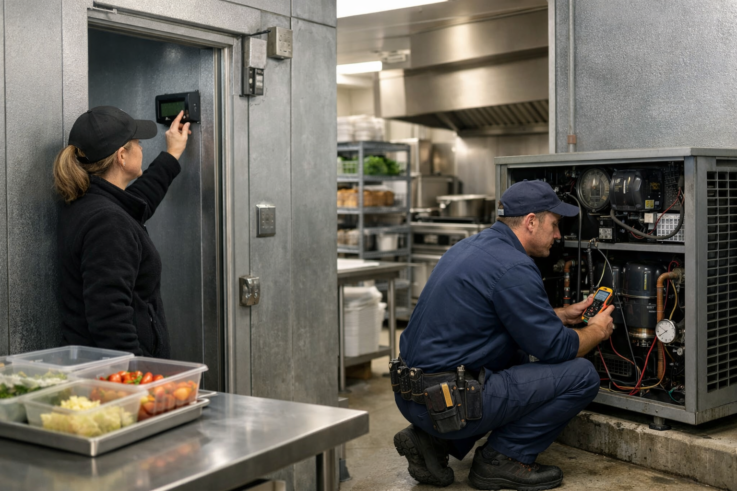
If you walk in before prep and the temperature is higher than expected, do not keep opening the door to troubleshoot. Every extra door opening adds warm, humid air and can make the problem worse. Use a calm, documented process.
- Record the temperature immediately. Note the air temperature on the thermostat or thermometer, the time, and whether the evaporator fans are running.
- Check product temperatures according to your food safety procedures. Air temperature alone does not always equal product temperature, especially if the issue just occurred.
- Keep the door closed. Assign one person to access the cooler only when necessary.
- Move critical product only if your procedures require it. Use another properly operating cooler or refrigerated truck if available.
- Look and listen from outside the equipment area. Note unusual noises, silence from fans, ice buildup, water on the floor, or alarms.
- Call for service if the cooler does not recover quickly or the issue repeats. A recurring overnight refrigeration failure usually will not fix itself.
If you need help deciding whether it is urgent, call Royal Cooling at 781-899-4441 or use the contact page. For Massachusetts businesses in the Boston metro, Middlesex County, Suffolk County, Worcester County, and nearby communities such as Boston, Cambridge, Lowell, Newton, Waltham, Framingham, Quincy, Worcester, and Springfield, fast diagnosis matters when morning prep or deliveries are at risk.
Common causes of a walk-in cooler not holding temperature overnight
1. Dirty condenser coils or poor condenser airflow
Yes, a dirty condenser can cause a walk-in cooler to lose temperature overnight. The condenser rejects heat from the refrigeration system. When the coil is packed with grease, dust, pollen, cardboard debris, kitchen lint, or outdoor debris, the system may run longer, operate at higher pressure, and struggle to remove heat efficiently.
This can show up overnight because the cooler may slowly fall behind after the evening rush, especially after a large delivery, heavy restocking, or warm product load. If the condensing unit is on a roof, behind a building, in a mechanical area, or near a loading zone, airflow can also be blocked by storage, snow, leaves, or equipment placement. Massachusetts businesses should be especially careful during pollen season, summer heat, fall debris, and winter conditions that can affect outdoor equipment access.
2. Evaporator coil icing or restricted airflow inside the box
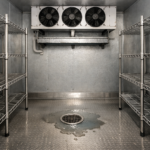
The evaporator coil absorbs heat inside the walk-in. If the coil is iced, blocked by stacked product, or starved for airflow, the cooler may not maintain temperature through the night. Ice can form from excessive humidity, air leaks, fan problems, low refrigerant, failed defrost controls, or repeated door openings before closing.
Look for product stacked too close to the evaporator, boxes blocking return air, plastic wrap pulled into fan guards, or frost patterns on the coil. Do not chip ice off the coil with tools. Damaging the coil can create a refrigerant leak and turn a repairable service call into a larger problem.
3. Defrost schedule or control problems
Some overnight temperature complaints are tied to defrost timing. A walk-in cooler may have scheduled defrost periods that stop cooling temporarily to remove frost from the evaporator. If defrost is too long, too frequent, misprogrammed, or not terminating correctly, the box can warm overnight and be discovered above setpoint in the morning.
Controls can also be affected by incorrect sensor placement, damaged sensors, thermostat calibration problems, loose wiring, or failed relays. If someone recently adjusted the thermostat, replaced a controller, changed a time clock, or reset power after an outage, mention that to the technician. A small programming issue can mimic a major mechanical failure.
4. Door not fully closing after the last shift
This article is not a general door-gasket guide, but overnight issues often start at closing. A pallet, mop bucket, uneven threshold, swollen floor panel, damaged latch, worn hinge, or product box can prevent the door from sealing. Even a small opening allows warm humid air to enter for hours.
Unlike daytime door openings, an overnight air leak is continuous. The evaporator can ice up, the compressor can run excessively, and the cooler can be warm by morning. Train closing staff to confirm the door closes fully, the light turns off if visible, and no product is blocking the sweep area.
5. Warm product loaded late in the day
A walk-in cooler is designed to hold refrigerated product at temperature, not rapidly chill large volumes of warm product. If a restaurant receives a late delivery, loads hot prep containers, stacks cases tightly, or stores product with no air gaps, the system can be overwhelmed overnight. The air may cool around the thermostat while dense product remains warm, or the cooler may run constantly and still not reach setpoint.
This is especially relevant for caterers, commissary kitchens, bakeries, breweries, supermarkets, and hotels that load product after closing. Spread product to allow airflow, follow cooling procedures, and avoid blocking the evaporator discharge or return.
6. Failing evaporator or condenser fan motors
A fan motor can operate intermittently. It may run while you are watching it during the day and fail when heat, vibration, or electrical load changes overnight. Bad bearings, weak capacitors, wiring issues, or failing motor windings can cause inconsistent operation.
If the evaporator fans are silent when the box is calling for cooling, the coil may be cold but the air is not moving. If the condenser fan fails, the compressor can overheat, trip on safety, or struggle to reject heat. These are jobs for a commercial refrigeration technician, not a kitchen staff repair.
7. Refrigerant leak or low refrigerant charge
Low refrigerant can cause poor capacity, long run times, uneven frost, warm box temperatures, and compressor stress. Refrigerant is not a consumable item; if the charge is low, there is usually a leak that needs to be found and repaired. Simply adding refrigerant without addressing the leak may lead to repeat calls and compliance concerns.
Because refrigerant diagnosis requires gauges, leak detection practices, and EPA-compliant handling, call a qualified technician. Royal Cooling provides commercial refrigeration service for walk-in coolers, walk-in freezers, reach-in refrigerators, wine coolers, and freezer repair needs across Massachusetts service areas.
8. Compressor, electrical, or safety control trips
Sometimes the cooler is warm in the morning because the condensing unit stopped running overnight. Causes may include compressor overheating, high-pressure trips, low-pressure controls, contactor failure, voltage problems, loose wiring, tripped breakers, or safety controls responding to another underlying issue.
If a breaker is tripped, do not repeatedly reset it. A breaker that trips again can indicate an electrical fault or equipment failure. Repeated resets can increase risk to equipment and staff. Document what happened and call an HVAC contractor or commercial refrigeration technician trained on refrigeration electrical systems.
Symptoms, likely causes, and what to do next
| Morning symptom | Possible cause | Safe owner check | When to call Royal Cooling |
|---|---|---|---|
| Cooler is warm, compressor seems to run constantly | Dirty condenser, warm product load, low refrigerant, airflow restriction | Keep door closed, check for blocked coils or blocked airflow areas without removing panels | Call if temperature does not recover or the pattern repeats overnight |
| Cooler was fine at closing but warm before prep | Door left slightly open, defrost/control issue, intermittent fan or compressor problem | Check door obstruction, closing checklist, and temperature log | Call for diagnosis if there is no obvious door issue or product is at risk |
| Ice or frost on evaporator coil | Air leak, failed defrost, fan problem, low refrigerant, humidity infiltration | Do not chip ice; reduce door openings and document frost pattern | Call for walk-in cooler repair before the coil becomes fully blocked |
| Fans are silent or making noise | Motor failure, capacitor issue, wiring problem, control problem | Listen and note whether the thermostat is calling for cooling | Call promptly; airflow problems can cause food temperature and compressor issues |
| Breaker tripped or unit is off | Electrical fault, compressor issue, shorted component, overload | Follow your facility policy; avoid repeated resets | Call immediately if the breaker trips again or there is burning smell, buzzing, or visible damage |
| Temperature recovers later in the day | Intermittent control, defrost timing, outdoor ambient effect, fan problem | Save temperature logs and note recovery time | Call because recurring overnight refrigeration failure often worsens |
Safe checks restaurant owners can make before calling
There are a few practical checks that do not require tools, gauges, panel removal, or electrical work. These can help you communicate clearly when you call for service.
- Confirm the thermostat setpoint. Make sure it was not changed during cleaning, restocking, or a shift change.
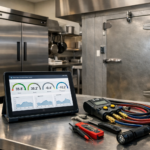
- Review the temperature log. Look for when the temperature began rising and whether it matches deliveries, closing, defrost, or power events.
- Inspect product placement. Keep boxes away from evaporator fans and leave space for air to circulate.
- Check for obvious door obstruction. Look for carts, shelving, damaged thresholds, or product preventing full closure.
- Look at the condenser area if accessible. Note blocked airflow, heavy dirt, debris, or snow around outdoor equipment. Do not remove panels or reach into moving parts.
- Listen for unusual operation. Short cycling, buzzing, clicking, grinding, or complete silence are useful clues.
- Document any recent changes. New product volume, electrical work, controller adjustments, maintenance, roof work, or cleaning can all matter.
If the cooler is repeatedly warm in the morning, the safe checks are not a substitute for service. They are a way to help the technician narrow down the cause faster.
What a commercial refrigeration technician checks during service
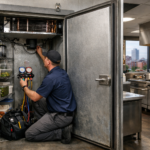
When Royal Cooling responds to walk-in cooler temperature problems, the goal is to identify the cause, not just lower the thermostat. A qualified technician may inspect the full refrigeration cycle, electrical components, airflow, controls, and site conditions.
Typical diagnostic steps can include checking box temperature versus setpoint, measuring superheat and subcooling when appropriate, inspecting condenser and evaporator coils, verifying fan operation, testing capacitors and contactors, checking pressure controls, reviewing defrost settings, confirming sensor accuracy, looking for refrigerant leaks, and evaluating compressor performance. The technician may also ask about delivery schedules, cleaning routines, product loading, and when the temperature rise is first noticed.
For Massachusetts properties in dense areas like Boston, Cambridge, and Quincy, roof access, shared mechanical spaces, and tight alleys can affect equipment service. In suburban and regional locations such as Newton, Waltham, Framingham, Lowell, Worcester, and Springfield, outdoor condenser conditions, loading dock practices, and longer delivery schedules may play a role. The equipment, building, and operating routine all matter.
Repair or replace: how to think about the decision
Many overnight cooler problems can be repaired: a failed fan motor, dirty condenser, faulty controller, misconfigured defrost schedule, damaged sensor, bad contactor, or small refrigerant leak may not require replacing the entire system. Repair often makes sense when the box structure is sound, the refrigeration system is appropriately sized, and the equipment has been maintained.
Replacement or major upgrade may be worth discussing when the condensing unit is repeatedly failing, the compressor has major damage, refrigerant issues are frequent, the system is undersized for current product volume, insulation panels are compromised, or energy and repair costs are becoming unpredictable. A technician can help you compare repair cost, equipment age, refrigerant type, operating risk, and business impact.
For businesses planning expansions, menu changes, or higher storage volume, it is also smart to evaluate whether the existing walk-in cooler still matches the operation. A system sized for a small sandwich shop may struggle after the same kitchen becomes a catering hub or commissary.
Preventing overnight refrigeration failure
Preventive maintenance is the best way to reduce surprise morning failures. A maintenance visit can find dirty coils, weak motors, failing electrical parts, inaccurate controls, drain issues, and early signs of refrigerant leaks before they interrupt opening hours.
- Clean and inspect condenser coils on a schedule appropriate for the location and kitchen conditions.
- Keep condensing units clear of storage, debris, snow, leaves, and blocked airflow.
- Train closing staff to confirm the walk-in door is fully closed and product is not blocking airflow.
- Maintain temperature logs and review trends instead of waiting for an alarm.
- Schedule inspection of evaporator fans, defrost controls, sensors, drains, and electrical components.
- Address small problems quickly, especially noise, frost, long run times, and repeated alarms.
Royal Cooling works with commercial refrigeration customers that rely on walk-in coolers, walk-in freezers, reach-in refrigerators, wine coolers, and freezer systems. If your business needs planned service coverage, visit the service area page or contact the team to discuss maintenance options.
When the issue is urgent enough to call now
Call for emergency refrigeration repair guidance if the walk-in cooler is above your acceptable operating range, product temperatures are at risk, the system is not recovering, the compressor is short cycling, there is heavy ice on the coil, a breaker keeps tripping, you smell burning, fans are not running, or the same overnight problem has happened more than once. Recurring warm mornings often indicate a developing failure that can become more expensive if ignored.
You should also call if the cooler warms before a major delivery, holiday weekend, catering event, inspection, or opening rush. A restaurant in Boston, grocery store in Worcester, hotel kitchen in Cambridge, convenience store in Lowell, liquor store in Quincy, or facility manager in Middlesex County or Suffolk County may have very little time to protect inventory and operations.
Need help with a walk-in cooler not holding temperature overnight? Call Royal Cooling at 781-899-4441 or request service through Royal Cooling’s contact page. We can help diagnose commercial refrigeration problems and recommend the next step for your Massachusetts business.
FAQ: walk-in cooler not holding temperature overnight
Why does my walk-in cooler get warm overnight but seem fine during the day?
It may be an intermittent fan, defrost, control, compressor, refrigerant, or airflow issue that appears after closing. A door left slightly open, late warm product loading, or a dirty condenser can also cause the cooler to fall behind slowly overnight.
What should a restaurant do if a walk-in cooler is warm in the morning?
Record the temperature, keep the door closed, follow your food safety procedure for checking product, reduce access, and document symptoms. If the cooler does not recover quickly or the issue repeats, call a commercial refrigeration technician.
Can a dirty condenser cause a walk-in cooler to lose temperature overnight?
Yes. A dirty condenser coil reduces heat rejection and can make the system run longer with less cooling capacity. After a busy evening, warm delivery, or high kitchen load, the cooler may gradually warm overnight and be discovered above setpoint in the morning.
When should I call a commercial refrigeration technician for overnight temperature issues?
Call when the cooler stays warm, product is at risk, the problem happens more than once, fans are not running, ice is building on the coil, the breaker trips, or the compressor cycles unusually. Repeated overnight refrigeration failure usually needs professional diagnosis.
Is it safe to reset a tripped breaker on a walk-in cooler?
Follow your facility’s safety policy, but do not repeatedly reset a breaker that trips again. Repeated tripping can indicate an electrical fault, compressor problem, or failed component that should be inspected by a qualified technician.
Can late deliveries make a walk-in cooler warm by morning?
Yes. Large amounts of warm product, tightly stacked cases, or blocked evaporator airflow can overwhelm a walk-in cooler. The system is intended to hold refrigerated product, not rapidly chill large warm loads without proper spacing and cooling procedures.
How can preventive maintenance reduce overnight cooler failures?
Maintenance helps identify dirty coils, weak motors, inaccurate sensors, defrost issues, refrigerant leaks, and electrical wear before they cause a morning temperature emergency. It also helps verify that the cooler is operating correctly for the business’s current load.
Does Royal Cooling service walk-in coolers outside Boston?
Royal Cooling serves Massachusetts businesses across the Boston metro and surrounding areas. Service area examples include Boston, Cambridge, Worcester, Lowell, Quincy, Newton, Waltham, Framingham, and nearby counties. Contact Royal Cooling to confirm availability for your location.