Walk-In Cooler Condensation Problems in Massachusetts: Sweating Walls,
Short answer: why your walk-in cooler is sweating
Walk-in cooler condensation in Massachusetts is usually caused by warm, humid air entering the cooler, poor door sealing, clogged or frozen drains, fan or airflow problems, incorrect temperature controls, or damaged insulation. If you see sweating walls, a wet floor in a walk-in cooler, product moisture, or recurring puddles, have a commercial refrigeration technician inspect it before product loss, slip hazards, or food safety concerns develop.
For Massachusetts restaurants, grocery stores, liquor stores, convenience stores, hotels, and commercial kitchens, moisture inside a walk-in cooler can move from nuisance to operational problem quickly. A little fog near the door after a busy lunch rush may clear on its own. Persistent condensation on walls, ceiling panels, shelving, boxes, beer cases, produce cartons, or floor seams is different. It often means the refrigeration system, the building environment, or the walk-in box itself is allowing too much humidity to stay inside the space.
Royal Cooling helps businesses diagnose and repair commercial refrigeration humidity problems across Massachusetts, including the Boston metro area, Worcester County, Middlesex County, Suffolk County, and communities such as Boston, Worcester, Cambridge, Quincy, Waltham, Lowell, Springfield, Newton, and Framingham. If your team is mopping the cooler every day or throwing away damp packaging, it is time to look deeper than the puddle.
Why condensation gets worse in Massachusetts walk-in coolers
Massachusetts weather can be hard on commercial refrigeration. A walk-in cooler in Boston may deal with humid summer air rolling in from a back door. A grocery store in Worcester or Framingham may see large temperature swings between loading dock conditions and the sales floor. A liquor store in Cambridge or Waltham may have constant door openings during peak hours, while a restaurant in Quincy or Newton may have kitchen heat, steam, and dishwashing humidity only a few steps away from the walk-in.
Condensation happens when warm, moisture-laden air contacts a colder surface and water vapor turns into liquid. In a walk-in cooler, the cold surfaces include wall panels, ceiling panels, evaporator housings, shelving, product containers, door frames, and floors. Some condensation may appear briefly when the door is open during a humid day. The concern is moisture that does not clear, appears in specific problem areas, or keeps returning after cleaning.
The primary keyword for this problem is simple: walk-in cooler condensation Massachusetts. But the root cause is not always simple. The same symptom can come from door gaskets, a failed door closer, heavy staff traffic, a drain issue, an evaporator fan problem, an oversized or undersized system, poor setpoint control, or an insulation breakdown inside the walk-in panels.
Common symptoms of condensation in a walk-in cooler
Business owners often describe the problem in different ways. Some say the walk-in cooler is sweating. Others notice a wet floor in the walk-in cooler near the threshold or under the evaporator. Some first discover the issue when cardboard packaging softens or labels peel from product containers.
Watch for these symptoms:
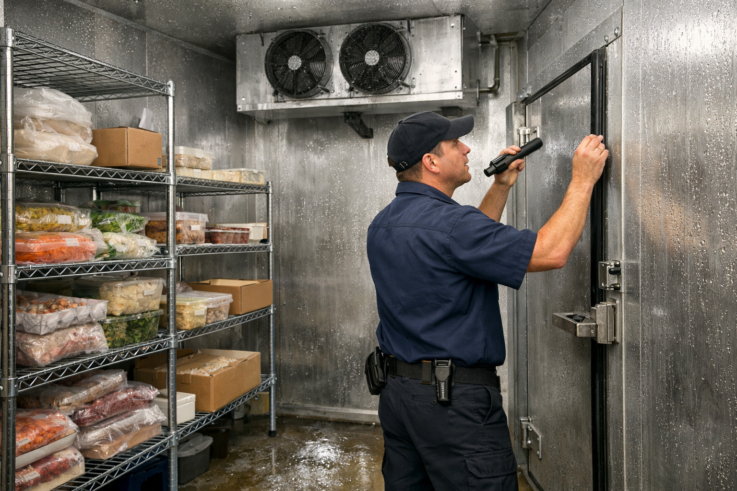
- Sweating walls or ceiling panels: moisture beads on metal or insulated panels, often near the door, corners, penetrations, or seams.
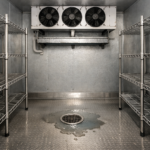
- Wet floor or standing water: puddles near the door, under the evaporator, along a wall, or around the drain line.
- Damp product packaging: soggy cardboard, wet cases, moisture on bottles, or condensation on wrapped food containers.
- Fog or mist when the door opens: especially during humid days or when warm kitchen air enters the box.
- Ice forming with water nearby: moisture may freeze on the evaporator coil, drain pan, threshold, or floor edges.
- Musty odors or visible growth: moisture that stays trapped can contribute to sanitation concerns.
- Slippery surfaces: a wet cooler floor can create a safety hazard for employees handling heavy inventory.
- Temperature complaints: condensation often appears alongside uneven temperatures, long run times, or a cooler struggling to recover after door openings.
If these symptoms are recurring, do not treat them as a housekeeping issue only. Cleaning is important, but commercial refrigeration humidity problems usually require an equipment and building-condition diagnosis.
What causes walk-in cooler sweating?
There are several common reasons for walk-in cooler sweating. A technician will look at the moisture pattern, temperature readings, door condition, air movement, drain operation, and refrigeration performance before recommending a repair.
1. Warm humid air entering through the door
The most common cause of condensation in walk-in cooler spaces is infiltration. Every door opening lets warm air into the cooler. In a busy restaurant, employees may enter dozens or hundreds of times per day. If the door is held open for deliveries, prep, keg swaps, or stocking, the cooler must remove both heat and moisture from that incoming air.
Humidity load is especially high in summer or during rainy Massachusetts weather. A walk-in located near a kitchen line, dish area, exterior delivery door, or loading dock is more vulnerable. Strip curtains, air curtains where appropriate, door discipline, and good stocking procedures can reduce moisture entry.
2. Worn door gaskets, hinges, or closers
A damaged gasket can let humid air seep into the box all day. You may see condensation around the door frame, threshold, or nearby wall panels. If the door does not self-close fully, a small gap can create a constant stream of warm air. Hinges, latches, sweeps, and closers all matter. Even a cooler that reaches temperature can still sweat if it is continuously pulling in humidity through a gap.
3. Clogged, slow, or frozen drain lines
If water is collecting under the evaporator, the drain pan or drain line may be blocked. Evaporator coils remove moisture from the air. That water should drain away properly. Food debris, slime, mineral buildup, ice, a sagging drain line, or incorrect pitch can cause backups. In some cases, a drain line may freeze because of low temperature conditions, failed drain heaters, improper traps, or airflow problems.
4. Evaporator fan or airflow issues
Evaporator fans move air across the coil and throughout the walk-in. If a fan motor fails, a blade is damaged, the coil is dirty, shelves are blocking airflow, or product is stacked too tightly, humidity may not be removed evenly. You may see wet areas in some parts of the cooler and dry areas in others. Airflow problems can also cause coil icing, poor temperature recovery, and inconsistent product temperatures.
5. Incorrect temperature, thermostat, or control settings
A setpoint that is too low for the application can cause excessive frost or ice, followed by water during off cycles or defrost. A thermostat that is out of calibration may run the equipment incorrectly. Controls that short cycle, run too long, or fail to coordinate defrost properly can create moisture problems even when the box feels cold.
6. Defrost problems
Walk-in coolers and walk-in freezers manage frost differently, but both rely on proper coil condition and drainage. If defrost timing, termination, heaters, sensors, or controls are not working correctly, moisture may show up as ice first and water later. A cooler with a coil that repeatedly ices up may eventually drip, sweat, and fail to maintain safe product conditions.
7. Damaged panels, insulation, or vapor barrier
Walk-in cooler panels are designed to keep heat and moisture out. When panel seams separate, penetrations are unsealed, insulation becomes wet, or a vapor barrier is compromised, condensation can form in recurring locations. This may appear as sweating at seams, wet ceiling panels, rust, soft flooring, or water along wall-to-floor joints. Older walk-ins and boxes that have seen years of forklift impacts, cart damage, or patch repairs deserve a close inspection.
8. Product load and storage practices
Hot product placed directly into a cooler adds heat and moisture. Uncovered containers, wet produce, freshly washed items, open tubs, and frequent stocking can raise humidity. Overloaded shelving blocks airflow and traps moisture between cases. Good operating procedures help the refrigeration system do its job.
Moisture pattern comparison: what the location can suggest
The table below is not a substitute for an on-site inspection, but it can help you understand what a commercial refrigeration technician may consider when diagnosing condensation in a walk-in cooler.
| Moisture symptom | Possible causes | How urgent is it? | What to do next |
|---|---|---|---|
| Water near the door or threshold | Worn gasket, door not closing, heavy traffic, missing strip curtains, warm humid air infiltration | Moderate to urgent if recurring or slippery | Check door closure, gasket condition, latch, hinges, and staff habits; schedule walk-in cooler repair if the issue persists |
| Water under the evaporator | Clogged drain, frozen drain line, overflowing pan, coil icing, improper drain pitch | Urgent if puddles return after cleaning | Do not ignore; have the drain, pan, coil, and defrost operation inspected |
| Sweating walls or ceiling seams | Air leaks, insulation problems, vapor barrier failure, panel damage, high humidity load | Moderate to urgent depending on spread | Inspect seams, penetrations, door frame, and panel condition; consider technician evaluation |
| Damp boxes or product moisture | High humidity, poor airflow, hot product load, blocked fans, temperature swings | Urgent if food quality or packaging integrity is affected | Move product away from wet areas, check temperatures, and call for service if moisture continues |
| Ice plus water on floor | Defrost issue, coil icing, drain freeze-up, low airflow, refrigeration control problem | High urgency due to slip and performance risk | Document conditions and call a commercial refrigeration technician |
Is condensation in a walk-in cooler a food safety issue?
Condensation can become a food safety issue when moisture drips onto food, packaging, prep containers, shelving, or surfaces that should remain clean and dry. It can also create sanitation concerns if wet materials sit too long or if moisture collects in hard-to-clean areas. A wet floor in a walk-in cooler can also be a serious employee safety risk, especially when staff carry kegs, cases, produce boxes, or sheet pans.
Royal Cooling does not provide health code rulings or legal determinations. However, from a refrigeration and facility standpoint, persistent condensation should be addressed quickly. If product temperatures are affected, if water is dripping from overhead components, or if packaging has become saturated, follow your food safety procedures and local requirements. When in doubt, protect product, document temperatures, and call a qualified commercial refrigeration technician.
What you can check before calling for service
Some checks are safe for owners and managers to perform without opening electrical panels or disassembling refrigeration equipment. These steps can also help you explain the problem clearly when you contact Royal Cooling.
- Check the door: Does it close completely on its own? Are gaskets torn, brittle, loose, or pulled away? Is there light visible around the frame?
- Note when moisture appears: Is it worse during lunch rush, deliveries, humid days, overnight, or after defrost?
- Locate the water: Is the wet floor near the door, under the evaporator, along a wall seam, or across the whole floor?
- Review product placement: Are boxes stacked against fans or walls? Is product blocking airflow?
- Look for ice: Ice on the coil, drain pan, piping, threshold, or floor can point to a different issue than simple humidity.
- Check temperature logs: Are temperatures stable? Are there spikes after stocking or overnight?
- Reduce door-open time: Keep the door closed as much as possible while waiting for service.
- Clean up standing water safely: Use appropriate wet-floor procedures to reduce slip risk for employees.
Do not chip ice from coils with sharp tools, bypass controls, reset breakers repeatedly, or remove access panels unless your staff is trained and authorized. Those actions can damage equipment or create safety hazards.
When should a Massachusetts restaurant call a technician?
A Massachusetts restaurant, grocery store, liquor store, commercial kitchen, or facility manager should call a commercial refrigeration technician when condensation is persistent, recurring, or connected to product risk. Occasional moisture after a door is open during a humid delivery may clear. Repeated sweating, puddles, or dripping should not be treated as normal.
Call for walk-in cooler repair if you notice any of the following:
- Water returns shortly after mopping or cleaning.
- The floor is slippery or creates a safety concern.
- Moisture is dripping from the ceiling, evaporator, piping, or shelving.
- Product packaging is wet, soft, or damaged.
- Temperatures are rising, unstable, or slow to recover.
- There is ice on the coil, drain pan, floor, or around the door.
- The door will not seal or close reliably.
- You hear fan changes, unusual noises, or notice poor airflow.
- Moisture appears near electrical components or controls.
- The problem affects service, inventory, or inspection readiness.
For urgent moisture issues, product temperature concerns, or suspected refrigeration failure, contact Royal Cooling at 781-899-4441 or request service through the contact page. If you are unsure whether your location is covered, review the service area information.
What Royal Cooling checks during a condensation service call
A good diagnosis looks at the whole system, not just the puddle. Walk-in cooler condensation in Massachusetts often involves multiple contributing factors. For example, a restaurant in Cambridge may have a worn gasket and blocked airflow. A market in Lowell may have a clogged drain and heavy delivery-door humidity. A hotel kitchen in Boston may have door traffic, hot product loading, and defrost timing issues all contributing at once.
During a walk-in cooler repair visit, a commercial refrigeration technician may check:
- Door gasket, latch, hinges, sweep, and closer: to confirm the door seals and closes correctly.
- Panel seams and penetrations: to identify air leaks, insulation concerns, or vapor barrier problems.
- Evaporator coil condition: including frost pattern, cleanliness, airflow, and signs of icing.
- Evaporator fans: motor operation, blade condition, rotation, airflow restrictions, and controls.
- Drain pan and drain line: clogs, pitch, traps, freeze points, heat tape or heater function where applicable.
- Temperature controls: thermostat calibration, sensor placement, setpoint, differential, and control response.
- Defrost operation: timing, termination, heaters or off-cycle function, and whether defrost water drains properly.
- Refrigerant-side performance: pressures, superheat/subcooling where appropriate, compressor operation, and coil performance.
- Condenser condition: dirty condenser coils, poor ambient ventilation, fan operation, and head pressure concerns.
- Operating conditions: door-opening patterns, product load, kitchen humidity, nearby heat sources, and stocking procedures.
This process helps separate a simple door gasket or drain cleaning issue from a larger refrigeration, airflow, or box-integrity problem.
Repair vs. replacement: how to decide
Not every condensation issue requires major work. Many problems can be corrected with targeted repairs and preventive maintenance. However, recurring moisture can sometimes reveal that equipment or walk-in box components are near the end of their useful life.
Repair may make sense when:
- The door gasket, closer, hinge, or sweep is the main problem.
- A drain line or pan needs cleaning, pitch correction, or heater repair.
- One or more evaporator fan motors need replacement.
- Controls need adjustment, calibration, or replacement.
- Airflow can be corrected by coil cleaning, fan repair, or better storage layout.
- Panel seams or penetrations can be sealed effectively.
Replacement or larger upgrades may be worth discussing when:
- Walk-in panels are saturated, delaminating, rusted, or structurally compromised.
- The floor is failing, soft, or repeatedly trapping water.
- The refrigeration system is severely mismatched to the box or use case.
- Repairs are frequent and downtime is affecting operations.
- The cooler no longer supports the business volume, door traffic, or product mix.
- Energy performance, reliability, or refrigerant compliance concerns make continued repair less practical.
A qualified HVAC contractor and commercial refrigeration technician can help weigh repair cost, equipment age, business risk, and operational needs. Royal Cooling services commercial refrigeration, walk-in coolers, walk-in freezers, wine coolers, reach-in refrigerators, freezer repair needs, and preventive refrigeration maintenance for Massachusetts customers.
Preventive maintenance tips to reduce humidity problems
Preventive maintenance is one of the best ways to reduce condensation in walk-in cooler equipment. It cannot change the weather in Massachusetts, but it can keep your refrigeration system, doors, drains, and airflow in better condition before moisture becomes a disruption.
- Inspect door gaskets regularly: Replace torn, loose, or hardened gaskets before they leak air constantly.
- Confirm doors self-close: A walk-in door that stays cracked open can load the cooler with humidity all day.
- Keep coils clean: Dirty evaporator and condenser coils reduce performance and can contribute to temperature and moisture issues.
- Maintain drains: Drain pans and lines should be clear, properly pitched, and protected from freezing where required.
- Protect airflow: Do not stack product against evaporator fans or tight to walls where air must circulate.
- Use strip curtains correctly: Replace damaged strips and make sure staff does not tie them aside during busy periods.
- Limit hot product loading: Follow safe cooling procedures and avoid adding unnecessary heat and steam to the walk-in.
- Review temperature logs: Spikes and slow recovery can be early clues that humidity removal is also suffering.
- Schedule seasonal service: Before humid summer conditions or heavy holiday volume, have the system checked.
Businesses in Boston, Worcester, Cambridge, Quincy, Waltham, Lowell, Springfield, Newton, and Framingham often see refrigeration issues change with the season. A cooler that seemed dry in winter may sweat in July. A system that handled light traffic may struggle when delivery schedules, menu volume, or store traffic increase.
Why acting early protects product and operations
Condensation is easy to postpone because the cooler may still feel cold. But water is a warning sign. Moisture can damage labels and packaging, create slip hazards, contribute to odor and sanitation problems, rust metal surfaces, accelerate panel deterioration, and hide deeper refrigeration performance issues. If condensation is associated with poor temperature recovery, the risk to inventory increases.
Early service is usually more manageable than emergency refrigeration repair after a drain overflow, iced coil, failed fan, or water-damaged product event. A focused inspection can identify whether the issue is a simple air leak, drain cleaning need, fan problem, control issue, or something more serious.
Local service context for Massachusetts businesses
Royal Cooling works with commercial refrigeration customers throughout Massachusetts service areas, including restaurants, convenience stores, supermarkets, grocery stores, liquor stores, hotels, commercial kitchens, facility managers, property managers, and homeowners with specialty wine coolers or freezers. The company services equipment such as walk-in coolers, walk-in freezers, reach-in refrigerators, wine coolers, and related refrigeration systems.
Whether your walk-in cooler condensation problem is in a Boston restaurant, a Worcester County market, a Middlesex County commercial kitchen, a Suffolk County food service facility, a Cambridge cafe, a Quincy liquor store, a Waltham hotel, or a Framingham grocery operation, the approach is the same: protect product, reduce slip risk, identify the source of moisture, and fix the cause rather than repeatedly mopping the symptom.
If you are dealing with walk-in cooler sweating, a wet floor in a walk-in cooler, product moisture, or suspected commercial refrigeration humidity problems, call Royal Cooling at 781-899-4441 or use the contact form to request service.
FAQ: walk-in cooler condensation in Massachusetts
Why is my walk-in cooler sweating inside?
Your walk-in cooler is likely sweating because warm, humid air is entering the box or moisture is not being removed properly. Common causes include worn door gaskets, heavy door traffic, poor airflow, clogged drains, incorrect controls, coil icing, or insulation problems.
What causes water on the floor of a walk-in cooler?
Water on the floor can come from a clogged or frozen drain, overflowing drain pan, air leaks at the door, condensation dripping from panels, evaporator icing, or product and stocking practices that add excess moisture. The water location helps narrow the cause.
Is condensation in a walk-in cooler a food safety issue?
Condensation can become a food safety concern if water drips on food, packaging, shelving, or clean surfaces, or if it contributes to unsanitary conditions. It can also create slip hazards. Follow your food safety procedures and address persistent moisture promptly.
When should a Massachusetts restaurant call a commercial refrigeration technician for condensation problems?
Call a technician when condensation keeps returning, water creates slippery floors, product packaging gets wet, temperatures fluctuate, ice appears with water, drains back up, or the door will not seal. These signs often require professional walk-in cooler repair.
Can a bad door gasket cause condensation in a walk-in cooler?
Yes. A torn, loose, or hardened door gasket can let humid air leak into the cooler continuously. This often causes sweating near the door, wet thresholds, longer run times, and recurring moisture even when staff keeps the door closed.
Can preventive maintenance reduce walk-in cooler humidity problems?
Yes. Preventive maintenance can reduce humidity problems by keeping gaskets, drains, evaporator fans, coils, controls, and defrost operation in good condition. It also helps identify airflow restrictions and early equipment issues before moisture causes product or safety problems.
Does condensation mean my walk-in cooler needs replacement?
Not always. Many condensation problems are repairable, such as gasket leaks, drain clogs, fan failures, control issues, or airflow restrictions. Replacement may be considered if panels, flooring, insulation, or the refrigeration system are severely deteriorated or repeatedly failing.
Final CTA: stop mopping the same cooler problem
If condensation in your walk-in cooler keeps coming back, your business needs more than a mop. Royal Cooling can inspect the door, drain, fans, controls, coils, airflow, and walk-in box condition to find the source of the moisture. For walk-in cooler condensation in Massachusetts, call 781-899-4441 or request help through the contact page. To learn more about availability by location, visit the service area page.