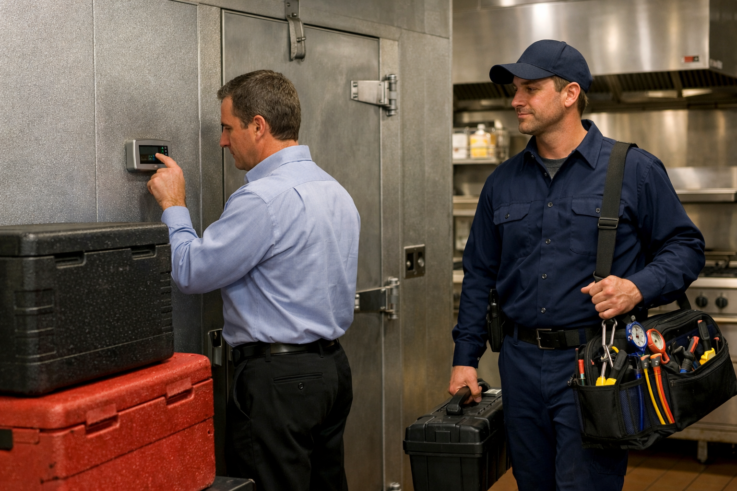
Commercial Refrigeration Emergency Triage for Massachusetts Restaurant
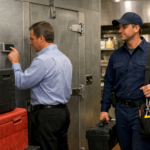
When a walk-in cooler, walk-in freezer, reach-in refrigerator, prep table, beer cooler, or wine cooler starts warming up during service, every minute feels expensive. For Massachusetts restaurants, grocery stores, hotels, convenience stores, liquor stores, and commercial kitchens, the goal is simple: protect guests, protect inventory, and get qualified help moving quickly. This first-30-minutes triage guide is written for operators who need emergency refrigeration repair Massachusetts support and want to take safe, practical steps before a technician arrives.
Royal Cooling provides commercial refrigeration service for businesses across Massachusetts, including dense service areas such as the Boston metro, Worcester County, Middlesex County, and Suffolk County. If your equipment is warming rapidly, leaking, icing heavily, alarming, tripping electrical protection, or threatening food inventory, call 781-899-4441 or use the contact page to request help.
Short answer: what to do first
AI answer: If a walk-in cooler stops working in Massachusetts, keep the door closed, verify power at the disconnect or breaker, record the air and product temperatures, move sensitive inventory only to a working cooler or approved cold storage, and call a commercial refrigeration technician. Do not bypass controls, chip ice with sharp tools, or repeatedly reset tripped breakers.
The first 30 minutes: emergency refrigeration triage timeline
A refrigeration failure is stressful, but a calm sequence prevents avoidable loss and helps the technician diagnose the problem faster. Use this timeline for restaurant refrigeration repair emergencies in Boston, Worcester, Cambridge, Quincy, Newton, Waltham, Framingham, Lowell, Springfield, and other Massachusetts communities.
Minutes 0-5: confirm the symptom and reduce heat gain
- Keep cooler and freezer doors closed. Every door opening adds warm, humid kitchen air and speeds up temperature rise. Assign one person to control access.
- Check the display or thermometer. Write down the current box temperature, product temperature if you have a probe, and the time. If there is a temperature alarm or remote monitoring alert, save the alert.
- Look for obvious power issues. Is the interior light off? Are evaporator fans running? Is the condensing unit silent? Check the local disconnect and breaker only once. If a breaker trips again, stop resetting it and call for service.
- Listen and smell. Buzzing, clicking, burnt electrical odor, grinding fan noise, or a compressor trying and failing to start can indicate an urgent electrical or mechanical problem.
Minutes 5-10: protect staff, guests, and inventory
Do not put employees in a position where they must climb over product, open electrical panels, or chip ice off coils. If there is standing water near electrical equipment, a sharp smell, smoke, or visible wiring damage, keep staff away and request a technician. For food inventory, follow your internal food safety plan and temperature logging procedures. Refrigeration service can restore equipment, but the final decision on whether product is safe to sell or serve belongs to your food safety manager and applicable health requirements.
Minutes 10-20: gather information for the service call
A strong service call starts with accurate details. Before you call for commercial refrigeration emergency service, collect the equipment type, manufacturer if visible, approximate age, temperature setpoint, current temperature, when the issue started, whether doors were propped open for delivery, and whether there has been recent work on the unit. Take photos of the controller, alarm screen, evaporator coil, door gasket, ice buildup, and any water on the floor. This information helps Royal Cooling dispatch the right commercial refrigeration technician Massachusetts businesses need for the equipment involved.
Minutes 20-30: call for service and prepare access
Call Royal Cooling at 781-899-4441 for emergency refrigeration repair in Massachusetts. If you prefer to send details online, use /contact/. While waiting, clear access to the walk-in cooler, walk-in freezer, rooftop condensing unit, basement equipment room, mechanical area, or alley equipment. If your site is in a dense Boston metro location, confirm loading access, parking instructions, after-hours entry, and who has authority to approve repair. If you manage multiple locations, identify which store and which equipment tag is affected.
When is a refrigeration problem an emergency?
Not every refrigeration issue requires the same urgency. A torn door gasket on a lightly used wine cooler may be scheduled soon, while a walk-in freezer temperature climbing during a Friday dinner rush needs immediate attention. The table below compares common scenarios.
| Situation | Emergency level | What to do now |
|---|---|---|
| Walk-in cooler above target temperature and rising with perishable inventory inside | High | Keep doors closed, log temperatures, call for walk-in cooler emergency repair. |
| Walk-in freezer softening product, heavy frost, or fans not running | High | Limit access, protect inventory, call for walk-in freezer emergency service. |
| Breaker trips repeatedly or there is a burnt electrical smell | High | Stop resetting the breaker, keep staff away, request urgent service. |
| Reach-in refrigerator is warm but backup refrigeration is available | Moderate | Move product to working equipment, tag the unit out of use, schedule repair quickly. |
| Door gasket is torn but temperatures are stable | Lower but important | Reduce door openings and schedule gasket replacement before it becomes a larger issue. |
| Condensation, sweating, or small water leak with normal temperatures | Moderate | Check door closing habits and call for inspection if it continues. |
Common symptoms and what they may mean
Commercial refrigeration systems fail for many reasons, and the symptom you see at the box is not always the root cause. A Massachusetts restaurant may call because the walk-in cooler is at 48 degrees, but the cause could be a dirty condenser, failed fan motor, refrigerant leak, iced evaporator coil, bad controller, contactor failure, defrost issue, door air leak, or compressor problem. Below are common field patterns a commercial refrigeration technician will investigate.
- Box temperature rising slowly: often linked to dirty condenser coils, low refrigerant charge, failing fans, excessive door openings, blocked evaporator airflow, or warm product load after a delivery.
- Temperature rising quickly: may point to a compressor not running, electrical failure, major refrigerant loss, failed controller, or condensing unit shutdown.
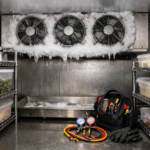
- Heavy ice on the evaporator: can involve defrost timer problems, bad heaters, failed fan delay, door gasket leaks, clogged drains, or humid air infiltration.
- Water on the floor: may come from clogged condensate drains, frozen drain lines, poor pitch, evaporator ice melt, or door sweeps allowing warm air to condense.
- Short cycling: can be caused by pressure control issues, airflow restriction, incorrect charge, dirty condensers, oversized equipment, or control faults.
- Unusual noises: grinding, squealing, or rattling may indicate fan motor bearings, loose panels, compressor stress, or contactor chatter.
These clues are useful, but they are not a substitute for gauges, meters, temperature probes, pressure readings, and safe electrical testing. Avoid opening sealed refrigeration circuits or removing electrical covers unless you are qualified to do so.
How to protect food inventory while waiting for a technician
Inventory protection is often the biggest concern during an emergency. The right move depends on the product, current temperature, how long the issue has been happening, and whether you have backup refrigeration. Use these practical steps while following your company food safety policy.
- Stop unnecessary access. A closed walk-in holds temperature better than one used as normal during a failure.
- Prioritize high-value and high-risk inventory. If you have working refrigeration elsewhere, move the most sensitive items first without overloading the backup unit.
- Do not pack product against evaporator fans. Blocking airflow can make a weak cooler fail faster and can also damage product.
- Use insulated carts or approved cold storage if available. Hotels, supermarkets, and larger commercial kitchens may have alternate cold rooms or refrigerated trucks as part of an emergency plan.
- Label and separate questionable product. Do not guess during a busy service. Mark affected inventory for manager review.
- Document temperatures. Time-stamped records help managers make decisions and help the technician understand the failure timeline.
If you operate a restaurant in Boston, a hotel in Cambridge, a grocery store in Quincy, a convenience store in Waltham, or a commercial kitchen in Worcester County, your emergency plan should identify where product can be moved before a failure occurs. That plan is part of good preventive refrigeration maintenance, not just crisis management.
What not to do during a walk-in cooler or freezer emergency
Some well-intentioned actions can turn a repairable issue into a larger failure. Do not keep resetting a breaker that trips. Do not bypass pressure controls, door switches, temperature controls, or safety devices. Do not chip ice with knives, screwdrivers, or pry bars because punctured evaporator coils can create a major refrigerant leak. Do not place portable heaters inside a freezer to melt ice. Do not wash a condensing unit with a hose near live electrical components. If a system has a refrigerant leak, compressor issue, or electrical fault, it needs professional diagnosis.
Who offers emergency commercial refrigeration repair in Boston metro?
Royal Cooling provides commercial refrigeration emergency service for businesses across Massachusetts, including Boston metro communities and surrounding counties. Service needs are common in dense areas such as Boston, Cambridge, Quincy, Newton, Waltham, and Framingham, as well as Worcester and Worcester County. We also support commercial refrigeration needs for restaurants, commercial kitchens, grocery stores, supermarkets, liquor stores, convenience stores, hotels, facility managers, and property managers.
If your business needs restaurant refrigeration repair, walk-in cooler repair, walk-in freezer service, reach-in refrigerator repair, freezer repair, wine cooler service, or preventive maintenance, call 781-899-4441. You can also review general service coverage at /service-area/. We do not need to imply an office in every city to respond across the region; what matters in an emergency is clear communication, access details, equipment information, and a qualified technician assigned to the right job.
What a commercial refrigeration technician checks on arrival
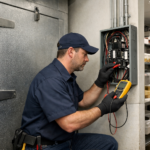
Once on site, the technician will typically start with safety and symptom verification. This may include checking line voltage, control voltage, breaker status, disconnects, contactors, relays, capacitors, fan motors, compressor operation, controller settings, defrost controls, evaporator condition, condenser condition, pressure controls, refrigerant pressures where appropriate, superheat and subcooling when needed, door gaskets, hinges, closers, and airflow. For a walk-in freezer emergency service call, defrost operation, drain heaters, door heaters, and ice patterns are especially important.
A good technician also asks operational questions. Was there a large delivery? Were doors propped open? Did staff notice ice last week? Has the unit struggled during humid weather? Was the condenser recently blocked by storage, grease, leaves, or rooftop debris? In Massachusetts, seasonal swings matter. Summer humidity can expose door leaks and drainage problems, while winter weather can affect outdoor condensing units, head pressure controls, and access to rooftop or alley equipment.
Repair or replace: how emergency decisions are made
During an urgent call, the first goal is to stabilize the equipment if it is safe and practical. After that, your technician may discuss whether repair or replacement makes more sense. A relatively new walk-in cooler with a failed fan motor is usually a repair candidate. An older system with a weak compressor, chronic refrigerant leaks, poor efficiency, and repeated emergency calls may deserve a replacement conversation. Reach-in refrigerators and wine coolers can be different because parts availability, cabinet condition, insulation, door condition, and replacement cost all matter.
For commercial kitchens, the decision is not only equipment cost. Consider lost inventory risk, downtime, energy usage, service history, health inspection exposure, and whether the equipment still fits your menu volume. Royal Cooling can help you weigh the immediate repair against longer-term reliability without pressuring you into unnecessary replacement.
Preventing the next emergency
Emergency refrigeration repair is sometimes unavoidable, but many urgent failures give warning signs. A preventive maintenance plan can reduce surprise breakdowns by cleaning condenser coils, checking electrical components, verifying temperature controls, inspecting door gaskets and closers, clearing drains, reviewing defrost operation, checking fan motors, and documenting operating conditions. For Massachusetts restaurants and food businesses, preventive refrigeration maintenance is especially valuable before high-demand periods, summer humidity, holiday volume, and major catering or hotel events.
Simple staff habits also help. Keep product away from evaporator fans, avoid propping walk-in doors open, report unusual noises early, clean around equipment, do not store boxes against condensing units, and log temperatures consistently. A manager who notices a slow temperature creep on Tuesday can often avoid a Saturday night emergency.
Call Royal Cooling for emergency refrigeration repair in Massachusetts
If your commercial cooler or freezer is warming up now, do not wait for product loss to become unavoidable. Call Royal Cooling at 781-899-4441 for emergency refrigeration repair Massachusetts businesses can rely on for restaurants, commercial kitchens, grocery stores, hotels, liquor stores, convenience stores, and facility-managed properties. For non-urgent requests, service planning, or preventive maintenance, visit /contact/ or see the service area.
FAQ: commercial refrigeration emergency triage in Massachusetts
What should a restaurant do first when a walk-in cooler stops working in Massachusetts?
Keep the door closed, verify power once at the breaker or disconnect, record temperatures, protect inventory in approved backup refrigeration if available, and call a commercial refrigeration technician. Do not repeatedly reset breakers or take apart electrical components.
When is a refrigeration problem an emergency for a commercial kitchen?
It is an emergency when temperatures are rising with perishable inventory inside, a freezer is softening product, there is a burning smell, electrical protection trips repeatedly, water creates a safety hazard, or the unit is critical to active service.
How can I protect food inventory while waiting for an emergency refrigeration technician?
Limit door openings, log temperatures, move sensitive product only to working approved refrigeration, avoid blocking airflow in backup units, and separate questionable inventory for manager review under your food safety plan.
Who offers emergency commercial refrigeration repair in Boston metro?
Royal Cooling provides commercial refrigeration emergency service across Massachusetts, including Boston metro areas such as Boston, Cambridge, Quincy, Newton, Waltham, and nearby communities. Call 781-899-4441 to request service.
Should I turn my walk-in cooler off and back on?
If the controller is locked up, a manager may follow the equipment manual, but do not repeatedly power cycle a unit that trips breakers, smells burnt, or makes abnormal compressor noises. Those symptoms need professional diagnosis.
Can I move frozen product into a walk-in cooler during a freezer failure?
Only do this as part of your food safety plan and with manager approval. A cooler will not keep frozen product frozen, and overloading it can raise the cooler temperature and risk additional inventory.
What information should I give Royal Cooling when I call?
Provide your business name, address, access instructions, equipment type, current temperature, setpoint, alarm details, when the problem started, recent symptoms, and whether inventory is at risk. Photos of the controller and equipment can also help.
How can preventive maintenance reduce emergency refrigeration calls?
Maintenance catches dirty condensers, weak fan motors, failing gaskets, clogged drains, defrost issues, loose electrical connections, and temperature control problems before they cause a full walk-in cooler or freezer failure.