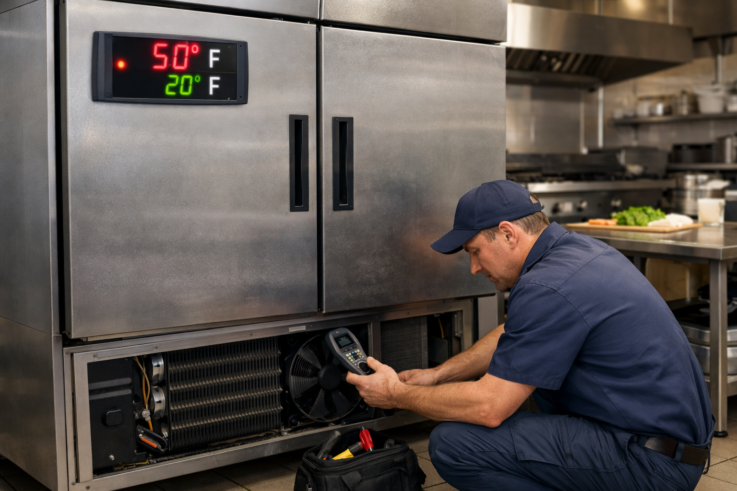
Commercial Refrigeration Not Reaching Setpoint: How to Triage Before a
Short answer: why your commercial refrigerator is not reaching setpoint
If your commercial refrigerator is not reaching setpoint, start with safe checks: confirm the controller setting, compare actual air and product temperatures, look for blocked airflow, inspect door gaskets, reduce warm loading, and check whether the condenser is dirty or obstructed. If temperatures keep rising, product safety is at risk, ice is forming, breakers trip, or alarms continue, call a commercial refrigeration technician.
For Massachusetts restaurants, convenience stores, hotels, supermarkets, liquor stores, and facility teams, a setpoint problem is more than an annoyance. It can affect food safety, beverage quality, inventory value, health inspection readiness, and daily operations. Whether you operate in Boston, Worcester, Cambridge, Lowell, Springfield, Quincy, Newton, Waltham, Framingham, or another Massachusetts community, the goal is the same: triage the issue safely, protect product, and know when professional commercial refrigeration service is needed.
This guide explains how to approach commercial refrigeration troubleshooting when a refrigerator is not cold enough or a cooler will not pull down to the thermostat setpoint. It is written for operators, managers, and facility staff who need practical steps before calling for service, while avoiding unsafe electrical, refrigerant, or mechanical work.
Setpoint versus actual temperature: know what you are comparing
The setpoint is the target temperature programmed into the temperature controller or thermostat. The actual temperature is what the sensor, air probe, or thermometer is reading inside the box. A commercial refrigerator may cycle above and below setpoint during normal operation, but it should not drift warmer for hours, fail to recover after doors close, or run constantly without getting close to the target.
Before assuming the equipment has failed, confirm what temperature you are measuring. Air temperature changes quickly when doors open. Product temperature changes more slowly and is often the more important food safety indicator. A walk-in cooler, reach-in refrigerator, prep table, wine cooler, display case, or undercounter unit may all show different behavior depending on door traffic, product load, airflow, and controller design.
If you are seeing cooler setpoint problems, write down the setpoint, displayed temperature, independent thermometer reading, approximate product temperature if you can measure it safely, the time of day, and whether the equipment is running. This information helps a commercial refrigeration technician diagnose the problem faster if you call Royal Cooling at 781-899-4441.
Safe triage checklist before calling for refrigeration repair
These steps are intended for safe visual checks and basic operational review. Do not remove electrical panels, bypass controls, add refrigerant, force defrost components, or continue resetting breakers. If you are unsure, stop and call for service.
1. Confirm the setpoint and controller mode
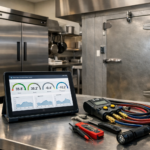
Start with the obvious, because accidental setting changes happen in busy kitchens and retail environments. Check that the setpoint is appropriate for the equipment and product. Confirm the controller is not in defrost, standby, night setback, or an alarm state. If the controller display is flashing a code, record it before touching anything.
A thermostat calibration issue can also make a refrigerator appear not cold enough when the air temperature is acceptable, or the opposite: the display may look acceptable while product is warming. Compare the controller reading with a reliable thermometer placed away from doors and direct fan discharge.
2. Look at door use, gaskets, hinges, and closers
Warm, moist air entering the refrigerated space is one of the most common reasons a commercial refrigerator is not reaching setpoint. Inspect the door gaskets for tears, gaps, hardened sections, food debris, or areas that do not seal. Make sure reach-in doors close fully and walk-in cooler doors are not propped open during deliveries or prep.
In Massachusetts kitchens during humid summer weather, even small air leaks can create frost, condensation, longer run times, and temperature recovery problems. In winter, door heaters, closers, and gaskets can still matter because heavy traffic and loading patterns continue to challenge the equipment.
3. Check for blocked airflow inside the box
Commercial refrigeration depends on air movement. Do not stack boxes tight against evaporator fans, discharge grilles, return air paths, or interior walls where airflow is required. Overloading a reach-in refrigerator or walk-in cooler can create warm pockets that never reach setpoint even when the refrigeration system itself is operating.
Look for product pushed against the fan guard, shelving that blocks return air, pans covering vents in prep tables, or cases packed beyond recommended load lines. If only one area is warm, airflow restriction may be more likely than a total system failure.
4. Review recent loading and delivery activity
A cooler may miss setpoint after a large delivery of warm product, especially if cases are tightly stacked or doors stayed open for a long time. This is common for restaurants, grocery stores, convenience stores, and hotels receiving inventory early in the morning or before a busy weekend.
If the equipment was holding temperature before the delivery, reduce door openings, improve spacing around product, and monitor recovery. However, do not wait too long if temperatures are unsafe, the unit runs continuously, or product temperature continues rising. A healthy system should recover within a reasonable period based on load, equipment size, and conditions.
5. Inspect the condenser area without opening electrical panels
Yes, a dirty condenser can cause a commercial cooler to miss setpoint. The condenser rejects heat from the refrigeration system. If the coil is clogged with grease, dust, flour, lint, cardboard fibers, or kitchen debris, the system may run hot, lose capacity, trip on safety controls, or fail to pull the box down to setpoint.
Look for blocked airflow around the condenser, especially on self-contained reach-ins, prep tables, bar coolers, display cases, and ice-related equipment. Make sure nothing is stored directly against ventilation grilles. If the condenser is accessible and cleaning is part of your normal maintenance procedure, clean it according to the manufacturer instructions and your site safety policy. If the coil is heavily impacted, greasy, hard to reach, or near electrical components, call a technician.
6. Listen for fans, compressor operation, and unusual sounds
Without disassembling the unit, note whether fans are running, whether the compressor seems to start and stop rapidly, whether the unit is unusually loud, or whether it is completely silent. A failed evaporator fan, condenser fan problem, compressor issue, control fault, or electrical problem can all show up as a commercial refrigerator not reaching setpoint.
Do not put hands near moving fan blades. Do not remove guards while equipment is energized. If you hear buzzing, clicking, grinding, or repeated short cycling, treat it as a service issue.
7. Look for ice, frost, water, oil residue, or refrigerant-related clues
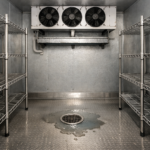
Heavy frost on an evaporator, ice covering a coil, water where it should not be, or oily residue around refrigeration lines can indicate a deeper problem. Causes may include defrost failure, door air infiltration, blocked drains, low refrigerant, refrigerant leaks, expansion valve issues, or sensor problems.
Do not chip ice with knives or sharp tools. Do not use torches or heat guns in a cooler or freezer. Improper thawing can damage coils, puncture refrigerant tubing, create electrical hazards, and turn a repairable issue into a major repair.
Common causes of setpoint problems and how urgent they are
| Possible cause | What you may notice | Safe operator check | When to call Royal Cooling |
|---|---|---|---|
| Incorrect setpoint or controller mode | Display is set too warm, flashing, or in defrost | Record settings and compare with thermometer | Call if codes remain, sensor readings seem wrong, or settings will not hold |
| Blocked interior airflow | Warm spots, product near vents, fans running | Move product away from fan discharge and return air paths | Call if temperature does not recover after airflow is restored |
| Door gasket or closer issue | Condensation, frost near door, door not sealing | Inspect gasket, hinges, sweep, and closer visually | Call for gasket replacement, hinge adjustment, or persistent air leaks |
| Dirty condenser coil | Unit runs constantly, cabinet warm, poor recovery | Check for blocked grille or visible dust and grease | Call if coil is heavily dirty, hard to access, or unit still misses setpoint |
| Failed fan or motor | No airflow, odd noise, warm cabinet, ice buildup | Listen and visually confirm airflow without removing guards | Call promptly for commercial refrigeration technician diagnosis |
| Refrigerant leak or low charge | Gradual loss of cooling, ice pattern, long run time | Record symptoms; do not add refrigerant | Call for leak detection, repair, evacuation, and proper charging |
| Defrost or sensor problem | Coil icing, temperature swings, alarms | Note alarm codes and timing of defrost cycles | Call before ice blocks airflow or product is affected |
| Compressor or electrical issue | Breaker trips, buzzing, short cycling, no cooling | Stop repeated resets and document what happened | Call immediately; this can become an emergency refrigeration repair |
What a restaurant or facility should not do
When a refrigerator is not cold enough, pressure is high and staff may want to try anything to keep service moving. Some actions can create safety hazards or increase repair cost. Avoid these common mistakes:
- Do not keep lowering the setpoint to force cooling. If the system cannot reach the existing setpoint, a lower number usually will not solve the root cause.
- Do not repeatedly reset breakers or unplug and replug equipment without understanding why it tripped or stopped.
- Do not bypass door switches, pressure controls, temperature controls, defrost timers, or safety devices.
- Do not add refrigerant from a can or ask unqualified personnel to top off a system. Refrigerant work requires proper tools, recovery practices, and licensing.
- Do not chip ice off evaporator coils with sharp tools.
- Do not assume the displayed temperature is the only reading that matters. Verify with an independent thermometer and protect product based on your food safety procedures.
When is a refrigeration setpoint issue an emergency?
A setpoint issue becomes an emergency when product safety, business continuity, or equipment integrity is at immediate risk. For a Massachusetts restaurant during dinner prep in Boston, a hotel kitchen in Cambridge, a convenience store in Quincy, or a grocery operation in Worcester County, the decision often depends on temperature trend, product type, and how fast the problem is developing.
Call Royal Cooling at 781-899-4441 for emergency refrigeration repair guidance if any of the following are happening:
- The actual temperature is rising and product temperature may enter an unsafe range.
- A walk-in freezer, walk-in cooler, reach-in refrigerator, prep table, or display case is running constantly but not cooling.
- The unit is completely down, silent, or repeatedly tripping a breaker.
- You see heavy ice buildup, water near electrical components, burning smells, buzzing, or short cycling.
- Multiple pieces of equipment are affected, which could indicate power, control, or building-related issues.
- High-value inventory, seafood, dairy, meat, prepared foods, pharmaceuticals, wine, or frozen product may be compromised.
If the equipment is only slightly above setpoint after a delivery and is steadily recovering, it may be reasonable to continue monitoring while limiting door openings. If the temperature is not improving, do not wait until closing time. Earlier service calls often give a commercial refrigeration technician more options and may reduce product loss.
What a commercial refrigeration technician checks
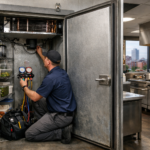
When Royal Cooling responds to a commercial refrigeration service call in Massachusetts, the technician’s job is not just to make the display look normal. The goal is to identify why the system missed setpoint and confirm reliable operation. Depending on the equipment and symptoms, a technician may check:
- Controller settings, sensor placement, probe accuracy, alarms, and temperature history if available.
- Evaporator airflow, fan motors, fan blades, guards, coil condition, and frost pattern.
- Condenser coil condition, condenser fan operation, ambient conditions, and clearance around equipment.
- Compressor operation, amperage, start components, contactors, relays, safeties, and electrical connections.
- Refrigerant pressures, superheat, subcooling, leak indicators, and whether the charge matches system requirements.
- Defrost controls, heaters, timers, termination sensors, drains, and drain line condition.
- Door gaskets, hinges, closers, strip curtains, thresholds, and sources of infiltration.
- Overall equipment age, repair history, cleanliness, installation conditions, and preventive maintenance needs.
This process applies across many types of commercial refrigeration: walk-in cooler repair, walk-in freezer service, reach-in refrigerators, bar coolers, undercounter boxes, prep tables, wine coolers, display cases, and freezer repair. The exact diagnostic path depends on the unit design and the symptom pattern.
Repair versus replace: when does a setpoint problem point to bigger decisions?
Many cooler setpoint problems are repairable. Cleaning a condenser, replacing a failed fan motor, correcting a control issue, repairing a door gasket, clearing a drain, or fixing a defrost problem can restore normal performance when the equipment is otherwise in good condition.
Replacement becomes worth discussing when the equipment is older, inefficient, frequently down, poorly sized for the current business, using obsolete components, or facing a major compressor or coil repair. A restaurant that has expanded production, a convenience store that added more grab-and-go inventory, or a hotel kitchen with heavier banquet demand may be asking an old system to do more than it was designed to handle.
A good repair-versus-replace discussion should consider the cost of repair, downtime risk, product value, energy use, refrigerant considerations, parts availability, and how critical the equipment is to operations. Royal Cooling can evaluate the issue and help you decide whether repair, planned replacement, or preventive refrigeration maintenance is the best next step.
Preventive maintenance helps prevent missed setpoints
The best time to solve a commercial refrigerator not reaching setpoint is before it happens during a rush, delivery, holiday weekend, or health inspection. Preventive maintenance is especially important in Massachusetts businesses where seasonal humidity, kitchen grease, basement equipment rooms, coastal air, and heavy urban usage can all stress refrigeration systems.
A practical preventive maintenance plan may include condenser coil cleaning, evaporator inspection, fan checks, drain cleaning, temperature control review, gasket inspection, electrical inspection, refrigerant leak checks when symptoms indicate, and performance testing. For busy restaurants in Boston metro, facilities in Middlesex County, kitchens in Suffolk County, stores in Worcester County, and properties around Waltham, Newton, Framingham, Lowell, and Springfield, scheduled maintenance can reduce surprise failures and help equipment recover properly after heavy use.
Operators can support maintenance by keeping vents clear, training staff not to block fans, closing doors quickly, cleaning visible debris, reporting alarms early, and logging temperature issues. Small observations from staff often help identify patterns before they become emergency refrigeration repair calls.
When to call Royal Cooling
If your commercial refrigerator is not reaching setpoint after basic safe checks, or if you are unsure whether the issue is urgent, call Royal Cooling at 781-899-4441. We service commercial refrigeration, walk-in freezers, walk-in coolers, wine coolers, reach-in refrigerators, freezer systems, and preventive refrigeration maintenance needs for Massachusetts businesses.
Royal Cooling helps restaurants, commercial kitchens, liquor stores, convenience stores, supermarkets, grocery stores, hotels, facility managers, property managers, and homeowners with specialty wine coolers or freezers. To learn more about service coverage, visit our Massachusetts service area page. To request help online, use the contact page.
FAQ: commercial refrigerator not reaching setpoint
Why is my commercial refrigerator not reaching the thermostat setpoint?
A commercial refrigerator may miss setpoint because of blocked airflow, dirty condenser coils, door leaks, incorrect controller settings, heavy warm product loading, failed fans, defrost problems, refrigerant leaks, compressor issues, or electrical faults. Start with safe visual checks, then call a technician if temperatures do not recover.
What should a restaurant check before calling for refrigeration repair?
Check the setpoint, controller display, independent thermometer reading, door seals, hinges, recent deliveries, blocked vents, product loading, condenser airflow, and obvious ice or water. Record alarm codes and temperature trends. Do not open electrical panels or attempt refrigerant repairs.
When is a refrigeration setpoint issue an emergency?
It is an emergency when temperatures keep rising, food or inventory safety is at risk, the unit is down, breakers trip, heavy ice forms, water reaches electrical areas, or high-value product may be lost. Call for emergency refrigeration repair guidance instead of waiting.
Can a dirty condenser cause a commercial cooler to miss setpoint?
Yes. A dirty condenser reduces heat rejection, which can make the system run hotter, lose cooling capacity, run constantly, trip safeties, or fail to reach setpoint. Condenser cleaning is a key part of commercial refrigeration troubleshooting and preventive maintenance.
Should I lower the setpoint if my refrigerator is not cold enough?
Usually no. Lowering the setpoint does not fix poor airflow, dirty coils, refrigerant problems, fan failures, or door leaks. It may make the unit run longer without solving the cause. Verify temperatures and address the reason the unit cannot reach its current target.
How long should I wait for a cooler to recover after a delivery?
Recovery time depends on equipment size, product temperature, door openings, airflow, and ambient conditions. If the temperature is steadily improving, monitor closely. If it stalls, rises, alarms, or product safety is in question, call a commercial refrigeration technician.
Do setpoint problems happen in both walk-in coolers and reach-in refrigerators?
Yes. Walk-in coolers, walk-in freezers, reach-in refrigerators, prep tables, wine coolers, bar coolers, and display cases can all miss setpoint. The causes overlap, but the diagnostic details vary by equipment type, controls, airflow design, and refrigerant system.
Get help with commercial refrigeration setpoint problems in Massachusetts
A commercial refrigerator that will not reach setpoint can move from minor inconvenience to product loss quickly. If you have completed the safe checks above and the system is still not recovering, contact Royal Cooling. Call 781-899-4441 or request service through our contact page for commercial refrigeration troubleshooting, repair, and preventive maintenance in Massachusetts.