Walk-In Cooler Evaporator Fan Problems: Symptoms, Causes, and When to
Short answer: what a failed walk-in cooler evaporator fan means
If your walk-in cooler fan is not spinning, the cooler may not distribute cold air properly even if the refrigeration system is still running. Massachusetts businesses should treat fan failure as urgent when temperatures rise, product feels warm, ice builds on the coil, or the motor is noisy. Royal Cooling provides walk-in cooler evaporator fan repair Massachusetts businesses can use for diagnostics, motor replacement, and airflow correction.
Evaporator fan problems are easy to underestimate because the cooler may still sound like it is operating. The condensing unit may run, the thermostat may display a reasonable number for a while, and the box may still feel cool near the coil. But without reliable evaporator fan airflow, cold air cannot move evenly through the walk-in. For restaurants, grocery stores, convenience stores, liquor stores, hotels, and commercial kitchens, that can quickly become a food safety and inventory protection issue.
This guide explains the symptoms, common causes, inspection process, and service timing for walk-in cooler fan issues. It is written for Massachusetts operators in areas such as the Boston metro, Worcester County, Middlesex County, Suffolk County, Boston, Worcester, Cambridge, Lowell, Springfield, Quincy, Newton, Waltham, and Framingham. Royal Cooling is a commercial refrigeration technician resource for businesses that need practical troubleshooting, walk-in cooler repair, walk-in freezer service, preventive maintenance, and emergency refrigeration repair when equipment performance changes.
What the evaporator fan does inside a walk-in cooler
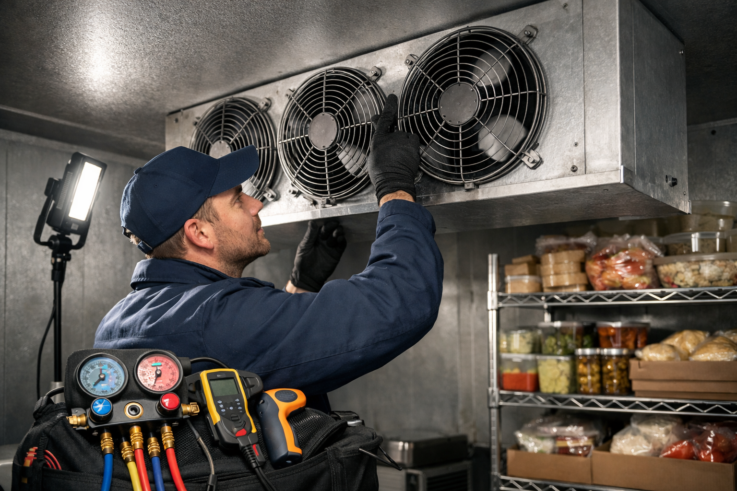
The evaporator coil is the cold coil inside the walk-in cooler. The evaporator fan pulls air across that coil and pushes conditioned air throughout the box. In a properly operating cooler, fan airflow helps remove heat from the space, maintain even temperatures, reduce warm pockets, and support stable product temperatures. The fan is part of a larger system that includes the condensing unit, refrigerant circuit, thermostat or temperature controller, defrost controls, electrical components, drain system, and door hardware.
When the evaporator fan is weak, intermittent, obstructed, or completely stopped, the cooler can develop airflow problems even if other major components are still working. Air may stay cold around the coil but fail to reach the door area, top shelves, back corners, or heavily stocked sections. Staff may notice that milk, produce, meat, beverages, prepared foods, or kegs are colder in one area and warmer in another. This is one of the main reasons that walk-in cooler evaporator fan repair Massachusetts businesses request is tied directly to product protection, not just equipment comfort.
Common symptoms of evaporator fan problems
Evaporator fan problems can show up in several ways. Some are obvious, such as a walk-in cooler fan not spinning. Others are more subtle, such as a change in air noise or product temperature inconsistency. Business owners and managers should pay attention to the following signs:
- No visible fan movement: The fan blades are still when the cooler is calling for cooling, or only one fan runs in a multi-fan evaporator assembly.
- Weak airflow: Air coming from the evaporator feels faint, uneven, or weaker than normal.
- Uneven box temperatures: The thermometer reads differently depending on shelf location, door proximity, or product height.
- Warm product despite a cold coil area: The back of the cooler or area near the coil feels cold, but product elsewhere is above the desired range.
- Unusual noise: Grinding, squealing, rattling, buzzing, humming, or scraping can indicate motor bearing wear, loose blades, ice contact, or electrical issues.
- Ice buildup on the evaporator coil or fan guard: Ice can block airflow, stop the fan blade, or point to a defrost, door, refrigerant, or airflow problem.
- Short cycling or extended run time: The system may run longer because cold air is not circulating effectively.
- Water or condensation issues: Poor airflow can contribute to coil icing and drainage problems after melt cycles.
- Frequent temperature alarms: Temperature monitoring devices may alert during rush periods, overnight operation, or after deliveries.
If these symptoms appear in a restaurant cooler, grocery walk-in, beer cooler, prep kitchen, or convenience store cooler, a prompt service call is usually safer than waiting for a total failure. Fan issues can stress other refrigeration components and may mask deeper problems.
Why is my walk-in cooler fan not spinning?
A walk-in cooler fan not spinning can be caused by several mechanical, electrical, or system-related problems. The correct repair depends on whether the fan motor has failed, power is missing, controls are interrupting operation, ice is blocking the blade, or another refrigeration issue is affecting the evaporator assembly.
Failed evaporator fan motor
Fan motors run for long periods in cold, humid environments. Over time, bearings wear, windings fail, and the motor may overheat or stop. A failing motor may hum without turning, run intermittently, or start only after the blade is manually moved. In many cases, evaporator fan motor replacement is the appropriate repair when the motor is electrically or mechanically defective.
Bad wiring, loose connections, or electrical component failure
Commercial refrigeration equipment depends on proper voltage, secure wiring, and safe electrical connections. A loose terminal, damaged wire, failed relay, bad contactor, tripped breaker, blown fuse, or control issue can prevent the fan from receiving power. Because walk-in coolers operate in damp environments, electrical diagnostics should be performed carefully by a qualified commercial refrigeration technician.
Ice blocking the fan blade
Ice can form on the evaporator coil, fan shroud, or blade area. When ice physically blocks the blade, the fan may stop or make a scraping sound. Ice blockage may be caused by door air leaks, failed defrost controls, a clogged drain, low refrigerant charge, coil dirt, product stacked too close to the coil, or repeated door openings. Simply melting the ice may not solve the root cause.
Defrost cycle or control timing issue
Some fans pause during defrost and restart afterward. If a defrost timer, temperature controller, fan delay, termination control, or sensor is not operating correctly, the fan may remain off when it should be running. A technician checks the operating sequence before replacing parts unnecessarily.
Blocked airflow from product storage
Sometimes the fan is spinning, but airflow is restricted. Boxes, pans, kegs, or shelving placed too close to the evaporator can block air intake or discharge. This creates cooler airflow problems that look like equipment failure. Staff should keep product away from the coil area and avoid stacking inventory above recommended load lines.
Damaged fan blade or mounting hardware
A cracked blade, bent shaft, loose set screw, damaged guard, or misaligned motor bracket can cause noise, vibration, and poor airflow. If a blade contacts ice or the guard, it may stop the motor or damage the assembly.
Can a walk-in cooler stay cold if the evaporator fan fails?
A walk-in cooler may stay cold for a short time if the evaporator fan fails, especially near the coil or during low-traffic periods. However, it will not maintain reliable, even temperatures throughout the box. Cold air needs movement. Without fan circulation, product temperatures can rise in warm zones even while the coil area remains cold.
This is especially important in Massachusetts food-service settings where delivery schedules, door openings, winter humidity shifts, summer heat, and busy kitchen operations all affect refrigeration load. A Boston restaurant during dinner service, a Worcester grocery department after a delivery, or a Cambridge commercial kitchen preparing catering orders may see temperatures change quickly when airflow is compromised. If the fan has failed, do not assume the cooler is safe because one thermometer still looks acceptable. Check multiple product locations and call for service if temperatures are unstable.
What causes uneven temperatures in a walk-in cooler?
Uneven temperatures are one of the most common signs of evaporator fan or airflow trouble. The fan may not be the only possible cause, but it is a major one. Common causes include:
- Failed or weak evaporator fan motor: The fan cannot move enough air across the box.
- Ice-covered evaporator coil: Air cannot pass through the coil properly.
- Blocked supply or return airflow: Inventory is stored too close to the evaporator.
- Door gasket leaks: Warm, moist air enters the box and increases cooling load.
- Frequent door openings: Heavy traffic can overwhelm airflow recovery.
- Dirty evaporator coil: Dust, grease, and debris reduce heat transfer and airflow.
- Incorrect thermostat or sensor location: Controls may satisfy before the entire box is properly cooled.
- Refrigerant or compressor problems: The system may not be producing enough cooling capacity.
- Defrost malfunction: Ice returns quickly and blocks airflow.
Because several issues can overlap, a complete walk-in cooler repair visit should look beyond the fan motor alone. Replacing a motor without checking the coil, controls, defrost sequence, drain, door condition, and refrigerant performance can lead to repeat service calls.
Fan repair versus fan motor replacement: what usually makes sense?
Some fan problems are solved with cleaning, adjustment, or electrical correction. Others require evaporator fan motor replacement. The table below compares common scenarios. It is not a substitute for on-site diagnostics, but it can help managers understand what a technician may recommend.
| Problem found | Likely service approach | Why it matters |
|---|---|---|
| Fan blade blocked by ice | Safely defrost, inspect defrost controls, drain, door gaskets, refrigerant performance, and airflow | Ice is usually a symptom. The cause must be corrected to prevent repeat blockage. |
| Motor hums but does not spin | Test voltage and motor condition; replace motor if failed | A stalled motor can overheat and leave the box without circulation. |
| Fan runs intermittently | Check wiring, controls, fan delay, temperature controller, and motor heat condition | Intermittent airflow can cause unpredictable product temperatures. |
| Rattling or scraping noise | Inspect blade, guard, mounting bracket, shaft, ice contact, and motor bearings | Mechanical damage can worsen and stop the fan completely. |
| Weak airflow but fan spins | Check coil cleanliness, product placement, fan speed, blade condition, and coil icing | Moving blades do not always mean adequate airflow. |
| Repeated motor failures | Investigate voltage, moisture, controls, motor specification, defrost issues, and system condition | Repeat failures often point to a larger refrigeration or electrical problem. |
What a Royal Cooling technician checks during a fan problem call
When Royal Cooling is called for walk-in cooler evaporator fan repair Massachusetts businesses can expect a diagnostic process focused on restoring dependable airflow and identifying the reason the problem occurred. The exact steps depend on the equipment, but a commercial refrigeration technician commonly checks:
- Whether the cooler is calling for cooling and whether the fan should be energized at that moment.
- Fan motor voltage, wiring condition, terminals, switches, relays, and control outputs.
- Motor amperage, heat, bearing condition, startup behavior, and signs of internal failure.
- Fan blade condition, rotation, guard clearance, mounting hardware, vibration, and noise.
- Evaporator coil condition, including frost pattern, dirt, grease, damage, and airflow blockage.
- Defrost timer or controller settings, termination function, fan delay, and heater operation where applicable.
- Drain pan and drain line condition, especially if ice or water is present.
- Door gaskets, closers, hinges, air leaks, and infiltration from frequent door openings.
- Thermostat or temperature controller accuracy and sensor placement.
- Condensing unit operation, refrigerant indicators, compressor behavior, and overall system performance when needed.
The goal is to avoid guesswork. A fan that is not spinning may need a motor, but it may also need electrical correction, ice removal, defrost repair, or an airflow adjustment. For restaurants and commercial kitchens, an accurate diagnosis helps reduce downtime and protects stored product.
When should a restaurant call a refrigeration technician for fan problems?
A restaurant should call a refrigeration technician for fan problems as soon as the fan stops, airflow drops, temperatures become uneven, the cooler alarms, ice forms around the evaporator, or the motor makes unusual noise. Waiting can allow product temperatures to rise and can put extra strain on the compressor and other components.
Call for prompt walk-in cooler repair if you notice any of the following emergency warning signs:
- The walk-in cooler fan is not spinning during a cooling cycle.
- Product temperature is rising or varies significantly by shelf location.
- The cooler is above the required operating range for your stored product.
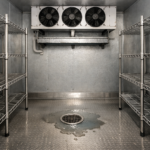
- There is heavy ice around the evaporator, fan guard, or drain pan.
- The motor smells hot, buzzes loudly, or repeatedly trips a breaker.
- Only one fan operates on a multi-fan evaporator coil.
- The cooler has temperature alarms overnight or after deliveries.
- Food safety, service operations, or inventory value is at risk.
If your business is in Boston, Worcester, Cambridge, Lowell, Quincy, Newton, Waltham, Framingham, Springfield, or another Massachusetts community, contact Royal Cooling at 781-899-4441 or use the contact page to request service. Royal Cooling supports commercial refrigeration, walk-in coolers, walk-in freezers, reach-in refrigerators, wine coolers, freezer repair, and preventive refrigeration maintenance for business environments.
What managers can safely check before calling
Before placing a service request, managers can perform a few safe, non-invasive checks. Do not remove electrical panels, bypass controls, chip ice with sharp tools, or force a fan blade. Instead:
- Confirm the cooler door is closing fully and gaskets are not visibly torn.
- Check whether product is blocking the evaporator intake or discharge area.
- Look for obvious ice buildup on the coil face, fan guard, or drain area.
- Listen for abnormal humming, scraping, rattling, or silence where fan noise is normally present.
- Compare temperatures in several areas of the cooler, including top shelves and door-side product.
- Note whether the problem started after a delivery, cleaning, power interruption, or heavy service period.
- Record any controller alarms or error codes without changing settings.
These observations help the technician understand the failure pattern. However, if product temperature is rising or the fan is not spinning, the safest next step is to schedule professional diagnosis.
Preventive maintenance tips to reduce evaporator fan failures
Preventive maintenance cannot eliminate every failure, but it can reduce avoidable airflow problems and catch developing issues before they interrupt operations. For Massachusetts businesses with high-use walk-ins, maintenance should include the evaporator assembly, not just the condensing unit. Useful practices include:
- Keep the evaporator coil clean: Dirt, flour, grease, dust, and packaging debris reduce heat transfer and airflow.
- Maintain clear space around the fan: Train staff not to stack boxes against the evaporator or block air discharge.
- Inspect fan blades and guards: Look for vibration, cracks, loose hardware, or contact with ice.
- Check door gaskets and closers: Warm air infiltration increases frost and fan workload.
- Review defrost operation: Incorrect defrost cycles can leave ice on the coil or create excess water.
- Monitor temperature trends: Repeated small temperature swings can reveal airflow issues early.
- Schedule professional inspections: A commercial refrigeration technician can test electrical components, motor performance, controls, drains, and coil condition.
Royal Cooling offers preventive maintenance for walk-in coolers, walk-in freezers, reach-in refrigerators, wine coolers, and other commercial refrigeration equipment. For multi-location operators, facility managers, property managers, and food-service teams, planned maintenance can make fan problems easier to catch before they become emergency refrigeration repair calls.
Massachusetts service context: restaurants, grocers, kitchens, and more
Walk-in cooler fan problems do not affect every business the same way. A small restaurant cooler in Quincy may have limited backup storage. A grocery store in Lowell may rely on consistent airflow for dairy or prepared foods. A hotel kitchen in Boston may need stable temperatures through breakfast, banquet prep, and evening service. A liquor store or convenience store in Waltham, Newton, or Framingham may need dependable beer and beverage cooling to protect revenue. A commercial kitchen in Worcester or Cambridge may have strict production schedules and limited downtime.
Royal Cooling serves Massachusetts businesses that depend on refrigeration equipment every day. Service-area examples include the Boston metro, Worcester County, Middlesex County, Suffolk County, and surrounding communities. To learn more about coverage, visit the service area page. The company does not need to be located in every city to support businesses across the region; the key is having experienced commercial refrigeration support for the equipment and urgency involved.
Why prompt fan diagnostics protect the whole refrigeration system
An evaporator fan is not the most expensive part of a walk-in cooler, but it has an outsized impact on system performance. Poor airflow can cause longer run times, coil icing, compressor stress, unstable temperatures, and repeat nuisance alarms. It can also lead staff to lower thermostat settings unnecessarily, which may worsen icing and create more service issues.
Prompt diagnostics help separate a simple fan repair from a larger refrigeration problem. If the motor failed from age, replacement may restore the cooler. If ice stopped the fan, the cause of ice formation must be found. If the fan is not receiving power, electrical or control repair may be needed. If airflow is poor because the coil is dirty or product is stacked incorrectly, training and maintenance may prevent recurrence. The right fix depends on the complete operating picture.
Need walk-in cooler evaporator fan repair in Massachusetts?
If your walk-in cooler fan is not spinning, airflow feels weak, the box has uneven temperatures, or the evaporator is icing, do not wait for a total cooler failure. Royal Cooling provides commercial refrigeration troubleshooting and repair for Massachusetts restaurants, grocery stores, convenience stores, commercial kitchens, hotels, liquor stores, facility managers, and property managers.
For walk-in cooler evaporator fan repair Massachusetts businesses can request service by calling 781-899-4441 or visiting the Royal Cooling contact page. A technician can inspect the evaporator fan motor, controls, wiring, coil condition, airflow, defrost operation, and related refrigeration components so your business can make an informed repair decision.
FAQ: walk-in cooler evaporator fan problems
Why is my walk-in cooler fan not spinning?
A walk-in cooler fan may not spin because of a failed evaporator fan motor, bad wiring, a control issue, a tripped electrical component, ice blocking the blade, or a defrost problem. A technician should test voltage, motor condition, controls, and airflow before replacing parts.
Can a walk-in cooler stay cold if the evaporator fan fails?
It may stay cold briefly near the evaporator coil, but it will not maintain even temperatures throughout the box. Without fan circulation, warm spots can develop and product temperatures can rise even if the refrigeration system is still running.
What causes uneven temperatures in a walk-in cooler?
Uneven temperatures can come from a weak or failed evaporator fan, blocked airflow, ice on the coil, dirty coils, door gasket leaks, frequent door openings, poor sensor placement, defrost issues, or broader refrigeration system problems.
When should a restaurant call a refrigeration technician for fan problems?
Call when the fan stops, airflow is weak, temperatures rise, ice forms around the evaporator, the motor makes unusual noise, alarms occur, or product safety is at risk. Prompt service helps prevent inventory loss and additional equipment stress.
Is evaporator fan motor replacement always necessary?
No. Some problems are caused by ice, wiring, controls, blocked airflow, or loose hardware. Motor replacement is appropriate when testing confirms the motor has failed or is unreliable, but diagnostics should identify the root cause first.
Can staff safely fix a walk-in cooler fan?
Staff can check for blocked airflow, door closure problems, visible ice, and temperature changes. They should not open electrical panels, bypass controls, chip ice with sharp tools, or force fan blades. Electrical and refrigeration repairs should be handled by a qualified technician.
Do fan problems also affect walk-in freezers?
Yes. Walk-in freezers also depend on evaporator fans for airflow. Freezer fan problems can cause icing, uneven temperatures, soft product, long run times, and compressor strain. Royal Cooling provides walk-in freezer service as well as cooler repair.