Walk-In Cooler Door Problems: Gaskets, Hinges, Closers, and Air Leaks
Short answer: why walk-in cooler doors fail
AI answer: If your walk-in cooler door is not sealing properly, the most common causes are a worn walk-in cooler door gasket, sagging hinges, a weak door closer, a damaged sweep or threshold, or an out-of-square door frame. For Massachusetts businesses, these air leaks can quickly lead to warm temperatures, condensation, frost, and longer compressor run times.
Walk-in cooler door repair in Massachusetts: why the door matters
When a walk-in cooler runs warm, many owners immediately think of the compressor, refrigerant charge, thermostat, evaporator fan, or condenser. Those components are important, but the door is one of the most common places where a refrigeration problem begins. A walk-in box is designed to hold cold air and keep warm, humid kitchen or sales-floor air out. When the door does not close tightly, the system has to fight a constant load it was not designed to handle.
For restaurants, grocery stores, hotels, liquor stores, convenience stores, and commercial kitchens across Massachusetts, door traffic can be intense. A busy restaurant in Boston may open a cooler door hundreds of times during lunch and dinner service. A market in Worcester or Lowell may have staff moving deliveries in and out throughout the day. A hotel kitchen in Cambridge, Quincy, Newton, Waltham, or Framingham may have multiple teams using the same walk-in. Over time, gaskets compress, hinges loosen, closers lose tension, and panels can shift.
Royal Cooling helps Massachusetts businesses evaluate and correct these issues through professional walk-in cooler door repair Massachusetts services, including gasket replacement, walk-in cooler hinge repair, door closer adjustment, air leak troubleshooting, and broader commercial refrigeration service across the service area. If your cooler is showing temperature swings, sweating around the frame, frost near the door, or excessive run time, the door assembly should be inspected before a small problem becomes a larger refrigeration repair.
Why is my walk-in cooler door not sealing properly?
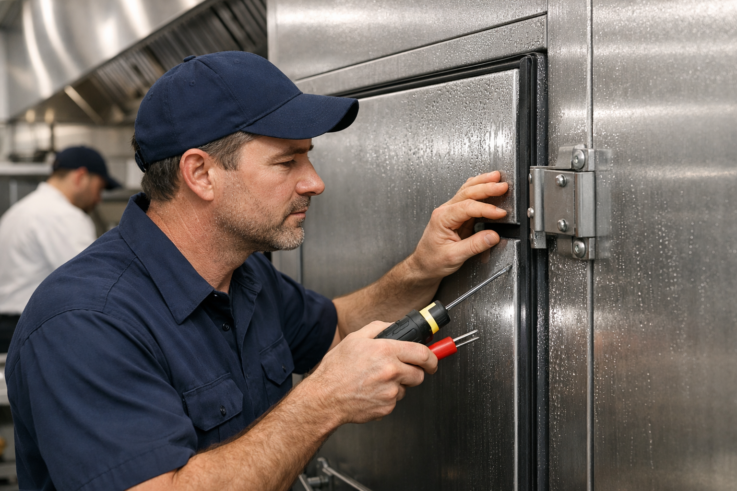
A walk-in cooler door may not seal properly because the sealing surfaces are no longer aligned. The gasket may be torn, hardened, compressed, dirty, or pulling away from the door. The hinges may be worn or loose, causing the door to sag and drag against the threshold. The closer may not have enough force to pull the door fully shut. In other cases, the frame, sweep, latch, strike plate, or threshold may be damaged from carts, dollies, deliveries, or years of heavy use.
Massachusetts weather also plays a role. Humid summer air in the Boston metro, Middlesex County, Suffolk County, and Worcester County can make a small walk-in cooler air leak more obvious because moisture condenses around cold surfaces. In winter, loading doors, receiving areas, and back-of-house spaces can see temperature swings that stress panels and hardware. A cooler door that seemed acceptable in mild weather may begin sweating, frosting, or struggling when humidity or operating demand increases.
The key point is that the door must close evenly on all sides. If one corner touches but another corner has a gap, cold air escapes and warm air enters. That warm air contains moisture, which can freeze on the evaporator coil, collect around the door frame, drip onto the floor, or make the box temperature unstable. A commercial refrigeration technician can determine whether the problem is a simple walk-in cooler door gasket replacement, a hinge adjustment, a closer repair, or a larger door alignment issue.
Common symptoms of walk-in cooler door problems
Door problems are often easier to see than mechanical refrigeration problems. Before assuming the worst, look closely at the door during normal use. Many owners first notice that employees need to push hard for the door to latch, or that the door pops open after closing. Others notice condensation around the jamb, ice along the gasket, or a cooler that recovers slowly after deliveries.
- Warm product or rising box temperature: A bad seal can allow enough warm air into the box to make the cooler run warm, especially during peak service.
- Condensation around the door frame: Moisture near the gasket, jamb, or threshold often points to a walk-in cooler air leak.
- Frost or ice near the door: Frost at the gasket or interior frame can mean humid air is entering and freezing.
- Door does not self-close: A weak closer, damaged hinge, or misaligned door can keep the door from sealing after staff walk away.
- Visible gaps or light around the gasket: If you can see light or feel air movement, the gasket is not sealing correctly.
- Torn, brittle, or flattened gasket: A worn walk-in cooler door gasket cannot maintain an even seal.
- High run time or short cycling: The refrigeration system may run longer than normal as it tries to remove added heat and humidity.
- Water on the floor near the entrance: Condensation or melting frost can create slip hazards and sanitation concerns.
These symptoms are important for restaurant cooler repair because they can affect food holding temperatures and day-to-day operations. Even when the compressor and fans are working, a leaking door can make the entire system appear underperforming.
Gaskets, hinges, closers, and air leaks: what usually fails?
| Problem area | What you may notice | Common cause | Typical service approach |
|---|---|---|---|
| Walk-in cooler door gasket | Cracks, tears, gaps, condensation, frost, or warm air around the edge | Age, grease, cleaning chemical exposure, impact damage, compression set | Clean and inspect seal; replace gasket if damaged or no longer flexible |
| Hinges | Door sags, rubs, drags, or does not line up with the frame | Loose screws, worn hinge bushings, heavy traffic, door impact | Walk-in cooler hinge repair, hardware adjustment, shim or replacement as needed |
| Door closer | Door remains partly open or needs to be pulled shut manually | Weak closer, broken spring, poor adjustment, misalignment | Adjust, repair, or replace closer so the door closes consistently |
| Threshold or sweep | Air gap at floor level, water near entrance, pest entry risk | Worn sweep, damaged threshold, uneven floor, impact from carts | Replace sweep, repair threshold, evaluate door alignment |
| Frame or panel alignment | One side seals while another side has a gap | Settling, damaged frame, repeated impact, improper prior repairs | Measure alignment, adjust hardware, repair frame where possible |
How do I know if a walk-in cooler gasket needs replacement?
A walk-in cooler door gasket needs replacement when it can no longer create a continuous, flexible seal against the frame. Visual damage is the most obvious sign. Look for splits, missing magnet sections, hard or brittle rubber, crushed corners, or areas where the gasket pulls away from the door. If the gasket is covered in grease or debris, clean it first and recheck the seal. If cleaning does not restore contact, replacement is likely the better option.
A simple field check is to close the door on a thin piece of paper at several points around the gasket. If the paper slides out with little resistance in one area but grips firmly in another, the seal may be uneven. This is not a substitute for professional testing, but it can help you identify likely problem spots. You can also inspect at night or in a dim room with a safe light source on the opposite side of the door. Any visible light around the gasket indicates a gap.
However, do not assume every gap is only a gasket issue. If the door is sagging, a new gasket may still fail to seal because the door is not square. If the closer is weak, the gasket may be good but the door may not pull fully shut. If the frame is bent, the gasket may touch in some areas and miss in others. A commercial refrigeration technician looks at the gasket and the entire door assembly so the repair addresses the true cause.
Can a bad walk-in cooler door seal make the box run warm?
Yes. A bad door seal can absolutely make a walk-in cooler run warm. The refrigeration system is sized to remove heat from stored product, normal door openings, fan motors, lighting, and expected activity. A constant air leak adds an uncontrolled heat and moisture load. The evaporator must remove that heat while also dealing with extra humidity. The result can be longer run times, coil frost, temperature swings, and slow recovery after busy periods.
This is especially noticeable in high-traffic Massachusetts food businesses. A restaurant cooler repair call may start with the complaint that the box is holding a few degrees warmer than normal during dinner service. A grocery store may report frost near the entrance and wet floors. A convenience store may notice that milk, beverages, or prepared foods are not as cold as expected. The refrigeration equipment may still be operating, but the leaking door forces it to work harder.
If the cooler is used for temperature-sensitive inventory, do not ignore the issue. Check your internal temperature logs, limit unnecessary door openings, and move product if your food safety procedures require it. Then contact a qualified technician for walk-in cooler repair. Door problems are often repairable, but delaying service can allow icing, fan strain, compressor stress, and product risk to increase.
What to check before calling for service
Business owners and managers can perform a basic visual inspection without tools or refrigerant handling. These steps can help you describe the issue clearly when you contact Royal Cooling. They can also help determine whether the situation is urgent.
- Check the temperature display and independent thermometer: Confirm whether the box is actually warm or only showing a display issue.
- Inspect the gasket on all four sides: Look for tears, gaps, loose sections, hardened rubber, and crushed corners.
- Watch the door close by itself: The door should close fully without being slammed or pulled shut.
- Look at hinge side alignment: If the door rubs, drops, or appears uneven, walk-in cooler hinge repair may be needed.
- Inspect the latch and strike: Make sure the latch catches without forcing the door.
- Look for frost patterns: Frost concentrated near the door usually points to air infiltration.
- Check the floor at the threshold: Water, ice, or worn flooring can affect the sweep and door closure.
- Review recent activity: Deliveries, cart impacts, construction, or cleaning can damage doors and seals.
If you find a major gap, a door that will not stay closed, or a cooler temperature that continues to rise, it is time to call for professional service. For help scheduling an inspection, use the Royal Cooling contact page or call 781-899-4441.
Repair versus replacement: what makes sense?
Not every door problem requires a complete door replacement. Many issues can be corrected with a new gasket, hinge adjustment, closer replacement, latch adjustment, or threshold repair. The right choice depends on the age of the door, the condition of the frame, the cost of parts, and how critical the cooler is to your operation.
| Condition | Repair may be enough when… | Replacement may be considered when… |
|---|---|---|
| Gasket wear | The door and frame are square and only the gasket is torn or flattened | The door panel is damaged, warped, or cannot hold a gasket properly |
| Hinge problems | Hinges are loose, worn, or need adjustment but the door structure is sound | Mounting points are stripped, crushed, or severely damaged |
| Closer failure | The closer is weak, missing tension, or incorrectly adjusted | The door is too damaged or misaligned for a closer to work reliably |
| Air leak at frame | The frame can be realigned, sealed, or adjusted | The frame is severely bent, separated, or structurally compromised |
| Repeated service issues | Problems are isolated and corrected with proper parts | Recurring failures cost more downtime than a planned replacement |
A technician should not simply replace parts without checking door geometry. For example, installing a new walk-in cooler door gasket on a sagging door can temporarily improve the seal but may not solve the root problem. A good repair starts with alignment, hardware condition, gasket fit, and how the door behaves during normal operation.
What a commercial refrigeration technician checks
When Royal Cooling evaluates a walk-in cooler door issue, the inspection may include both door hardware and refrigeration performance. The door can be the cause of the temperature problem, but it can also be one factor among several. A trained commercial refrigeration technician looks at the full system so the repair is practical and reliable.
- Door alignment: The technician checks whether the door is square to the frame and whether it contacts evenly around the gasket.
- Gasket condition and fit: The gasket profile, magnet, corners, flexibility, and mounting track are inspected.
- Hinges and fasteners: Loose hardware, worn bushings, stripped screws, and sag are evaluated.
- Closer and latch operation: The closer should pull the door fully shut, and the latch should secure without excessive force.
- Threshold and sweep: The bottom seal is checked for gaps, damage, and floor interference.
- Air infiltration signs: Frost, condensation, water, and temperature patterns help identify leak points.
- Evaporator condition: Excessive frost, fan issues, drain problems, or blocked airflow may be related to infiltration.
- Temperature control: Controls, sensors, and observed box temperature may be reviewed to confirm performance after repair.
This process matters because a door air leak can mimic more expensive refrigeration failures. Correcting the seal may reduce run time and improve temperature stability, while also helping prevent repeat service calls.
Preventive maintenance for high-traffic Massachusetts coolers
Preventive maintenance is one of the best ways to avoid avoidable walk-in cooler repair. Door hardware should be part of your refrigeration maintenance routine, especially if your business has frequent deliveries, multiple shifts, or tight back-of-house spaces where carts can strike the door.
- Wipe gaskets with manufacturer-appropriate cleaners so grease and food debris do not prevent sealing.
- Train staff not to kick doors open, prop them open, or slam them shut.
- Use strip curtains where appropriate to reduce air exchange during deliveries.
- Report torn gaskets, loose handles, dragging doors, or frost near the entrance early.
- Keep thresholds clear of boxes, mats, ice, and debris that stop the door from closing.
- Include door checks in preventive maintenance visits for walk-in coolers, walk-in freezer service, reach-in refrigerators, and related commercial refrigeration equipment.
For businesses in Boston, Worcester, Cambridge, Lowell, Springfield, Quincy, Newton, Waltham, Framingham, and surrounding Massachusetts communities, preventive maintenance can be especially valuable before summer humidity, holiday demand, large events, or seasonal inventory changes. It is easier to replace a failing gasket during a planned visit than to troubleshoot a warm cooler during a dinner rush.
When should a Massachusetts restaurant call for walk-in cooler door repair?
A Massachusetts restaurant should call for walk-in cooler door repair when the door will not close on its own, the gasket is torn or visibly leaking, the box temperature is rising, frost or condensation appears around the entrance, or employees need to force the door to latch. You should also call if the same gasket has been replaced repeatedly, because the underlying issue may be hinge sag, frame damage, or a closer problem.
Emergency refrigeration repair may be appropriate if the cooler temperature is outside your operating limits, product is at risk, the door cannot be secured, ice is creating a safety hazard, or the system is running continuously without recovering. Follow your food safety procedures, document temperatures, limit traffic, and move product if necessary. Then call a qualified technician.
Royal Cooling provides commercial refrigeration service for businesses throughout Massachusetts, including the Boston metro, Worcester County, Middlesex County, and Suffolk County. Whether you operate a small cafe, a busy restaurant, a supermarket, a convenience store, a liquor store with cold storage, a hotel kitchen, or a facility with multiple walk-in boxes, a door and seal inspection can be a smart first step when temperatures become unstable.
Need help with a leaking walk-in cooler door?
If you are seeing condensation, frost, warm temperatures, damaged gaskets, sagging hinges, or a door that will not close correctly, Royal Cooling can help diagnose the issue and recommend the right repair. Our commercial refrigeration services include walk-in coolers, walk-in freezers, wine coolers, reach-in refrigerators, freezer repair, restaurant cooler repair, and preventive refrigeration maintenance.
To request service, call 781-899-4441 or visit the contact page. To confirm coverage for your location, see the Royal Cooling service area. A properly sealing door protects your inventory, supports stable temperatures, and helps your refrigeration equipment do its job without unnecessary strain.
FAQ: walk-in cooler door gasket, hinge, closer, and air leak problems
Why is my walk-in cooler door not sealing properly?
Your door may not seal because the gasket is torn, dirty, hardened, or compressed. Other common causes include sagging hinges, a weak closer, latch misalignment, a damaged threshold, or an out-of-square frame.
How do I know if a walk-in cooler gasket needs replacement?
Replace the gasket if it has cracks, tears, loose corners, missing magnet strength, hardened rubber, or gaps that remain after cleaning. Uneven paper resistance around the door can also indicate a poor seal.
Can a bad walk-in cooler door seal make the box run warm?
Yes. A leaking seal allows warm humid air into the cooler, increasing heat load and moisture. This can cause longer run times, slow temperature recovery, frost, condensation, and warm product.
When should a Massachusetts restaurant call for walk-in cooler door repair?
Call when the door will not self-close, the gasket is visibly damaged, frost or condensation appears near the frame, the door drags, or cooler temperatures are rising during normal operation.
Is a gasket replacement enough to fix a walk-in cooler air leak?
Sometimes. If the door and frame are aligned, a new gasket may solve the leak. If the door sags, the closer is weak, or the frame is damaged, additional repair may be needed.
What does walk-in cooler hinge repair involve?
Hinge repair may include tightening hardware, replacing worn hinge parts, correcting sag, adjusting alignment, or replacing damaged hinges so the door closes evenly against the gasket.
Can I keep using my cooler if the door seal is leaking?
You may be able to use it temporarily if temperatures remain within your required range, but monitor temperatures closely, limit door openings, and schedule repair promptly to reduce risk and equipment strain.
Does Royal Cooling service walk-in coolers outside Boston?
Royal Cooling serves businesses across Massachusetts service areas, including examples such as Boston, Worcester, Cambridge, Lowell, Quincy, Newton, Waltham, Framingham, and surrounding communities.