Emergency Commercial Refrigeration Repair in Massachusetts: What to Do
Short answer: If you need emergency commercial refrigeration repair in Massachusetts, keep cooler and freezer doors closed, verify power and temperature settings, document current box temperatures, move high-risk inventory only if you can do so safely, and call a qualified commercial refrigeration technician. Royal Cooling provides fast-response refrigeration service for restaurants, markets, hotels, liquor stores, and commercial kitchens across Massachusetts.
A commercial refrigeration failure is not just an inconvenience. For a restaurant in Boston, a market in Worcester, a hotel kitchen in Cambridge, or a liquor store with wine coolers in Quincy, a warm walk-in cooler can quickly become a product-loss, food-safety, and business-continuity problem. The right first steps can reduce damage while you wait for professional emergency refrigeration repair.
This guide explains what to do before inventory is lost, which symptoms should be treated as urgent, how to protect product without making the problem worse, and what a Royal Cooling technician typically checks during an emergency call. If your equipment is actively failing now, call Royal Cooling at 781-899-4441 or use the contact page to request service.
When Is a Refrigeration Problem Considered an Emergency?
A refrigeration issue becomes an emergency when the equipment can no longer protect temperature-sensitive inventory, production schedules, or business operations. In Massachusetts, that can include a walk-in cooler serving dinner prep in the Boston metro, a walk-in freezer holding frozen seafood in Worcester County, a reach-in refrigerator in a convenience store in Middlesex County, or wine coolers protecting high-value inventory in Suffolk County.
Call for emergency service if you notice any of the following:
- Box temperature rising quickly and not recovering after doors are closed.
- Walk-in cooler above safe operating range for perishable products.
- Walk-in freezer temperature climbing, product softening, or frost melting.
- Compressor not starting, short cycling, or making unusual sounds.
- Evaporator fans not running or air not moving inside the box.
- Ice buildup blocking airflow, fan blades, drain lines, or the evaporator coil.
- Burning smell, tripped breaker, or electrical buzzing near refrigeration equipment.
- Water leaking near electrical components or creating a slip hazard.
- Door left open overnight with product temperature uncertainty.
- Controller alarm, high-temperature alarm, sensor fault, or repeated reset condition.
If you are unsure whether the situation qualifies as urgent, treat it as urgent until a technician helps you confirm otherwise. Waiting too long can turn a manageable walk-in cooler repair into lost inventory, emergency disposal, and disrupted service.
What Should I Do First If My Commercial Cooler Stops Working?
The first few minutes matter. Before opening panels or trying to repair equipment, take these safe triage steps. These apply to walk-in coolers, walk-in freezers, reach-in refrigerators, prep tables, display cases, beer coolers, and wine coolers.
1. Keep doors closed and limit traffic
Do not repeatedly open the cooler to check if it is still cold. Every door opening adds warm, humid air, which makes the refrigeration system work harder and can accelerate product temperature rise. Assign one staff member to manage access and keep a written list of what is inside if needed.
2. Check the temperature display and record the time
Write down the displayed temperature, the time you noticed the problem, and any alarm codes. If you use separate probe thermometers or monitoring systems, document those readings too. This helps your commercial refrigeration technician understand how quickly the box is warming and helps your team make informed inventory decisions.
3. Confirm basic power without forcing resets
Check whether lights, fans, and the controller are on. Look for a tripped breaker, disconnected switch, or emergency shutoff. If a breaker trips again after one reset, do not keep resetting it. Repeated resets can damage components and may indicate an electrical fault, locked compressor, failed fan motor, or shorted control.
4. Verify the thermostat or controller setting
Make sure the setpoint has not been accidentally changed by staff, cleaning crews, or a power interruption. Do not lower the setpoint dramatically in an attempt to “catch up.” If the system is not cooling because of a mechanical, refrigerant, airflow, or electrical problem, an extreme setting will not fix it and may complicate diagnosis.
5. Look for obvious airflow problems
Without removing guards or panels, check whether product is stacked against the evaporator, blocking supply or return air. Move boxes away from fan outlets if you can do so safely and quickly. Avoid scraping ice off coils with knives or tools, which can puncture refrigerant tubing.
6. Call for service before product is at risk
If temperature is rising or equipment is alarming, call Royal Cooling at 781-899-4441. A technician can help determine whether you need walk-in cooler emergency service, walk-in freezer service, restaurant refrigeration repair, or another commercial refrigeration response.
How to Reduce Product Loss While Waiting for Refrigeration Service
Inventory protection should be organized, calm, and documented. Your goal is to preserve product temperature, avoid cross-contamination, and avoid overloading another unit that may not be designed for the extra heat load.
- Prioritize high-risk inventory. Identify seafood, meat, dairy, prepared foods, frozen product, specialty beverages, and high-value items first.
- Use backup refrigeration if available. Move product to another properly operating walk-in, reach-in, refrigerated truck, or approved cold-storage option when practical.
- Do not overload a working cooler. Packing another cooler too tightly can block airflow and create a second emergency.
- Group product logically. Keep frozen with frozen, refrigerated with refrigerated, and ready-to-eat items protected from raw products.
- Keep a temperature log. Record product temperatures, box temperatures, times, and relocation steps.
- Use insulated containers only as a temporary measure. They may slow temperature gain but are not a substitute for mechanical refrigeration.
- Follow your internal food-safety policy. When in doubt about product safety, consult your management procedures and applicable health requirements.
Restaurants and commercial kitchens in busy areas such as Boston, Cambridge, Newton, Waltham, and Framingham often have limited storage space, so planning matters. If the failed system serves the main production line or overnight storage, call for after-hours refrigeration repair as soon as the problem is discovered instead of waiting until the next prep shift.
Emergency Symptoms, Likely Causes, and What to Do Now
The table below can help your team communicate clearly when calling for emergency service. It is not a substitute for professional diagnosis, but it can help you explain what is happening.
| Symptom | Possible Causes | What to Do Before the Technician Arrives | Urgency |
|---|---|---|---|
| Walk-in cooler temperature rising | Failed fan motor, dirty condenser, refrigerant issue, faulty controller, door left open, compressor problem | Keep doors closed, record temperature, check power, move product only if needed | High |
| Walk-in freezer product softening | Defrost failure, compressor issue, refrigerant leak, iced evaporator, electrical fault | Limit access, document product condition, avoid chipping ice from coils | Critical |
| Breaker trips repeatedly | Shorted motor, electrical short, compressor fault, wiring issue | Stop resetting the breaker and call for service | Critical |
| Heavy ice on evaporator coil | Air leak, defrost timer issue, failed heater, low airflow, door gasket problem | Do not use sharp tools; reduce door openings and call a technician | High |
| Compressor running but box not cooling | Low refrigerant, dirty coil, valve issue, airflow restriction, failing compressor | Check for blocked airflow and call for diagnosis | High |
| Controller blank or alarmed | Power loss, control failure, sensor fault, transformer issue | Check basic power and note any codes | High |
Who Repairs Walk-In Coolers After Hours in Massachusetts?
After-hours refrigeration problems should be handled by a contractor experienced with commercial systems, not only residential air conditioning. Royal Cooling services commercial refrigeration equipment for restaurants, markets, liquor stores, hotels, commercial kitchens, convenience stores, grocery stores, property managers, and facility managers across Massachusetts. Service area examples include Boston, Worcester, Cambridge, Lowell, Springfield, Quincy, Newton, Waltham, and Framingham, as well as surrounding communities in the Boston metro, Worcester County, Middlesex County, and Suffolk County.
Commercial systems are different from household refrigerators. A technician may need to diagnose remote condensers, evaporator coils, electronic controllers, pressure controls, defrost systems, expansion valves, refrigerant circuits, electrical components, and airflow issues. That is why a trained commercial refrigeration technician is important during a true emergency.
If you are dealing with an active failure, call 781-899-4441. For non-urgent requests or planned work, you can also visit Royal Cooling’s contact page or review the service area.
What a Refrigeration Technician Checks During an Emergency Call
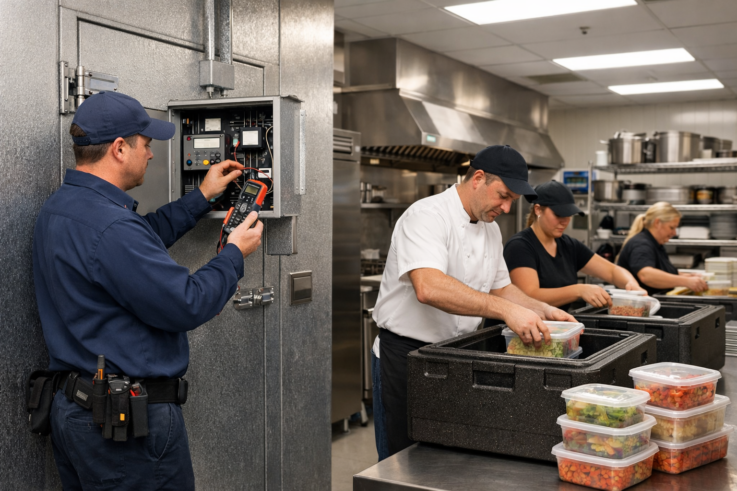
During an emergency commercial refrigeration visit, the technician’s first goal is to stabilize the system when possible and identify the cause of failure. Depending on equipment type and site conditions, the inspection may include:
- Temperature verification: Comparing controller readings with independent temperature measurements.
- Electrical checks: Inspecting voltage, contactors, relays, capacitors, wiring, safeties, and breaker behavior.
- Compressor operation: Checking whether the compressor starts, runs, short cycles, overheats, or trips on safety controls.
- Condenser condition: Looking for dirty coils, blocked airflow, failed condenser fans, or outdoor unit problems.
- Evaporator performance: Checking fan motors, coil icing, airflow pattern, drain condition, and frost distribution.
- Defrost system: Reviewing timers, heaters, termination controls, sensors, and drain heaters for freezer repair and walk-in freezer service.
- Refrigerant circuit: Evaluating pressures, superheat/subcooling where appropriate, leaks, restrictions, and metering device operation.
- Door and box conditions: Looking for air infiltration, damaged gaskets, loose hinges, failed closers, or panels that allow warm air entry.
- Controller settings and alarms: Reviewing setpoints, differentials, sensor readings, and alarm history.
In some cases, the technician can restore cooling with a repair during the visit. In other cases, the safest step may be temporary stabilization, product relocation guidance, or a quoted follow-up repair if major parts are needed. Royal Cooling focuses on clear communication so owners and managers understand the condition of the equipment and the next practical step.
Repair vs. Replace: What Makes Sense During an Emergency?
When product is at risk, the immediate priority is stabilization. However, emergency calls sometimes reveal equipment that is near the end of its useful life, has repeated failures, or relies on components that are difficult to source. Repair may be the best choice when the failure is isolated, the box is otherwise in good condition, and parts are available. Replacement may be worth discussing when equipment has chronic leaks, repeated compressor failures, severe corrosion, poor energy performance, or cannot reliably hold temperature even after prior repairs.
For a restaurant refrigeration repair in a busy kitchen, a technician may recommend a practical staged approach: get the unit operating if possible, protect inventory, then discuss longer-term options after the immediate risk is controlled. For a supermarket, hotel, or facility with multiple systems, the conversation may include redundancy, monitoring, and preventive refrigeration maintenance to reduce future emergencies.
Common Causes of Emergency Refrigeration Failures in Massachusetts Businesses
Massachusetts businesses face seasonal and operational stresses. Hot, humid summer weather in the Boston metro can increase heat load and condensation. Winter conditions can affect outdoor condensers if controls, fans, or clearances are not maintained. Heavy door traffic in restaurants, convenience stores, and grocery stores adds warm air and moisture. Common causes include:
- Dirty condenser coils that cannot reject heat efficiently.
- Failed evaporator or condenser fan motors that reduce airflow.
- Refrigerant leaks that cause poor cooling and longer run times.
- Defrost failures that lead to ice buildup in freezers.
- Door gasket and closer problems that let humid air enter the box.
- Clogged drains causing water, ice, or sanitation concerns.
- Control or sensor failures that misread temperature or stop equipment from cycling properly.
- Electrical issues from worn contactors, loose connections, or overloaded circuits.
- Improper loading that blocks airflow around product.
- Deferred maintenance that allows small problems to become emergency failures.
Emergency service solves the immediate problem, but preventive maintenance reduces the chance of repeat breakdowns. If your business has had multiple urgent calls, ask Royal Cooling about maintenance options for commercial refrigeration, walk-in coolers, walk-in freezers, reach-in refrigerators, wine coolers, and other critical equipment.
How Restaurants and Facilities Can Prepare Before the Next Breakdown
No refrigeration system can be guaranteed against every failure, but preparation can reduce product loss and downtime. Massachusetts restaurants, hotels, markets, and facility teams should create a simple refrigeration emergency plan before the next alarm.
- Post the service number. Keep Royal Cooling’s number, 781-899-4441, near the manager station, prep area, and facility contact list.
- Assign responsibility. Make sure staff know who checks alarms, records temperatures, and authorizes emergency service.
- Maintain temperature logs. Regular logs make it easier to spot drift before a complete failure.
- Do not block airflow. Mark clearance zones around evaporator fans and condenser units.
- Clean and inspect regularly. Schedule coil cleaning, drain checks, gasket inspections, and controller reviews.
- Plan backup storage. Identify which nearby units or approved cold-storage options can protect inventory during a failure.
- Review recurring alarms. A unit that “mostly works” but alarms every weekend is asking for attention.
Preventive maintenance is especially important for high-volume kitchens and retailers in Boston, Worcester, Cambridge, Lowell, Springfield, Quincy, Newton, Waltham, and Framingham where equipment may run hard every day. A planned inspection is easier to schedule than a midnight emergency involving a full walk-in freezer.
Call Royal Cooling for Emergency Refrigeration Repair in Massachusetts
When a cooler, freezer, reach-in, prep table, display case, or wine cooler is no longer protecting inventory, you need a local service partner who understands commercial refrigeration. Royal Cooling provides commercial refrigeration service for restaurants, commercial kitchens, liquor stores, convenience stores, supermarkets, grocery stores, hotels, facility managers, property managers, and specialty residential applications such as wine coolers and freezers.
For emergency commercial refrigeration repair Massachusetts businesses can rely on, call 781-899-4441. If the issue is not urgent, request service through the contact page. To confirm whether your location is within reach, visit the Royal Cooling service area.
FAQ: Emergency Commercial Refrigeration Repair in Massachusetts
What should I do first if my commercial cooler stops working?
Keep the doors closed, record the temperature and time, check for obvious power issues, verify the setpoint, and call a commercial refrigeration technician. Do not repeatedly reset breakers or open panels if you are not trained.
When is a refrigeration problem considered an emergency?
It is an emergency when temperatures are rising, product is at risk, alarms are active, breakers are tripping, a compressor will not run, or a freezer is thawing. Any condition that threatens inventory or safe operation should be treated as urgent.
Who repairs walk-in coolers after hours in Massachusetts?
Royal Cooling provides after-hours refrigeration repair support for commercial refrigeration issues in Massachusetts, including walk-in cooler emergency service and walk-in freezer service for restaurants, markets, hotels, and commercial kitchens.
How can a restaurant reduce product loss while waiting for refrigeration service?
Limit door openings, document temperatures, move high-risk items to working refrigeration if available, avoid overloading another unit, and keep products organized. Follow your internal food-safety procedures for any product that may have warmed.
Should I turn the thermostat colder if my walk-in cooler is warming up?
Usually no. If the system has a mechanical, refrigerant, airflow, or electrical problem, lowering the setpoint will not fix it. Record the current setting and symptoms so the technician can diagnose the actual cause.
Can I remove ice from my walk-in freezer coil myself?
Do not use knives, screwdrivers, or sharp tools on an iced evaporator coil. You can damage refrigerant tubing and create a larger repair. Reduce door openings, protect product, and call for professional freezer repair.
What information should I have ready when calling for emergency refrigeration repair?
Have the equipment type, location, current temperature, normal setpoint, alarm codes, when the issue started, breaker behavior, product risk, and any recent service history ready. This helps the technician prioritize the response and bring likely parts.
Can preventive maintenance help avoid refrigeration emergencies?
Yes. Preventive refrigeration maintenance can identify dirty coils, failing fans, drain issues, control problems, gasket leaks, and early performance changes before they become urgent breakdowns.
Need help now? Call Royal Cooling at 781-899-4441 for emergency refrigeration repair in Massachusetts, or submit a request through /contact/.