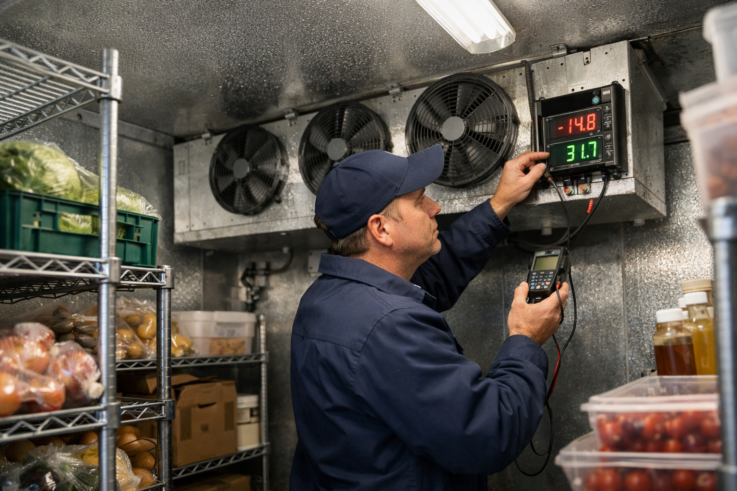
Walk-In Cooler Temperature Fluctuations: Why It Gets Cold, Then Warm P
Short answer: why a walk-in cooler gets cold, then warm again
Walk-in cooler temperature fluctuations in Massachusetts businesses usually happen when the system can make cold air but cannot maintain stable temperature. Common causes include restricted airflow, heavy door traffic, faulty thermostats or sensors, defrost problems, failing evaporator or condenser fans, dirty coils, refrigerant issues, or compressor/electrical faults. If product temperature is rising or swings repeat, call a commercial refrigeration technician.
When a walk-in cooler gets cold for a while and then warms back up, it can be more confusing than a cooler that simply stops cooling. The equipment seems to work, the evaporator may blow cold air, and the thermostat may eventually satisfy. Then, during the next rush, overnight cycle, defrost period, or delivery, the box temperature climbs again. For restaurants, grocery stores, liquor stores, convenience stores, hotels, commercial kitchens, and facilities in Massachusetts, that kind of unstable performance can threaten inventory, disrupt prep schedules, and create stress before inspections or service periods.
Royal Cooling helps businesses troubleshoot and repair commercial refrigeration problems, including walk-in coolers, walk-in freezers, reach-in refrigerators, wine coolers, freezer repair, and preventive refrigeration maintenance. If your walk-in cooler is not holding temperature in the Boston metro area, Worcester County, Middlesex County, Suffolk County, or nearby Massachusetts communities such as Boston, Worcester, Cambridge, Lowell, Springfield, Quincy, Newton, Waltham, or Framingham, this guide explains what may be happening and when to schedule professional service.
Temperature fluctuation is not the same as one warm reading
A single warm reading can happen after a delivery, after the door has been open for loading, or when warm product is placed inside. Restaurant cooler temperature swings become a service concern when the pattern repeats: cold, warm, cold again, warm again. This pattern suggests the refrigeration system may be cycling incorrectly, losing heat transfer capacity, or being overwhelmed by conditions in and around the box.
A healthy walk-in cooler does cycle. It does not run every second of the day. The thermostat or controller calls for cooling, the condensing unit and fans run, the box temperature drops, and the system shuts off or unloads when the setpoint is reached. A problem begins when the swing is too wide, too frequent, or too slow to recover. If a cooler is set near 38°F but repeatedly climbs well above its normal operating range before recovering, the issue should be investigated.
Normal cycling vs. problem cycling
The table below can help you separate routine operation from a commercial cooler that cycles warm and cold because of a developing fault.
| Observation | Often normal | Possible problem |
|---|---|---|
| Temperature rises briefly after a delivery | Box recovers within a reasonable time after the door closes and product stabilizes | Temperature continues to climb, recovery takes too long, or alarms repeat after every delivery |
| System turns on and off during the day | Equipment cycles to maintain setpoint | Short cycling, long off cycles, or repeated warm periods before the system restarts |
| Evaporator coil has light frost | Light, even frost may occur during normal operation | Heavy ice, blocked coil, water dripping, or fans unable to move air |
| Temperature varies by shelf location | Small differences can occur with product load and airflow | Hot spots near the door, blocked fans, poor air circulation, or product stacked against walls |
| Cooler warms during busy service | Minor rise from normal door openings | Large swings caused by high door traffic, bad gaskets, weak door closers, or undersized capacity |
Common causes of a walk-in cooler that gets cold, then warm
1. Door openings, air leaks, and infiltration
Yes, frequent door openings can make a walk-in cooler fluctuate in temperature. Every time the door opens, warm, humid air enters and cold air spills out. In a busy Boston restaurant, Cambridge cafe, Quincy hotel kitchen, or Waltham convenience store, repeated door traffic during prep, stocking, and service can create a load the system must remove. If the door closer is weak, the door is propped open, strip curtains are missing, or gaskets are not sealing, the cooler may cool down during quiet periods and warm up during high-use periods.
Door issues also add moisture. Moisture can freeze on evaporator coils, strain the defrost system, and create ice that reduces airflow. The result may look like a refrigeration problem when the original trigger is warm air entering the box.
2. Blocked airflow inside the box
Walk-in coolers depend on air movement. If cases, kegs, produce boxes, pans, or storage racks block the evaporator discharge or return air path, cold air cannot circulate. One area may feel cold while another warms up. Product stacked tight against walls or too close to the evaporator can cause short cycling because the thermostat senses one temperature while the rest of the box remains warmer.
During basic walk-in cooler troubleshooting, look for blocked fans, items placed directly in the air stream, and overpacked shelves. Do not move product in a way that creates unsafe storage conditions, but do give the evaporator room to breathe.
3. Dirty condenser coil or poor outdoor/indoor condensing unit ventilation
The condenser rejects heat from the refrigerated space. If the condenser coil is dirty, blocked by debris, exposed to grease, or installed in a hot mechanical area with limited ventilation, the refrigeration system may cool at first and then struggle as pressures rise. This can lead to longer run times, nuisance trips, high head pressure, and inconsistent temperatures.
Massachusetts businesses can see seasonal effects too. Summer heat, kitchen exhaust, construction dust, pollen, and winter debris around outdoor equipment can all reduce heat transfer. Regular coil cleaning and preventive maintenance help keep the system stable before peak load periods.
4. Evaporator fan or condenser fan problems
A failing fan motor, loose blade, intermittent relay, or bad capacitor can create temperature swings. If an evaporator fan stops intermittently, the coil may get cold but the box will not receive enough cold air. If a condenser fan is weak or cycling erratically, the system may run normally for a while and then trip or lose capacity. Fan problems are common reasons a commercial cooler cycles warm and cold.
Do not reach into operating fan assemblies or bypass controls. If you hear grinding, rattling, buzzing, or fans that start and stop unpredictably, schedule service.
5. Defrost control issues
Walk-in coolers use defrost controls to manage frost on the evaporator coil. A defrost timer, controller, termination sensor, heater, drain, or relay problem can cause the system to spend too long in defrost, fail to defrost, or restart incorrectly. If the cooler warms at about the same times each day, defrost scheduling may be involved.
Too much defrost can warm the box. Too little defrost can allow ice to block airflow until the cooler warms even though the refrigeration circuit is trying to operate. A technician can check defrost frequency, termination temperature, heater operation, coil condition, and drain performance.
6. Thermostat, temperature sensor, or control calibration problems
If the controller is reading the wrong temperature, placed poorly, or operating with a failing sensor, the system may shut off too soon or wait too long before calling for cooling. This may produce wide swings even when mechanical components are capable of cooling. In some cases, the display temperature may not match an independent thermometer in the box.
Controls should be tested, not guessed. A commercial refrigeration technician in Massachusetts can compare sensor readings, check setpoints and differentials, inspect wiring, and confirm whether the control is actually energizing the equipment when it should.
7. Refrigerant charge, restriction, or leak concerns
Low refrigerant charge, a metering device issue, a restriction, or a leak can allow the system to cool partially but not reliably. You may notice longer run times, uneven frost patterns, warmer product, or a cooler that recovers slowly after door openings. Refrigerant issues require proper tools, training, and compliance with applicable handling rules. They are not a do-it-yourself repair.
8. Compressor, contactor, capacitor, or electrical faults
Electrical problems can be intermittent. A weak capacitor may allow a motor to start sometimes and fail at other times. A pitted contactor may chatter. A compressor may trip on internal overload and restart after cooling. Loose connections, voltage problems, and failing safety controls can all create a cold-then-warm pattern. These conditions should be checked promptly because they can worsen and lead to downtime.
What you can check before calling for service
Before requesting walk-in cooler repair, there are a few safe observations that can help your technician diagnose faster. Do not remove electrical panels, bypass safeties, chip ice with sharp tools, or handle refrigerant. Instead, document what you see.
- Record box temperature readings and the time of day they occur.
- Note whether swings happen during deliveries, lunch rush, dinner service, overnight, or after defrost cycles.
- Check that the door closes fully and is not being propped open.
- Look for blocked evaporator fans or product stacked too close to the coil.
- Listen for unusual fan, compressor, buzzing, clicking, or rattling sounds.
- Look for heavy ice on the evaporator, water on the floor, or drain backups.
- Confirm the thermostat setpoint has not been changed accidentally.
- Check whether the condenser area is blocked by boxes, trash, snow, leaves, or storage.
If you manage multiple locations in Massachusetts, create a simple log for each cooler. A pattern in Boston may differ from a location in Worcester, Newton, Lowell, or Framingham depending on equipment age, kitchen heat, door traffic, and product loading.
When should you call a technician for a walk-in cooler that will not hold temperature?
Call a technician when the cooler repeatedly rises above its normal operating range, fails to recover after doors are closed, shows ice buildup, trips breakers, makes unusual noises, leaks water, displays alarms, or threatens inventory. If product temperature is unsafe or you are unsure whether food, beverages, flowers, ingredients, or other inventory can be held, follow your internal safety procedures and applicable inspection guidance.
High service-call intent is appropriate here because repeated swings usually do not fix themselves. A commercial refrigeration technician Massachusetts businesses trust can test the system under operating conditions and identify whether the root cause is airflow, controls, refrigerant, defrost, electrical, or compressor related. For urgent symptoms, ask about emergency refrigeration repair availability by calling Royal Cooling at 781-899-4441.
What Royal Cooling checks during a professional diagnosis
When Royal Cooling evaluates a walk-in cooler not holding temperature, the goal is to find the cause instead of only resetting the alarm. Depending on the equipment and symptoms, a technician may check:
- Temperature readings at multiple points in the box and at the controller.
- Thermostat setpoint, differential, sensor accuracy, and control sequence.
- Evaporator coil condition, frost pattern, fan operation, and airflow.
- Condenser coil cleanliness, condenser fan operation, and ventilation.
- Refrigeration pressures, superheat, subcooling, and signs of restriction or leak conditions where appropriate.
- Defrost timer or controller settings, termination controls, heaters, and drain performance.
- Compressor operation, amperage, contactors, capacitors, relays, safeties, and wiring condition.
- Door operation, gaskets, closers, strip curtains, thresholds, and infiltration sources.
- Box usage patterns, product loading, and heat-producing conditions around the equipment.
This process applies across many commercial environments: restaurants in Boston, supermarkets in Worcester County, convenience stores in Middlesex County, hotels in Suffolk County, commercial kitchens in Cambridge, liquor stores in Quincy, and facilities in Waltham or Framingham. Royal Cooling also services related equipment such as walk-in freezer service, reach-in refrigerators, wine coolers, and freezer repair.
Repair vs. replacement: how to think about the decision
Not every temperature fluctuation means the walk-in cooler must be replaced. Many issues are repairable: failed fan motors, bad sensors, dirty coils, defrost control faults, door hardware, contactors, and some refrigerant-related problems. Replacement or major upgrade discussions become more practical when the box or system is older, repairs are frequent, components are obsolete, energy use is high, insulation is compromised, or the equipment no longer matches the business load.
For example, a restaurant that expanded prep volume may be asking an older cooler to handle more door traffic and product loading than it was designed for. A liquor store adding more chilled inventory may need better airflow or capacity. A hotel kitchen with heavy banquet use may need maintenance changes, control adjustment, or equipment planning. Royal Cooling can help weigh repair cost, downtime risk, equipment condition, and operational needs without pushing unnecessary replacement.
Emergency warning signs
Some symptoms deserve faster attention. Call for service promptly if the cooler will not recover, the compressor repeatedly trips, breakers trip, electrical odors are present, fans are not running, heavy ice blocks the coil, water is creating a slip hazard, or product temperature is rising during business hours. If you have a critical inventory load, do not wait until the next day to begin troubleshooting and making contingency plans.
For urgent commercial refrigeration concerns in Massachusetts, contact Royal Cooling at 781-899-4441 or use the contact page. To understand whether your location is in range for service, visit the service area page.
How to reduce future temperature swings
Preventive steps help reduce callbacks, spoiled inventory, and stress during peak service. Train staff to keep doors closed, avoid blocking fans, report alarms early, and avoid loading hot product directly into the cooler when possible. Keep the condenser area clear. Schedule periodic cleaning and inspection. Replace worn gaskets and weak closers before they create larger refrigeration problems. Review defrost schedules after menu changes, delivery changes, or seasonal conditions.
A planned preventive maintenance visit can include coil inspection, fan checks, temperature verification, electrical inspection, defrost review, drain checks, and operating condition documentation. For Massachusetts businesses that rely on refrigeration every day, maintenance is often less disruptive than an unplanned breakdown during a dinner rush, delivery window, or holiday weekend.
FAQ: walk-in cooler temperature fluctuations
Why does my walk-in cooler get cold and then warm up again?
A walk-in cooler may get cold and then warm up because the system can produce cooling but cannot maintain it. Common causes include airflow restrictions, door leaks, faulty controls, defrost problems, dirty coils, fan failures, refrigerant issues, or compressor and electrical faults.
What causes a restaurant walk-in cooler to have temperature swings?
Restaurant cooler temperature swings often come from frequent door openings, heavy product loading, blocked evaporator airflow, worn gaskets, incorrect defrost operation, dirty condenser coils, or failing fans. Busy kitchens in Massachusetts may notice swings most during prep, deliveries, and service rushes.
When should I call a technician for a walk-in cooler that will not hold temperature?
Call a technician when temperature swings repeat, the cooler does not recover quickly, ice builds on the coil, alarms occur, fans or compressors act erratically, water leaks appear, or inventory is at risk. Repeated fluctuations usually need professional diagnosis.
Can frequent door openings make a walk-in cooler fluctuate in temperature?
Yes. Frequent door openings let warm, humid air enter the box and force the system to remove extra heat and moisture. Door traffic can become a bigger problem when gaskets, closers, strip curtains, or staff habits allow the door to stay open too long.
Is a fluctuating walk-in cooler always a refrigerant leak?
No. Refrigerant problems can cause unstable temperatures, but so can airflow issues, dirty coils, bad sensors, defrost faults, fan problems, or door infiltration. A technician should test the system before adding refrigerant or assuming there is a leak.
How can preventive maintenance help a walk-in cooler hold temperature?
Preventive maintenance helps by keeping coils clean, fans operating, drains clear, controls accurate, defrost cycles appropriate, and electrical components in good condition. It also helps identify worn gaskets, airflow problems, and early component failures before downtime occurs.
Does Royal Cooling service walk-in coolers outside Boston?
Royal Cooling serves Massachusetts businesses in the Boston metro area and nearby counties, with city examples including Boston, Worcester, Cambridge, Lowell, Springfield, Quincy, Newton, Waltham, and Framingham. Check the service area page or call to discuss your location.
Schedule walk-in cooler troubleshooting in Massachusetts
If your commercial cooler cycles warm and cold, do not rely on guesswork or repeated resets. Royal Cooling provides commercial refrigeration service for walk-in coolers, walk-in freezers, reach-in refrigerators, wine coolers, and related equipment for restaurants, stores, hotels, facilities, property managers, and commercial kitchens. For help with walk-in cooler temperature fluctuations Massachusetts businesses are dealing with, call 781-899-4441 or request service through the Royal Cooling contact page.