Commercial Refrigeration Emergency Service in Massachusetts: What to顮p
Short answer: During an emergency refrigeration repair Massachusetts visit, a Royal Cooling technician first verifies the equipment, temperature risk, power, airflow, controls, refrigerant indicators, defrost system, doors, drains, and visible mechanical issues. The goal is to stabilize the box, diagnose the failure, complete safe repairs when possible, and explain next steps if parts or further work are needed.
When a commercial cooler or freezer stops holding temperature, every minute feels expensive. A restaurant in Boston may be trying to protect prep inventory before dinner service. A liquor store in Waltham may have a warm beer cave or wine cooler that is affecting product quality. A hotel in Cambridge may have a reach-in refrigerator down in a banquet kitchen. A market in Quincy, Worcester, Lowell, Springfield, Newton, or Framingham may be watching case temperatures climb while staff decide what to move, what to document, and who to call.
This guide explains what happens during the first visit for commercial refrigeration emergency service, what information you should gather before dispatch, and how a commercial refrigeration technician Massachusetts businesses rely on typically approaches urgent refrigeration problems. It is written for restaurants, commercial kitchens, supermarkets, grocery stores, convenience stores, liquor stores, hotels, facility managers, property managers, and homeowners with specialty wine coolers or freezers.
If your walk-in cooler, walk-in freezer, reach-in refrigerator, wine cooler, prep table, or commercial freezer is failing now, contact Royal Cooling at 781-899-4441 or use the contact page. If you are comparing coverage areas, visit the Royal Cooling service area page for Massachusetts service context.
When Is a Commercial Refrigeration Issue Urgent Enough for Emergency Service?
Not every refrigeration issue needs an emergency call, but many do. The difference usually comes down to product safety, business interruption, equipment damage, and whether the temperature trend is getting worse. For food-service and retail operations, a warm box can become a product-loss and compliance problem quickly, especially when doors are opening during service hours or deliveries.
Call for emergency refrigeration repair when you see any of the following conditions:
- Walk-in cooler temperature rising and not recovering: If the cooler is above your safe operating target and continues to climb after doors are closed, you may need walk-in cooler emergency repair.
- Walk-in freezer softening product: Ice cream, seafood, meat, frozen bakery products, or other inventory beginning to soften can justify walk-in freezer emergency service.
- Unit running but not cooling: Fans may run while a compressor, refrigerant circuit, defrost system, control, or condenser problem prevents cooling.
- No power to the equipment: A tripped breaker, failed disconnect, control failure, damaged wiring, or building electrical issue may be involved. Do not repeatedly reset a breaker that trips again.
- Alarms, error codes, or controller faults: Digital controls can identify high temperature, probe failure, defrost faults, pressure problems, or communication issues.
- Heavy ice, frost, or airflow blockage: A frozen evaporator coil can prevent air from moving through the box and may point to defrost, door, fan, refrigerant, or infiltration issues.
- Water leaks or drain backups: Standing water around a case, cooler, or freezer can create slip hazards and may indicate clogged drains, pan problems, freeze-ups, or improper condensate removal.
- Burning smell, buzzing, repeated clicking, or hot components: Shut down equipment if safe to do so and call for service. Electrical symptoms should not be ignored.
If you are unsure whether the issue is urgent, call and describe the symptoms. A short conversation can help determine whether dispatch is appropriate, what equipment is affected, and what you can safely do while waiting.
What Information Should Restaurants Gather Before Calling for Emergency Refrigeration Repair?
Before calling for restaurant refrigeration repair or commercial cooler service, gather the information that helps a technician arrive prepared. You do not need to diagnose the problem yourself. The goal is to reduce delays, improve dispatch accuracy, and help the technician understand the equipment and urgency before arriving.
Helpful information to have ready
- Business name, address, and access instructions: Include loading dock details, rear entrance codes, parking limitations, and after-hours contact names.
- Equipment type: Walk-in cooler, walk-in freezer, reach-in refrigerator, prep table, wine cooler, beer cave, ice machine, display case, or specialty freezer.
- Location on site: Kitchen line, basement, roof-connected condensing unit, mechanical room, storage area, bar, market floor, or outdoor enclosure.
- Current temperature and normal setpoint: Provide both if you have them. Also note whether the temperature is rising, falling, or fluctuating.
- When the problem started: Overnight, after a delivery, after cleaning, after a power interruption, during peak service, or after a previous alarm.
- Symptoms: Warm air, no fans, loud noise, ice buildup, water leak, short cycling, breaker trip, high-pressure reset, error code, compressor not starting, or doors not sealing.
- Photos if available: Controller display, equipment nameplate, ice buildup, leaking area, alarm screen, or damaged door gasket.
- Model and serial number: The equipment nameplate may be inside a reach-in, near a condensing unit, on a cooler panel, or on a manufacturer tag.
- Recent work or changes: New shelving, recent maintenance, door repairs, thermostat changes, condenser cleaning, construction dust, or product loading changes.
- Product risk: Let the dispatcher know if you have high-value inventory, food safety concerns, medication storage, wine inventory, or event-related demand.
For restaurants and commercial kitchens, designate one person who can authorize work, answer questions, and point the technician to electrical panels, roof access, equipment rooms, and temperature logs. For hotels, supermarkets, and multi-tenant properties, facility managers should coordinate building access and confirm which assets are affected.
What Happens When a Refrigeration Technician Arrives for an Emergency Repair?
The first visit is usually a structured process: verify the complaint, protect the site, diagnose the failure, make repairs when possible, and communicate findings. A qualified commercial refrigeration technician does not simply add refrigerant or replace parts without checking the system. Emergency service is urgent, but it still needs to be methodical.
1. Site check, safety, and urgency confirmation
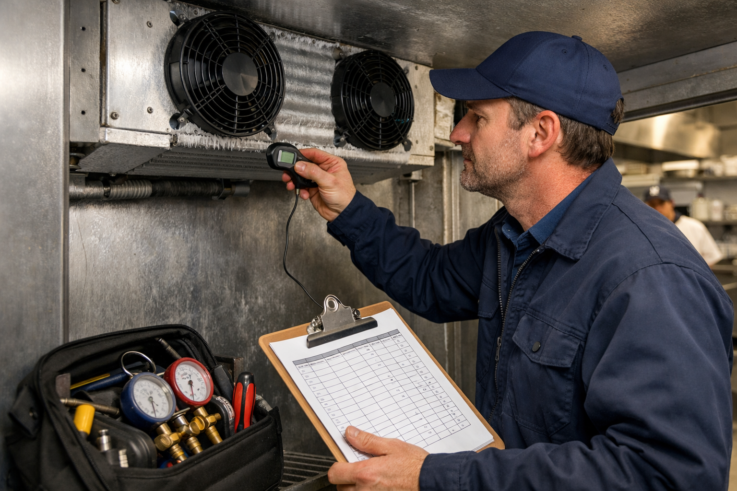
After arrival, the technician confirms the equipment, listens to the customer’s description, and checks the immediate conditions. They may ask what the temperature was earlier, whether staff moved product, whether the unit has been reset, and whether any breakers or disconnects were touched.
Safety matters. The technician may inspect for water around electrical components, damaged wiring, hot compressor surfaces, blocked exits, ceiling or roof access hazards, or signs of refrigerant oil. If a condition is unsafe, the first recommendation may be to shut equipment down until it can be serviced safely.
2. Temperature, airflow, and box-condition checks
Next, the technician verifies temperature with appropriate instruments and checks airflow. A walk-in cooler can feel cold near the evaporator but still fail to maintain an even box temperature if fans are not moving air, the coil is frozen, product is stacked too tightly, or the door is leaking warm humid air.
Common checks include:
- Supply and return air temperature readings
- Evaporator fan operation and direction
- Air restrictions from product stacking or blocked grilles
- Door gasket condition, door closer operation, and threshold gaps
- Ice or frost pattern on evaporator coil
- Drain line condition and pan icing
- Controller display, sensor readings, and alarm history
In Massachusetts, seasonal conditions can influence diagnosis. Humid summer air in Boston metro kitchens can worsen door-sweat and coil-frost problems. Cold outdoor weather can affect head-pressure controls on remote condensing units. Older buildings in Suffolk County, Middlesex County, or Worcester County may also have access, ventilation, and electrical-panel constraints that affect troubleshooting.
3. Electrical and controls diagnostics
Electrical checks are central to emergency commercial refrigeration repair. A technician may verify incoming voltage, control voltage, fuses, contactors, relays, pressure controls, overloads, capacitors, defrost timers, electronic controllers, temperature probes, and wiring connections. If the compressor is not starting, the problem may be a failed start component, control issue, safety lockout, compressor winding fault, or supply-voltage problem.
Repeated breaker trips, burned wires, buzzing contactors, and melted terminals are urgent symptoms. These issues are not solved by resetting the breaker over and over. A technician needs to identify why the electrical protection is opening before returning equipment to service.
4. Refrigerant-side and mechanical checks
Refrigeration systems remove heat by moving refrigerant through a compressor, condenser, metering device, and evaporator. If the system is not cooling, the technician may check pressure readings, superheat, subcooling, refrigerant line temperatures, condenser fan operation, coil cleanliness, compressor amperage, sight glass condition where applicable, and signs of oil staining that may indicate a leak.
A low refrigerant condition is often a symptom, not the root cause. If refrigerant is low, the system may have a leak that needs to be found and repaired. If the condenser is dirty or blocked, the system may operate at high pressure and shut down. If a metering device is restricted, the evaporator may starve for refrigerant. If a compressor has failed mechanically, more extensive repair or replacement may be required.
5. Defrost system and ice-related diagnostics
For walk-in freezers and many low-temperature applications, the defrost system is critical. If defrost heaters, termination sensors, fan delay controls, drain heaters, or timers fail, ice can build until airflow stops. In coolers, ice buildup may result from door leaks, failed fans, refrigerant charge issues, control problems, or constant infiltration of warm humid air.
During a first visit, a technician may need to safely remove enough ice to restore airflow or access components. Heavy ice removal can take time and may reveal additional issues once the coil is clear.
Emergency Visit Priorities: What the Technician Is Trying to Determine
| Priority | What the technician checks | Why it matters |
|---|---|---|
| Product and temperature risk | Box temperature, product condition, setpoint, alarm history, door activity | Helps determine urgency, stabilization steps, and whether product should be moved or monitored |
| Power and controls | Breaker, disconnect, voltage, controller, sensors, contactors, relays, safeties | Many no-cooling calls start with electrical or control failures rather than major mechanical failure |
| Airflow | Evaporator fans, blocked coils, blocked shelves, product stacking, condenser airflow | Poor airflow can make a working refrigeration system look like it has a deeper cooling problem |
| Refrigerant circuit | Pressures, line temperatures, compressor operation, condenser, metering device, leak indicators | Determines whether the system can move heat properly and whether leaks or restrictions are likely |
| Defrost and drainage | Defrost heaters, timers, probes, drain lines, drain heaters, pan icing | Ice and water issues are common emergency causes in walk-in cooler repair and freezer service |
| Repair feasibility | Parts availability, equipment age, accessibility, failure severity, safety concerns | Helps decide whether the first visit can restore operation or whether follow-up work is needed |
Can a Technician Diagnose a Walk-In Cooler Problem on the First Visit?
In many cases, yes. A technician can often diagnose a walk-in cooler problem on the first visit because common failures have measurable symptoms: voltage, control status, fan operation, coil temperature, pressure readings, refrigerant line temperatures, compressor amperage, door condition, and defrost operation. A first-visit diagnosis is especially likely when the failure is active and accessible.
However, some problems require more time or follow-up. Intermittent faults may not appear while the technician is on site. A refrigerant leak may require leak-search procedures after enough evidence confirms a low-charge condition. A compressor failure may require additional testing and replacement planning. A specialty controller, fan motor, door hardware, evaporator coil, condensing unit component, or manufacturer-specific part may need to be sourced.
The best first visit gives you a clear answer to three questions: What is failing? What can be safely done now? What is the recommended next step if a permanent repair cannot be completed immediately?
Common Problems Found During Emergency Refrigeration Repair in Massachusetts
Royal Cooling’s commercial refrigeration work may involve many equipment types, from walk-in coolers and walk-in freezers to reach-in refrigerators, wine coolers, freezer repair, and preventive refrigeration maintenance. While every system is different, emergency calls often fall into several categories.
Door and air infiltration problems
Damaged gaskets, weak hinges, failed door closers, missing sweeps, and doors left open during deliveries allow warm humid air into the box. That air adds heat load and moisture. The result can be sweating walls, ice buildup, long run times, and warm product. Door problems are especially common in busy restaurant kitchens and markets where staff enter the cooler frequently.
Dirty or blocked condenser coils
Condensers reject heat. If the coil is packed with grease, dust, lint, leaves, cottonwood, construction debris, or rooftop grime, the system may run hot, trip on pressure, lose efficiency, or fail to recover temperature. This is a common issue for restaurants in dense Boston, Cambridge, and Quincy environments as well as properties with limited mechanical-room airflow.
Evaporator fan or airflow failure
If evaporator fans fail, the box may be cold in one area and warm in another. Product may block air paths, shelving may be too close to the coil, or fan motors may be iced, seized, or electrically failed. Airflow diagnosis is essential before assuming the compressor is the problem.
Defrost failure in freezers
Walk-in freezers depend on reliable defrost. Failed heaters, controls, drain heaters, sensors, or timers can create heavy ice that blocks airflow. A freezer may run constantly but still warm up because cold air cannot move through the coil.
Control, sensor, and thermostat issues
A bad temperature sensor, miscalibrated thermostat, failed controller, loose wiring, or incorrect settings can cause short cycling, overcooling, undercooling, or no call for cooling. Control issues are often repairable, but they need to be verified against actual temperature readings.
Refrigerant leaks or restrictions
A low refrigerant charge, leak, plugged filter drier, restricted metering device, or moisture contamination can reduce cooling. A technician should avoid treating refrigerant loss as a one-time event without considering leak location and repair options.
Compressor or condensing-unit failure
Compressor failures are among the more serious emergency findings. Symptoms can include locked rotor, high amperage, internal winding issues, loud operation, overheating, or failure to pump. Depending on equipment condition, age, refrigerant type, and availability, the recommendation may involve repair, compressor replacement, condensing-unit replacement, or broader system evaluation.
Repair Now or Replace? How the First Visit Helps You Decide
Emergency service is usually focused on restoring operation, but the first visit can also reveal whether the equipment is nearing the point where replacement should be considered. A repair may make sense when the system is generally sound, the failure is isolated, parts are available, and the equipment still fits your business needs. Replacement may be worth discussing when the equipment has repeated failures, major refrigerant leaks, severe corrosion, obsolete components, oversized or undersized capacity, or compressor failure on an aging system.
A technician should explain the practical tradeoffs: immediate repair cost, product-risk exposure, likely reliability, downtime, access challenges, and whether preventive maintenance could reduce repeat calls. For a high-demand restaurant cooler or supermarket freezer, reliability can be just as important as the one-time repair price.
What You Can Do While Waiting for Service
While waiting for a technician, do only what is safe and allowed by your internal procedures. In many cases, the best steps are simple: keep doors closed, reduce traffic into the box, document temperatures, move product to another working unit if appropriate, and avoid unnecessary resets.
- Do not prop cooler or freezer doors open to “air it out.”
- Do not chip ice from coils with knives or sharp tools.
- Do not keep resetting a breaker or overload that trips repeatedly.
- Do not block evaporator fans with boxes in an attempt to save space.
- Do record temperatures, times, alarms, and actions taken.
- Do clear access to the equipment, electrical panels, roof hatch, and mechanical areas.
Food-safety decisions should be made according to your policies and applicable regulatory guidance. A refrigeration technician can diagnose and repair equipment, but your operation is responsible for product handling decisions.
How Preventive Maintenance Reduces Refrigeration Emergencies
Emergency calls cannot always be avoided, but preventive maintenance can reduce many common failures. Regular service can identify weak fan motors, dirty coils, failing door gaskets, clogged drains, loose electrical connections, inaccurate controls, abnormal pressure readings, and early compressor stress before they become urgent.
For Massachusetts businesses with seasonal load swings, preventive refrigeration maintenance is especially valuable before summer heat and before high-volume periods. Restaurants, hotels, grocery stores, liquor stores, and convenience stores often benefit from scheduled inspections that include condenser cleaning, evaporator checks, drain clearing, defrost verification, gasket review, control calibration, and temperature-performance checks.
If your business has had multiple emergency calls for the same walk-in cooler or freezer, ask Royal Cooling about maintenance options during your repair conversation. A planned maintenance visit is usually easier to schedule than an emergency shutdown during service hours.
Massachusetts Service Context: Boston Metro and Nearby Counties
Royal Cooling supports commercial refrigeration needs across Massachusetts service areas, including Boston metro and nearby counties such as Middlesex County, Suffolk County, and Worcester County. Service-area examples include Boston, Worcester, Cambridge, Lowell, Springfield, Quincy, Newton, Waltham, and Framingham. These references describe service context and customer locations; they do not imply a separate office in every city.
Different Massachusetts properties create different refrigeration challenges. A compact Boston restaurant may have rooftop condensing units and tight kitchen access. A Cambridge lab-adjacent property or hotel kitchen may have strict facility-access rules. A Waltham office campus, Quincy market, Worcester grocery store, or Framingham restaurant may need coordination with property managers, loading docks, and building engineers. The more access details you provide during the call, the smoother the first visit can be.
When to Call Royal Cooling
Call Royal Cooling for emergency refrigeration repair Massachusetts service when a commercial refrigeration problem threatens product, interrupts operations, creates unsafe electrical or water conditions, or prevents a cooler or freezer from maintaining temperature. Royal Cooling works with commercial refrigeration, walk-in freezers, walk-in coolers, wine coolers, reach-in refrigerators, freezer repair, and preventive refrigeration maintenance needs for Massachusetts businesses and property teams.
To request service, call 781-899-4441 or submit a request through the contact page. For coverage context, see the service area page. When you call, have your equipment type, location, temperature, symptoms, access details, and authorization contact ready if possible.
FAQ: Commercial Refrigeration Emergency Service in Massachusetts
What should I expect when a refrigeration technician arrives for an emergency repair?
Expect the technician to confirm the equipment and symptoms, check temperatures, inspect power and controls, evaluate airflow, look for ice, leaks, alarms, and mechanical problems, then explain the likely cause and repair options. If the repair can be completed safely with available parts, the technician may restore operation during the first visit.
What information should restaurants gather before calling for emergency refrigeration repair?
Restaurants should gather the equipment type, current temperature, normal setpoint, when the problem started, symptoms, alarm codes, model and serial number if available, access instructions, and whether product is at risk. Photos of the controller, nameplate, ice buildup, or leak can also help.
Can a technician diagnose a walk-in cooler problem on the first visit?
Often, yes. Active failures such as fan problems, control issues, dirty condensers, defrost faults, electrical failures, and refrigerant-side symptoms can often be diagnosed on the first visit. Intermittent faults, refrigerant leaks, or specialty-part failures may require additional testing or follow-up work.
When is a commercial refrigeration issue urgent enough for emergency service?
Call for emergency service when temperatures are rising and not recovering, product is at risk, a walk-in freezer is softening inventory, electrical components smell hot or trip breakers, water is creating hazards, the unit has stopped cooling, or alarms indicate a high-temperature or system fault.
Should I turn off my walk-in cooler or freezer before the technician arrives?
Only shut equipment off if it appears unsafe, such as a burning smell, electrical arcing, repeated breaker trips, severe water near electrical parts, or instructions from a qualified professional. Otherwise, keep doors closed, reduce traffic, record temperatures, and wait for service guidance.
Does emergency refrigeration repair always fix the problem on the first visit?
No. Many problems can be repaired during the first visit, but completion depends on the failure, safety conditions, access, parts availability, and equipment condition. The first visit should still provide diagnosis, stabilization options, and a clear recommendation for permanent repair if follow-up is needed.
What types of businesses call for commercial refrigeration emergency service?
Restaurants, commercial kitchens, supermarkets, grocery stores, convenience stores, liquor stores, hotels, facility managers, property managers, and homeowners with wine coolers or specialty freezers may call when refrigeration equipment is not maintaining temperature or has failed unexpectedly.
How can I prevent repeat walk-in cooler emergency repair calls?
Schedule preventive maintenance, keep condenser coils clean, maintain door gaskets and closers, avoid blocking evaporator fans, clear drains, monitor temperatures, respond to alarms early, and fix small issues before they become product-threatening failures.
Need Emergency Refrigeration Help in Massachusetts?
If your commercial cooler, freezer, walk-in, reach-in, wine cooler, or refrigeration system is failing, Royal Cooling can help you understand the next step and schedule service based on your situation. Call 781-899-4441 or use the contact page to request assistance. For service-area details in Massachusetts, visit /service-area/.