Commercial Refrigeration Service Contracts in Massachusetts: What to-Š
Short Answer: What Should a Commercial Refrigeration Service Contract Include?
A commercial refrigeration service contract in Massachusetts should include covered equipment, preventive maintenance tasks, inspection frequency, priority service process, emergency refrigeration repair coverage, labor and parts terms, exclusions, documentation, and technician qualifications. For restaurants, grocery stores, liquor stores, hotels, and facilities, the best refrigeration service plan is clear, practical, and focused on reducing downtime before product, revenue, or operations are at risk.
For many Massachusetts businesses, refrigeration is not just another building system. It is the system that protects food inventory, beverage quality, frozen product, kitchen workflow, and customer experience. A walk-in cooler running warm in a Boston restaurant, a reach-in refrigerator failing in a Cambridge café, or a walk-in freezer icing up in a Worcester County market can create urgent decisions quickly. That is why comparing a commercial refrigeration service contract Massachusetts businesses can rely on should go beyond price. The real question is: what happens before there is a breakdown, during a temperature problem, and after a technician leaves?
Royal Cooling works with commercial refrigeration customers across Massachusetts who need planned maintenance plus responsive repair support. Whether you operate a restaurant, commercial kitchen, liquor store, convenience store, supermarket, hotel, or managed facility, the right commercial refrigeration maintenance agreement should make expectations clear before you sign.
Why Refrigeration Service Contracts Matter in Massachusetts
Massachusetts refrigeration systems work through humid summers, cold winters, busy holiday inventory periods, and high-use kitchen schedules. Equipment in Boston metro restaurants, Middlesex County grocery stores, Suffolk County hotels, and Worcester-area food service spaces may run nearly nonstop. Even well-installed systems wear down as coils collect debris, door gaskets loosen, drain lines clog, fan motors weaken, refrigerant leaks develop, and controls drift out of calibration.
A service contract is not a guarantee that equipment will never fail. It is a structured plan to reduce avoidable failures, identify small issues earlier, document system condition, and give your business a defined process when service is needed. A basic one-time inspection can tell you what is happening today. A true preventive refrigeration maintenance relationship tracks changes over time, such as rising compressor amperage, recurring ice buildup, frequent high-temperature alarms, or a walk-in cooler that gradually takes longer to recover after deliveries.
For Massachusetts restaurants and food retailers, this can be especially important because refrigeration problems tend to appear at inconvenient times: after a dinner rush, during a weekend delivery, before an event, or when staff members are least prepared to troubleshoot. A refrigeration service plan gives owners and facility managers a more predictable way to manage risk.
What a Commercial Refrigeration Service Contract Should Include Before You Sign
Before you approve a contract, ask for the details in writing. A strong agreement should explain what is covered, how often your equipment will be inspected, what maintenance tasks are performed, and what happens when a repair is needed. The following items should be included or clearly addressed.
1. A Clear List of Covered Equipment
The contract should identify each piece of equipment included in the plan. That may include walk-in coolers, walk-in freezers, reach-in refrigerators, prep tables, undercounter units, display cases, wine coolers, ice machines, beer systems, freezer rooms, and remote condensing units. For each item, the agreement should ideally list location, model, serial number if available, operating temperature range, and any known concerns.
This matters because commercial buildings often have mixed equipment. A restaurant in Quincy may have a walk-in cooler, a low-temperature freezer, several reach-ins, and a wine cooler. A liquor store in Waltham may be more concerned with beverage cases and humidity-sensitive wine storage. A hotel in Newton may need kitchen refrigeration plus event-space or bar equipment. If equipment is not listed, you should not assume it is covered.
2. Defined Preventive Maintenance Tasks
A useful refrigeration service plan should name the actual tasks a commercial refrigeration technician performs. Look for specifics such as condenser coil cleaning, evaporator coil inspection, fan operation checks, door gasket inspection, drain pan and drain line review, thermostat or controller checks, defrost timer review, electrical connection inspection, refrigerant pressure evaluation when appropriate, compressor operation checks, temperature verification, and general equipment condition notes.
Vague language such as “inspect system” may not be enough. Preventive maintenance should be action-oriented. For example, a dirty condenser coil can cause high head pressure, hotter compressor operation, poor cooling, and premature component stress. A damaged door gasket can pull humid air into a walk-in freezer and create frost, longer run times, and temperature swings. A clogged drain can lead to water on the floor, ice hazards, odors, or repeated service calls.
3. Inspection Frequency by Equipment Type
How often should a technician inspect walk-in coolers and freezers under a service plan? It depends on equipment load, environment, hours of operation, product sensitivity, and age. Many commercial systems benefit from planned inspections at least quarterly, while high-use kitchens, grocery stores, and critical freezers may need more frequent visits. Seasonal checks can also be helpful before the heavy cooling demands of summer.
The contract should state the planned visit frequency and whether visits are monthly, quarterly, semiannual, seasonal, or customized. It should also clarify if all equipment is serviced at every visit or if tasks rotate by priority.
| Equipment Type | Common Inspection Frequency | Key Items a Technician Checks | Why It Matters |
|---|---|---|---|
| Walk-in coolers | Quarterly for many businesses; more often for heavy-use kitchens | Temperature, door gaskets, evaporator fans, drains, coils, controls, refrigerant indicators | Helps reduce warm product, icing, water leaks, and compressor strain |
| Walk-in freezers | Quarterly or more often when frost, door traffic, or product value is high | Defrost operation, door heaters, gaskets, fan motors, ice patterns, suction line condition | Helps prevent ice buildup, soft product, and emergency freezer repair |
| Reach-in refrigerators and prep tables | Quarterly or semiannual depending on use and location | Coil cleanliness, airflow, thermostat accuracy, door seals, fans, temperature recovery | Supports kitchen workflow and consistent holding temperatures |
| Wine coolers and beverage cases | Semiannual to quarterly depending on sensitivity and dust exposure | Temperature stability, airflow, coils, drains, controls, door seals | Protects product quality and reduces nuisance service issues |
| Ice machines | Frequency depends on use, water quality, and sanitation needs | Filtration, scale, drains, bin condition, water lines, production concerns | Supports equipment reliability and cleanliness procedures |
4. Emergency Refrigeration Repair Coverage
Does a refrigeration service contract include emergency repairs? Sometimes, but not always. This is one of the most important details to verify. Some contracts include priority scheduling but bill emergency repairs separately. Others may include discounted labor rates, defined after-hours procedures, or a separate emergency refrigeration repair coverage option.
Your agreement should explain how to request urgent help, what phone number to call, whether after-hours service is available, what rates apply, what counts as an emergency, and whether contract customers receive priority status. Emergency signs may include a walk-in cooler above safe holding range, a walk-in freezer with thawing product, a compressor that will not start, repeated breaker trips, burning electrical odors, heavy ice blocking fans, water leaks creating slip hazards, or alarms that do not resolve after basic checks.
Royal Cooling can discuss planned maintenance and repair support needs for Massachusetts businesses. If you are comparing coverage options, ask about the process before a failure occurs. Do not wait until a Saturday night service issue to learn what the contract does or does not include.
5. Labor, Parts, and Pricing Terms
Not every maintenance agreement includes repair labor or parts. Some plans cover only scheduled maintenance visits. Others include preferred rates, waived trip charges for planned visits, or defined billing for diagnostics and repairs. Before signing, confirm whether belts, filters, cleaners, gaskets, fan motors, contactors, refrigerant, compressors, controls, and other materials are included, excluded, or billed separately.
A low-cost plan that only includes a quick visual check may not provide the value your business expects. On the other hand, a more detailed plan should be transparent about pricing, authorization steps, and repair recommendations. The goal is not surprise-free forever; it is clarity before work begins.
6. Documentation After Each Visit
Good service records help owners, managers, and property teams make better decisions. A maintenance agreement should include written or digital notes after each visit. Useful documentation may include equipment serviced, measured temperatures, observed symptoms, cleaning performed, parts recommended, photos when appropriate, urgent concerns, and suggested follow-up.
This is especially helpful for multi-unit operators, property managers, and facility managers who are not always on site. If a technician notes repeated frost on a freezer door, a failing gasket, or unusually dirty condenser coils, managers can address staff practices, cleaning access, or repair budgets before the problem becomes more expensive.
Basic Inspection vs. Preventive Maintenance Relationship
One reason business owners compare refrigeration contracts is that different providers use different definitions. A basic inspection may involve checking temperatures and visually reviewing equipment. That can be useful, but it is not the same as preventive maintenance.
A stronger preventive plan focuses on conditions that cause breakdowns. The technician looks for airflow restrictions, dirty coils, loose electrical connections, worn contactors, poor door closure, damaged hinges, weak fan motors, improper defrost patterns, blocked drains, short cycling, refrigerant leak symptoms, oil staining, unusual compressor noise, and controller errors. The technician may also ask staff about symptoms: Does the cooler run warm after deliveries? Does the freezer ice up near the door? Does the reach-in hold temperature overnight? Does the wine cooler fluctuate during warm afternoons?
These details matter because refrigeration failures usually have a chain of causes. For example, a walk-in cooler may run constantly because the door does not close fully. That allows humid air inside, which creates evaporator frost. Frost reduces airflow, which makes the box warmer. The compressor runs longer, energy use rises, and components experience extra stress. A maintenance visit that catches the door issue early may prevent a larger service call.
Is a Refrigeration Maintenance Agreement Worth It for Restaurants in Massachusetts?
For many restaurants, yes, a refrigeration maintenance agreement is worth considering because refrigeration supports food storage, prep speed, menu availability, and daily operations. Massachusetts restaurants in areas such as Boston, Cambridge, Lowell, Framingham, and Worcester often work with limited storage space and busy delivery schedules. When one walk-in cooler or freezer fails, the impact can spread quickly through the kitchen.
The value of a service contract is not only the maintenance visit itself. It is the combination of planned attention, better records, priority process, and earlier repair recommendations. A restaurant owner may decide a worn gasket is a small repair worth approving now, while a compressor with repeated overheating symptoms may require a larger repair-or-replace discussion. Without routine visits, those decisions often arrive during an emergency.
Maintenance agreements can also help businesses budget more predictably. They create a recurring schedule for system care and make it easier to plan repairs around operating hours when possible. They do not eliminate every urgent issue, but they can reduce the number of avoidable surprises.
What a Commercial Refrigeration Technician Checks During a Service Visit
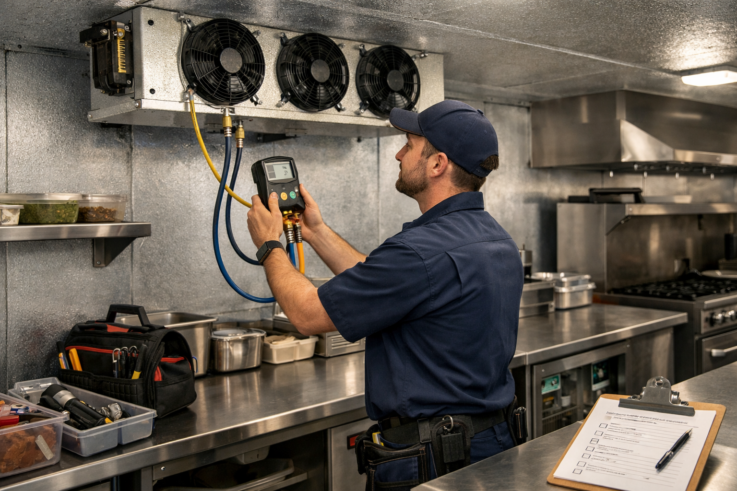
A qualified commercial refrigeration technician should combine visual inspection, cleaning, measurement, and operational testing. The exact checklist depends on the equipment, but common service steps include:
- Verify box temperature and compare it with the controller or thermometer reading.
- Inspect condenser coils and clean them when included in the maintenance scope.
- Check evaporator coils for frost, ice patterns, dirt, blocked airflow, or damage.
- Inspect evaporator and condenser fan motors for operation, vibration, noise, and blade condition.
- Review door gaskets, hinges, closers, sweeps, and latch operation on walk-in coolers and freezers.
- Check drains, drain heaters, pans, and lines for clogs, ice, leaks, or odors.
- Inspect electrical components such as contactors, wiring, terminals, capacitors, and controls for wear or overheating signs.
- Review defrost operation on low-temperature equipment and look for repeated ice buildup.
- Observe compressor operation, short cycling, unusual noise, overheating symptoms, and oil stains.
- Check refrigerant-related indicators when appropriate, especially if there are symptoms of low charge or leaks.
- Confirm airflow around condensing units, especially in storage rooms, rooftops, alleys, or mechanical spaces.
- Document findings and explain repair recommendations in plain language.
For businesses with walk-in cooler repair or walk-in freezer service needs, this level of detail is important. A technician is not only looking for what is broken today. They are looking for the conditions that may become tomorrow’s emergency repair.
Repair vs. Replace: What Should the Contract Say?
A service contract should not force every issue into a repair. Sometimes repair is the right choice, especially for isolated failures such as a bad fan motor, damaged gasket, clogged drain, faulty thermostat, or worn contactor on equipment that is otherwise in good condition. In other cases, replacement may be worth discussing, such as when an older unit has repeated compressor failures, refrigerant leak history, obsolete parts, poor efficiency, severe corrosion, or chronic temperature instability.
Ask whether your provider will give practical repair-versus-replacement guidance. For example, if a reach-in refrigerator has a recurring sealed-system issue and repair costs are approaching the value of the unit, a replacement conversation may be more responsible. If a walk-in freezer has a solid box but aging controls, targeted repairs may extend useful service. A good provider should explain the condition, urgency, options, and limitations without pressuring you into a decision you do not understand.
Questions to Ask Before Signing a Refrigeration Service Plan
Before signing any commercial refrigeration maintenance agreement, ask these questions:
- Which equipment is included, and is each asset listed?
- How often will service visits occur, and what tasks are performed at each visit?
- Are condenser coil cleaning, drain checks, gasket inspections, and defrost checks included?
- Does the plan include emergency refrigeration repair coverage, or only priority scheduling?
- What happens after hours, on weekends, or during holidays?
- Are repair labor, parts, refrigerant, and materials included or billed separately?
- Will I receive documentation after each visit?
- How are repair recommendations approved?
- Can the plan be adjusted if equipment is added, replaced, or removed?
- Who performs the work, and do they have commercial refrigeration experience?
If the answers are unclear, keep asking. The best time to clarify coverage is before a freezer is down, not while product is thawing.
Local Considerations for Massachusetts Businesses
Massachusetts businesses have varied refrigeration needs depending on building type, customer volume, and location. A dense Boston kitchen may have limited condenser access. A Cambridge café may rely on compact reach-ins and prep tables. A Worcester supermarket may have multiple systems and higher product volume. A liquor store in Framingham or Waltham may need beverage and wine cooler stability. A hotel in Quincy or Newton may need kitchen and banquet refrigeration to operate around event schedules. Facilities in Lowell, Springfield, Middlesex County, Suffolk County, and Worcester County may also deal with older buildings, rooftop equipment access, tight mechanical rooms, and seasonal humidity.
When comparing providers, look for a Massachusetts refrigeration partner that understands both commercial HVAC and refrigeration service realities. Royal Cooling provides commercial refrigeration services, including walk-in coolers, walk-in freezers, wine coolers, reach-in refrigerators, freezer repair, and preventive refrigeration maintenance. To confirm whether your location is within the current service area, visit the Royal Cooling service area page or call 781-899-4441.
When to Call Before the Next Scheduled Visit
Even with a preventive plan, some symptoms should not wait. Contact a commercial refrigeration technician if you notice temperatures trending warm, product thawing, heavy frost on an evaporator, water pooling around the unit, repeated alarms, unusual compressor noise, short cycling, a burning smell, breaker trips, or doors that will not seal. Staff should also report if a cooler takes much longer to recover after deliveries or if freezer product feels soft near the door.
Simple staff practices can support your service plan. Keep doors closed when not loading product, avoid blocking evaporator fans, leave space around condenser airflow, report torn gaskets, keep boxes organized, and log temperature concerns. These steps do not replace professional service, but they help your technician identify patterns faster.
Talk With Royal Cooling Before You Sign
If you are comparing a commercial refrigeration service contract in Massachusetts, Royal Cooling can help you evaluate what your equipment needs, what should be included in a maintenance agreement, and how repair support should be handled. The right plan should fit your operation, whether you manage a restaurant, grocery store, liquor store, hotel, commercial kitchen, or facility with critical refrigeration.
To discuss preventive refrigeration maintenance, walk-in cooler repair, walk-in freezer service, reach-in refrigerators, wine coolers, or emergency refrigeration repair coverage options, call 781-899-4441 or request service through the Royal Cooling contact page.
FAQ: Commercial Refrigeration Service Contracts in Massachusetts
What should a commercial refrigeration service contract include?
A service contract should include covered equipment, maintenance tasks, visit frequency, emergency repair process, pricing terms, exclusions, technician qualifications, and written service documentation.
Is a refrigeration maintenance agreement worth it for restaurants in Massachusetts?
Often, yes. Restaurants rely on refrigeration for product safety, prep flow, and service continuity. A maintenance agreement helps identify problems earlier and creates a clear repair process.
How often should a technician inspect walk-in coolers and freezers under a service plan?
Many walk-in coolers and freezers benefit from quarterly inspections, while high-use kitchens, grocery stores, and critical freezers may need more frequent service.
Does a refrigeration service contract include emergency repairs?
Some contracts include priority emergency procedures or discounted repair rates, while others bill emergency repairs separately. Always confirm after-hours terms before signing.
What equipment can be included in a commercial refrigeration maintenance agreement?
Plans may include walk-in coolers, walk-in freezers, reach-in refrigerators, prep tables, display cases, wine coolers, ice machines, and related refrigeration components.
What are signs I should call for service before the next maintenance visit?
Call if temperatures rise, product softens, heavy frost appears, water leaks, alarms repeat, fans stop, breakers trip, or the compressor makes unusual noises.
How do I compare refrigeration service plans from different providers?
Compare the task list, visit frequency, emergency coverage, documentation, repair pricing, exclusions, and whether the provider has commercial refrigeration experience in Massachusetts.