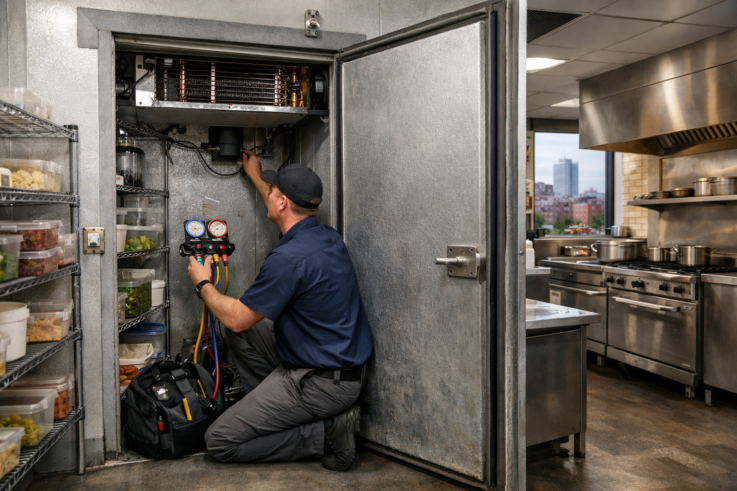
Commercial Refrigeration Energy Bills Rising in Massachusetts: Power-W
Short answer: Rising commercial refrigeration energy bills in Massachusetts are often caused by equipment running longer than normal due to dirty condenser coils, failing fans, damaged door gaskets, refrigerant issues, poor defrost, bad controls, or high kitchen heat loads. If a cooler or freezer runs constantly, struggles to hold temperature, or your utility bill jumps without another clear cause, schedule professional refrigeration maintenance before a minor efficiency problem becomes a breakdown.
For restaurants, grocery stores, liquor stores, convenience stores, hotels, supermarkets, and commercial kitchens across Massachusetts, refrigeration is not just another utility load. It protects inventory, supports food safety, and keeps daily operations moving. When energy bills climb, many owners first look at lighting, HVAC settings, or supplier rates. Those can matter, but commercial coolers, walk-in freezers, reach-in refrigerators, wine coolers, ice machines, and prep-line refrigeration can quietly waste a surprising amount of power when something is off.
This guide explains the most common refrigeration problems that increase electrical use, how to spot them early, and when a Massachusetts business should call a commercial refrigeration technician. If you operate in the Boston metro area, Worcester County, Middlesex County, Suffolk County, or nearby communities such as Cambridge, Lowell, Quincy, Newton, Waltham, Framingham, Springfield, Boston, or Worcester, summer heat, older buildings, tight mechanical rooms, and busy kitchen conditions can all make efficiency problems show up faster.
Why Commercial Refrigeration Energy Efficiency Matters in Massachusetts
Commercial refrigeration energy efficiency Massachusetts searches often start with a simple question: “Why did my electric bill go up?” Refrigeration equipment is designed to cycle, remove heat, and maintain a stable setpoint. When heat removal becomes harder, the compressor runs longer. Longer runtime means higher power use, more wear on electrical components, more stress on motors, and a greater chance of an emergency refrigeration repair call during peak business hours.
In Massachusetts, the load on coolers and freezers often increases before and during summer. Restaurants in Boston, Cambridge, Worcester, and Lowell may have hot kitchens, frequent door openings, deliveries arriving in warm weather, and staff moving quickly through walk-ins during rush periods. Liquor stores and convenience stores may have glass-door merchandisers exposed to customer traffic, sunlight, or air-conditioning drafts. Grocery stores and supermarkets may run multiple evaporators, remote condensers, reach-ins, and walk-in cooler systems under one roof. Older building stock can add another challenge: poor ventilation around condensers, limited roof access, crowded basements, and uneven electrical conditions.
The goal is not only to reduce utility cost. Efficient refrigeration usually means steadier temperatures, less ice, fewer nuisance alarms, reduced compressor strain, and better inventory protection. If your equipment is using more energy than usual, the system is giving you an early warning.
Symptoms That Suggest Refrigeration Is Wasting Power
Not every high electric bill is caused by a cooler, but these symptoms often point toward inefficient refrigeration operation:
- The commercial cooler is running constantly. A system that rarely cycles off may be fighting heat gain, airflow problems, refrigerant issues, or control problems.
- Temperatures recover slowly after deliveries. A walk-in that takes too long to pull back down after stocking can consume excess energy for hours.
- Utility bills rise while sales volume stays similar. If kitchen hours, menu volume, or store traffic have not changed much, refrigeration equipment should be inspected.
- Condensers feel extremely hot or are surrounded by warm air. Poor heat rejection can force compressors to work harder.
- Ice or frost appears where it did not before. Ice on evaporator coils, suction lines, door thresholds, or freezer ceilings may reduce efficiency.
- Fans sound different, vibrate, or stop intermittently. Weak airflow makes heat transfer less effective.
- Door gaskets are torn, loose, sticky, or not sealing. Air leaks are one of the simplest ways to lose walk-in cooler energy savings.
- Compressor short cycling or long cycling is noticeable. Either pattern can indicate electrical, control, airflow, or refrigerant problems.
If more than one of these symptoms appears, it is time to move from “watching it” to documenting temperatures, checking obvious issues, and scheduling service.
Common Refrigeration Problems That Cause High Energy Bills
1. Dirty Condenser Coils
Yes, a dirty condenser coil can make a walk-in cooler run constantly. The condenser coil rejects heat from the refrigeration system. When dust, grease, cardboard fibers, pollen, or kitchen debris coat the coil, the system cannot reject heat efficiently. Head pressure can rise, compressor runtime increases, and the unit may struggle to satisfy the thermostat.
This is common in commercial kitchens where grease-laden air reaches equipment, in liquor stores with dusty stockrooms, and in convenience stores where condensers are tucked into tight areas. Regular condenser coil cleaning is one of the most practical walk-in cooler energy savings steps for many Massachusetts businesses.
2. Weak or Failed Condenser Fans
Even a clean coil cannot reject heat well without proper airflow. A failing condenser fan motor, damaged blade, electrical issue, or blocked fan guard can keep heat trapped around the condensing unit. In warm weather, this can cause long runtimes and higher energy use. A technician will check motor amperage, airflow, fan cycling, wiring, contactors, and whether the condenser location has adequate ventilation.
3. Evaporator Airflow Problems
The evaporator coil inside the cooler or freezer absorbs heat from the box. If evaporator fans are weak, iced over, blocked by product, or spinning incorrectly, cold air will not move through the space the way it should. Employees may respond by lowering the thermostat, but that often increases runtime without solving the cause. Good airflow requires working fans, clean coils, clear product spacing, and a properly functioning defrost system.
4. Damaged Door Gaskets, Hinges, Closers, and Air Leaks
A small gap around a walk-in cooler door can pull in warm, humid air all day. That makes the evaporator remove extra heat and moisture. In freezers, the added moisture can become frost or ice. Door issues are especially expensive in busy restaurants, supermarkets, convenience stores, and kitchens where staff enter the box repeatedly during service.
Check for torn gaskets, loose hinges, doors that do not self-close, warped panels, worn sweeps, and light visible around the door edge. Air leaks may seem minor, but they can turn into high energy bills refrigeration problems quickly.
5. Incorrect Thermostat Settings or Control Calibration
Sometimes the equipment is working harder because controls are inaccurate or set too low. A walk-in cooler intended for typical food storage does not need to run like a freezer. A thermostat that reads incorrectly may call for cooling longer than needed. Digital controllers can also have sensor placement issues, programming errors, or failed probes. A commercial refrigeration technician can compare control readings to calibrated instruments and adjust settings where appropriate.
6. Refrigerant Problems
Low refrigerant, overcharge, restrictions, or metering device issues can all affect efficiency. Low refrigerant can reduce coil performance and make the compressor run longer while still failing to maintain temperature. Restrictions can starve the evaporator. Overcharge can increase head pressure. These issues require proper diagnostic tools and should not be guessed at. For Massachusetts businesses, refrigerant work should be handled by qualified technicians using appropriate recovery, charging, and leak-detection practices.
7. Defrost System Problems
In walk-in freezers and some cooler applications, defrost is essential. Too little defrost allows ice to insulate the coil and block airflow. Too much defrost adds unnecessary heat that the system must remove afterward. Failed heaters, bad termination controls, timer issues, sensors, or clogged drains can create repeated energy waste. This is a common reason a freezer appears to run all the time or struggles after busy periods.
8. Poor Equipment Location or Ventilation
A condensing unit installed in a hot mechanical room, crowded stock area, basement, rooftop location with debris, or near heat-producing equipment may run inefficiently. Older Massachusetts buildings in dense areas such as Boston, Cambridge, Somerville-adjacent markets, Worcester, and Quincy can have challenging layouts. If hot air from the condenser recirculates back into the coil, the system works harder every cycle.
9. Loading Practices and Product Temperature
Refrigeration is designed to hold product temperature, not rapidly chill large quantities of warm product unless the system was designed for that load. Placing hot prepared foods into a walk-in, blocking fan airflow with boxes, stacking product too tightly, or leaving deliveries in the door path can all raise energy use. Staff training can be part of preventive maintenance because daily habits affect compressor runtime.
Comparison Table: Energy-Wasting Symptoms, Likely Causes, and Next Steps
| Symptom | Likely Efficiency Problem | What to Check First | When to Call Royal Cooling |
|---|---|---|---|
| Commercial cooler running constantly | Dirty condenser coil, air leak, low refrigerant, bad control, high ambient heat | Door seal, thermostat setting, blocked coil, product blocking fans | If runtime stays abnormal, temperatures drift, or the compressor area is very hot |
| Walk-in cooler slow to recover after deliveries | High load, weak fans, dirty evaporator, poor airflow, undersized or aging equipment | Product spacing, fan operation, door left open, delivery temperature | If recovery takes much longer than normal or product temperature is at risk |
| Electric bill rises without clear business change | Long compressor runtime, failing motors, controls out of calibration, condenser issues | Compare runtime, check coils, review recent service history | If bills continue rising for more than one billing cycle or equipment symptoms appear |
| Frost or ice on coil or freezer surfaces | Defrost issue, air infiltration, door problem, refrigerant issue | Door closure, gasket condition, blocked drain, fan airflow | If ice returns after clearing, airflow is blocked, or temperatures fluctuate |
| Unusual noise or vibration | Fan motor, compressor, loose panel, contactor, bearing wear | Identify location of sound and whether it changes with cooling cycle | If noise is new, getting louder, or paired with temperature or energy issues |
| Reach-in refrigerator runs hot in a busy kitchen | Dirty coil, poor clearance, worn gasket, overloaded cabinet, failing fan | Clean exterior area, confirm clearance, inspect gasket, reduce blockage | If cabinet temperature remains unstable or compressor runs continuously |
Owner Inspection Steps Before Scheduling Service
Before calling for refrigeration maintenance Massachusetts service, you can gather useful information. These steps do not replace professional diagnostics, but they help you describe the problem clearly and may prevent unnecessary energy waste.
- Record temperatures. Note box temperature at opening, midday, closing, and after deliveries. Use a separate thermometer if available.
- Listen for runtime. Does the compressor cycle off, or does it seem to run continuously?
- Inspect door seals. Look for tears, gaps, crushed gasket corners, or light leaking around the door.
- Look for blocked airflow. Keep product away from evaporator fans and leave space for air circulation.
- Check visible coil condition. If a condenser is accessible and safe to view, look for dust, grease, or blocked fins. Do not damage fins or spray electrical components.
- Review recent changes. New menu items, longer hours, more deliveries, different storage practices, or a changed thermostat setting can affect energy use.
- Check the area around condensing units. Remove boxes, trash, or supplies that block ventilation, if safe to do so.
- Do not repeatedly lower the setpoint. If equipment cannot maintain temperature, lowering the thermostat may increase energy use without fixing the cause.
If you see active electrical issues, burning odors, severe ice, refrigerant oil stains, repeated breaker trips, or unsafe conditions, stop troubleshooting and contact a qualified technician.
What a Commercial Refrigeration Technician Checks
When Royal Cooling evaluates an inefficient cooler or freezer, the goal is to identify why the system is consuming excess power and whether repair, maintenance, or replacement planning makes the most sense. Depending on the equipment and symptoms, a technician may inspect:
- Condenser coil cleanliness and heat rejection
- Condenser fan motor operation, blade condition, and airflow
- Evaporator fan operation, coil condition, and airflow pattern
- Compressor amperage, temperature, cycling behavior, and start components
- Electrical contactors, capacitors, wiring, controls, and safeties
- Thermostat or controller calibration and sensor placement
- Refrigerant pressures, superheat, subcooling, and signs of leaks or restrictions
- Door gaskets, closers, hinges, sweeps, curtains, and air infiltration points
- Defrost timers, heaters, termination sensors, drain heaters, and drain function
- Box condition, insulation concerns, product loading, and temperature recovery
- Equipment age, service history, and whether components are nearing end of life
This process helps separate simple maintenance issues from deeper mechanical problems. For example, a dirty coil and torn gasket may be a straightforward efficiency repair. A compressor drawing abnormal amperage, a severely corroded coil, or repeated refrigerant loss may require a larger repair discussion.
Repair vs. Replacement: How to Think About Inefficient Equipment
Not every inefficient system needs replacement. Many high energy bills refrigeration problems are solved through cleaning, calibration, airflow correction, gaskets, fan motors, defrost repairs, or refrigerant diagnostics. However, older equipment can reach a point where repeated repairs, poor temperature stability, and high energy use make replacement worth discussing.
Consider replacement planning when a cooler or freezer has frequent breakdowns, major components are failing, parts are hard to source, refrigerant issues are recurring, insulation or box integrity is poor, or the system no longer matches the business load. For example, a restaurant in Newton that expanded catering volume, a market in Waltham that added more prepared foods, or a liquor store in Framingham with aging beverage coolers may need a capacity and layout review rather than another minor repair.
A reputable HVAC contractor Massachusetts businesses trust should explain the practical options: maintenance, targeted repair, controls correction, component replacement, or equipment upgrade. The right answer depends on operating hours, inventory risk, energy use, system age, and budget.
When an Inefficient Cooler Becomes Urgent
Energy waste is important, but some symptoms call for faster action because they can lead to food loss, business interruption, or equipment damage. Call for service promptly if you notice:
- Cooler or freezer temperatures moving out of acceptable range for your stored product
- Compressor running continuously with little or no temperature improvement
- Repeated breaker trips or electrical burning smell
- Heavy ice blocking evaporator fans or door operation
- Water near electrical components or unsafe floor conditions
- Oil residue near refrigerant piping, coils, or fittings
- Multiple pieces of equipment struggling during hot weather
- Wine coolers, reach-ins, or walk-ins affecting valuable inventory
For urgent concerns, contact Royal Cooling at 781-899-4441. If you are planning non-emergency maintenance, you can also use the contact page to request help.
Preventive Maintenance Tips for Walk-In Cooler Energy Savings
Preventive maintenance is the best way to protect efficiency before Massachusetts summer heat puts extra strain on refrigeration systems. A planned visit can help catch worn fan motors, dirty coils, failing gaskets, control drift, and defrost issues before they raise bills or cause a shutdown.
Helpful maintenance practices include:
- Clean condenser coils on a schedule matched to the environment, not just the calendar.
- Inspect and replace damaged door gaskets before warm air infiltration becomes constant.
- Verify temperature controls with calibrated readings.
- Confirm evaporator fans operate and product is not blocking airflow.
- Check defrost operation on walk-in freezers and low-temperature systems.
- Review compressor and motor electrical readings for abnormal trends.
- Keep condensing units clear of storage, dust, grease, and recirculated hot air.
- Train staff to minimize door-open time and avoid placing hot product directly into storage coolers.
- Document temperature logs so performance changes are easier to spot.
Royal Cooling provides commercial refrigeration, walk-in cooler repair, walk-in freezer service, freezer repair, wine cooler service, reach-in refrigerator repair, and preventive refrigeration maintenance for Massachusetts businesses. To see whether your location is within the service area, visit Royal Cooling’s service area page.
Massachusetts Businesses That Should Watch Refrigeration Energy Use Closely
Any business with cold storage can benefit from efficiency checks, but some locations are especially sensitive to rising refrigeration costs. Restaurants and commercial kitchens often have heat from ovens, fryers, dish machines, and staff traffic. Grocery stores and supermarkets may operate many systems at once. Convenience stores rely on beverage cases, prep coolers, reach-ins, and freezers that customers open all day. Liquor stores may use beer caves, wine coolers, and display coolers where temperature consistency protects customer experience and inventory quality. Hotels and property-managed buildings may have back-of-house refrigeration that is easy to overlook until the bill or alarm gets attention.
From Suffolk County and the Boston metro area to Worcester County and Middlesex County, building layout and usage patterns matter. A cooler in a tight Cambridge kitchen may need a different maintenance approach than a walk-in freezer serving a larger Worcester facility or a reach-in refrigerator line in a Quincy restaurant. The equipment, symptoms, urgency, and operating environment should guide the service process.
FAQ: Commercial Refrigeration Energy Bills in Massachusetts
Why is my commercial refrigerator using more electricity than usual?
It may be running longer because of dirty condenser coils, worn door gaskets, weak fans, low refrigerant, bad controls, poor ventilation, heavy product load, or high ambient kitchen temperatures. If the change is sudden or persistent, schedule a professional inspection.
Can a dirty condenser coil make a walk-in cooler run constantly?
Yes. A dirty condenser coil prevents the system from rejecting heat efficiently. The compressor may run longer, use more electricity, and still struggle to maintain temperature, especially during Massachusetts summer heat.
What refrigeration problems cause high utility bills in restaurants?
Common causes include grease-coated coils, damaged gaskets, doors left open during service, failing evaporator or condenser fans, incorrect thermostat settings, defrost problems, refrigerant issues, and hot equipment rooms with poor ventilation.
When should a Massachusetts business call a technician for an inefficient cooler?
Call when the cooler runs constantly, temperatures drift, energy bills rise without a clear reason, ice keeps returning, unusual noises appear, or product safety may be affected. A technician can identify whether maintenance, repair, or replacement planning is needed.
Can preventive maintenance lower refrigeration energy use?
Preventive maintenance can improve efficiency by cleaning coils, correcting airflow issues, checking electrical components, verifying controls, inspecting gaskets, and finding small problems before they make compressors run longer than necessary.
Should I repair or replace an older inefficient walk-in cooler system?
Repair may make sense for dirty coils, controls, fans, gaskets, or isolated component issues. Replacement planning may be smarter if the equipment has frequent breakdowns, major component failure, recurring refrigerant problems, poor box condition, or no longer matches your load.
Talk to Royal Cooling About Refrigeration Efficiency
If your utility bills are rising and your cooler, freezer, wine cooler, or reach-in refrigerator is running harder than it used to, do not wait for a complete failure. Royal Cooling helps Massachusetts restaurants, commercial kitchens, liquor stores, convenience stores, supermarkets, hotels, facility managers, and property managers identify refrigeration problems that waste power and threaten inventory.
Call 781-899-4441 to discuss service, or request help through the Royal Cooling contact page. For location details, visit the service area page. A focused inspection can help you understand the cause of rising energy use and choose the right next step for your business.