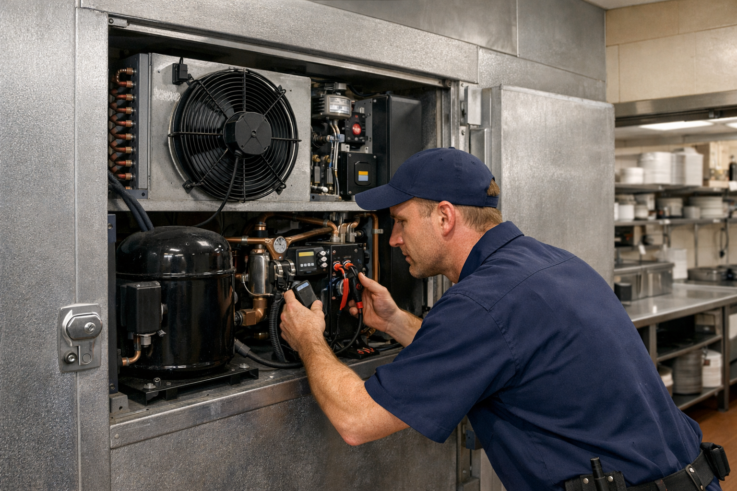
Commercial Refrigeration Compressor Short Cycling: What Massachusetts’
Short answer: Commercial refrigeration compressor short cycling means the compressor starts and stops too frequently instead of running steady cooling cycles. In Massachusetts restaurants, grocery stores, liquor stores, and commercial kitchens, the first checks should be airflow, dirty condenser coils, door issues, thermostat settings, and temperature trends. If box temperatures rise, alarms trigger, or cycling continues, call a commercial refrigeration technician.
When a walk-in cooler, walk-in freezer, reach-in refrigerator, wine cooler, or prep-line refrigeration system starts rapidly clicking on and off, it is more than an annoying sound from the back room. Commercial refrigeration compressor short cycling can create unstable product temperatures, increase electrical stress, and shorten compressor life. For Massachusetts businesses that depend on safe cold storage during lunch rushes, dinner service, deliveries, banquets, or overnight holding, repeated compressor cycling deserves prompt attention.
Royal Cooling works with commercial refrigeration equipment used by restaurants, commercial kitchens, convenience stores, supermarkets, grocery stores, hotels, liquor stores, facility managers, property managers, and homes with specialty wine coolers or freezer equipment. Whether your business is in the Boston metro area, Worcester County, Middlesex County, Suffolk County, or another Massachusetts service-area community such as Boston, Worcester, Cambridge, Lowell, Springfield, Quincy, Newton, Waltham, or Framingham, the goal is the same: protect inventory, stabilize temperatures, and avoid unnecessary compressor damage.
What Does Compressor Short Cycling Mean?
A normal commercial refrigeration system does not run the compressor every few seconds or every minute. It cycles based on load, temperature, pressure controls, and system design. Short cycling means the compressor turns on and off too frequently, often before it has completed a proper cooling cycle. You may hear the condensing unit start, run briefly, stop, and then try again. In some cases the compressor clicks, hums, trips out, or shuts down on a safety control.
Commercial refrigerator short cycling can happen on walk-in coolers, walk-in freezers, reach-in refrigerators, undercounter units, wine coolers, and remote condensing systems. It may be caused by something simple, such as blocked airflow around the condenser, or something more serious, such as refrigerant pressure problems, electrical component failure, a faulty control, or a compressor nearing the end of its service life.
The reason short cycling is so important is that compressors need proper run time and proper off time. Repeated starting creates heat and high electrical load. If the system is already struggling because of a dirty condenser, failed fan motor, refrigerant restriction, or bad contactor, short cycling can accelerate a breakdown.
Why Massachusetts Businesses Should Not Ignore It
Massachusetts food and beverage businesses often operate in tight windows. A restaurant in Boston may receive a large morning delivery before lunch prep. A grocery store in Worcester may need stable produce and dairy cases through evening traffic. A liquor store in Cambridge or Newton may rely on wine coolers to protect temperature-sensitive inventory. A hotel kitchen in Quincy or Waltham may need walk-in cooler performance through banquet service. When compressor cycling becomes irregular, the first question is not only “what is wrong?” but also “how much time do I have before product risk increases?”
Short cycling can lead to:
- Box temperatures drifting above the desired range
- Food, beverage, or specialty inventory exposure to temperature swings
- Higher energy use because the compressor starts too often
- Increased wear on contactors, capacitors, relays, and the compressor motor
- Ice patterns, pressure issues, or nuisance safety trips
- Unexpected downtime during service hours, delivery windows, or overnight holding
If you are already seeing temperature instability, compressor short cycling should be treated as an urgent service issue. If temperatures are still holding but the cycling is new, document what you observe and schedule professional walk-in cooler compressor troubleshooting before the issue turns into an emergency refrigeration repair call.
What to Check First Before Calling for Service
Business owners and managers can make several safe observations before calling an HVAC contractor or commercial refrigeration technician. These checks can help you explain the problem clearly, but they are not a substitute for professional diagnosis. Do not remove electrical covers, bypass pressure controls, reset breakers repeatedly, or add refrigerant without proper licensing and tools.
1. Check the Actual Box Temperature
Look at the thermostat or controller display, then compare it with a reliable independent thermometer if available. Is the cooler or freezer maintaining setpoint, drifting slowly, or already warm? For a walk-in cooler, note whether the temperature rises during high door traffic or remains high even when doors stay closed. For a walk-in freezer, note whether product is softening, frost patterns are changing, or the compressor cycling is accompanied by alarms.
2. Listen to the Cycling Pattern
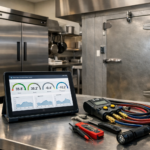
Short cycling is not one single sound. The compressor may start and stop every few seconds, every minute, or at irregular intervals. You might hear a click from the contactor, a hum, fan operation without compressor operation, or a full condensing unit start and stop. Write down how long it runs and how long it stays off. This helps a technician determine whether the issue may involve controls, pressure switches, electrical components, or compressor protection.
3. Inspect Airflow Around the Condenser
Many commercial systems have a condensing unit located on a roof, outside wall, mechanical room, basement area, or behind a reach-in refrigerator. If the condenser coil is packed with grease, dust, lint, cardboard debris, cottonwood, or kitchen residue, the system cannot reject heat properly. Restricted airflow can raise head pressure and cause safety controls to shut the compressor down. This is one reason the answer to “Can a dirty condenser cause commercial refrigeration short cycling?” is yes.
4. Look for Blocked Coils, Fans, and Vents
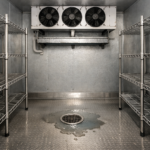
Inside the box, make sure product is not stacked directly against evaporator fans or blocking return airflow. In busy Massachusetts commercial kitchens, deliveries are often loaded quickly during service prep, and cases can end up against the evaporator. Poor airflow can cause uneven temperatures, coil icing, and control problems. If the evaporator fan is not running, if the coil is heavily iced, or if the fan guards are blocked, call for walk-in cooler repair or walk-in freezer service.
5. Confirm Doors Are Closing Fully
Door problems can add heat and moisture load, forcing the compressor to start more often. Check that walk-in doors close fully, gaskets seal, hinges align, and closers work. For reach-in refrigerators, inspect gaskets and make sure drawers or shelves are not preventing closure. A door leak may not be the only cause of compressor short cycling, but it can contribute to unstable operation and excessive run demand.
6. Review Recent Changes
Short cycling often appears after something changes. Did you receive a large warm delivery? Did staff change the thermostat setting? Was equipment recently moved, cleaned, repaired, or unplugged? Was there a power interruption, breaker trip, or building electrical work? Did a rooftop unit become blocked by snow, leaves, or nearby equipment? These details matter when troubleshooting commercial refrigerator short cycling.
Common Causes of Commercial Refrigeration Compressor Short Cycling
The table below shows common causes, what you may notice, what you can safely check, and when it becomes a service call.
| Possible Cause | Common Symptoms | Safe First Check | Service Urgency |
|---|---|---|---|
| Dirty condenser coil or blocked condenser airflow | Compressor starts, runs briefly, then shuts off; unit may feel hot; temperatures may creep up | Look for dust, grease, debris, blocked outdoor airflow, or items stored near the unit | High if temperatures are rising or the unit repeatedly trips |
| Failed or weak condenser fan motor | Compressor runs hot; fan not spinning; head pressure safety may trip | Visually confirm whether the fan operates; do not reach into the unit | High because compressor damage can follow |
| Thermostat, sensor, or controller issue | Rapid cycling even when box temperature is not changing much; inconsistent readings | Compare display with a separate thermometer and note setpoint changes | Moderate to high depending on product temperature |
| Low refrigerant, restriction, or pressure control problem | Short run times, icing patterns, poor cooling, possible low-pressure safety trips | Look for obvious oil stains or ice, but do not add refrigerant | High; requires licensed refrigeration diagnosis |
| Electrical component failure | Clicking, humming, intermittent starts, tripped overloads, breaker trips | Note sounds and breaker history; avoid repeated resets | High, especially if breakers trip or burning odors occur |
| Oversized, worn, or failing compressor | Very short cycles, overheating, repeated overload trips, poor reliability | Record cycling pattern and temperature history | High; technician should evaluate repair vs replacement |
Is Compressor Short Cycling an Emergency for a Restaurant Cooler?
It can be. Compressor short cycling is an emergency when the cooler or freezer is not holding temperature, alarms are active, product is warming, the compressor repeatedly trips, or the unit will not stay running. For a restaurant cooler during service hours, the practical risk is inventory loss and interruption to prep, line service, or delivery storage. In that situation, call for emergency refrigeration repair Massachusetts support instead of waiting to see if the issue clears on its own.
If temperatures are stable and you notice the cycling early, it may be possible to schedule service before a complete failure. However, do not ignore a new pattern. Short cycling rarely improves without addressing the cause. A dirty condenser may get worse. A failing fan motor may stop entirely. A pressure control issue may cause nuisance trips until the system finally locks out. An electrical issue may go from intermittent to no-cooling at the worst possible time.
Call Royal Cooling at 781-899-4441 if your Massachusetts business is dealing with repeated compressor starts and stops, unstable temperatures, or suspected walk-in freezer compressor problems. You can also use the contact page to request service.
When to Call a Commercial Refrigeration Technician
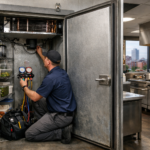
You should call a commercial refrigeration technician when compressor cycling continues after basic checks, when the system is not holding temperature, or when the cause involves refrigerant, electrical components, pressure controls, fans, or compressor health. These are not guesswork repairs. A qualified technician uses gauges, electrical meters, temperature measurements, control diagnostics, and refrigeration experience to determine why the compressor is starting and stopping.
Call promptly if you notice any of the following:
- The compressor starts and stops repeatedly within minutes
- The cooler or freezer temperature is rising or fluctuating sharply
- The breaker trips, the unit hums, or you hear repeated clicking
- The condenser fan is not running while the compressor is trying to run
- The condenser coil is extremely dirty or the unit seems overheated
- Ice is forming in unusual places, or the evaporator coil is blocked with ice
- There are oil stains, refrigerant leak concerns, or pressure-control trips
- The issue affects a restaurant, grocery store, liquor store, hotel, or commercial kitchen during active use
For businesses across Massachusetts, including the Boston metro area, Worcester County, Middlesex County, and Suffolk County, short cycling should be handled before it becomes a product-loss situation. If you are unsure whether your location is within Royal Cooling’s service area, visit the service area page or call 781-899-4441.
What Royal Cooling Checks During a Service Visit
Professional walk-in cooler compressor troubleshooting is systematic. The technician is not simply looking at the compressor; they are evaluating the entire refrigeration circuit, airflow path, electrical system, controls, and operating conditions. A compressor may be short cycling because it is failing, but it may also be reacting to another problem elsewhere in the system.
Depending on the equipment and symptoms, a technician may check:
- Box temperature, product load, setpoint, and controller operation
- Thermostat calibration, sensors, relays, and control wiring
- Compressor amperage, voltage, contactor condition, capacitors, overloads, and start components
- Condenser coil cleanliness and condenser fan motor operation
- Evaporator fan operation, coil condition, defrost function, and airflow restrictions
- Suction and discharge pressures where appropriate
- Superheat, subcooling, refrigerant charge indicators, and signs of restrictions
- Pressure controls, safety switches, and nuisance trip history
- Door gaskets, infiltration issues, and heat load from recent deliveries or usage patterns
- Whether the compressor is repairable or whether replacement should be discussed
This process matters because replacing a compressor without fixing the underlying cause can lead to repeated failure. For example, if a condenser fan motor failure caused high head pressure and overheating, a new compressor would still be exposed to the same damaging conditions unless the airflow problem is corrected. Similarly, adding refrigerant without finding a leak or diagnosing a restriction can create more problems.
Repair vs. Replacement: How the Decision Is Made
Not every short cycling compressor needs replacement. In many cases, the repair may involve cleaning a condenser coil, replacing a fan motor, correcting a control issue, repairing wiring, replacing a contactor or capacitor, fixing a refrigerant leak, or addressing defrost and airflow problems. For equipment that is otherwise in good condition, these repairs can restore stable operation.
Replacement may become a better discussion when the compressor has internal damage, repeated overload trips, poor winding readings, severe overheating history, contamination concerns, or a pattern of costly repairs. Age, refrigerant type, parts availability, equipment condition, and the importance of the box to daily operations all matter. A small reach-in refrigerator in a backup storage area is a different business decision than a main walk-in freezer serving a busy restaurant or supermarket.
Royal Cooling can help Massachusetts businesses weigh the practical options. The goal is not to sell the biggest repair; it is to restore dependable refrigeration in a way that makes sense for the equipment, inventory risk, and business schedule.
How Preventive Maintenance Reduces Short Cycling Risk
Preventive refrigeration maintenance is one of the best ways to reduce emergency calls related to commercial refrigerator short cycling. Commercial refrigeration systems operate in demanding environments. Restaurant grease, flour dust, cardboard fibers, pet hair in retail spaces, outdoor debris, snow exposure, and heavy door traffic can all affect system performance.
A maintenance visit may include coil cleaning, fan checks, temperature verification, control review, door gasket inspection, drain checks, electrical inspection, and operating condition measurements. For walk-in coolers, walk-in freezers, reach-in refrigerators, wine coolers, and specialty cold storage, these routine tasks can reveal early symptoms before a compressor starts tripping on safeties or cycling erratically.
For restaurants in Boston, convenience stores in Lowell, grocery stores in Framingham, commercial kitchens in Cambridge, and facility-managed properties in Newton or Waltham, a planned maintenance schedule is usually easier to manage than a breakdown during service or delivery. If your system has a history of nuisance trips or short cycling, mention it during preventive maintenance so the technician can look deeper than a basic cleaning.
Do Not Bypass Safety Controls or Keep Resetting the Unit
Pressure controls, overloads, and breakers exist to protect equipment and reduce risk. If a compressor shuts down on a safety control, the system is telling you something. Repeatedly resetting a breaker or power cycling a unit without finding the cause can damage the compressor and create a more expensive repair. Bypassing controls is unsafe and should never be done by store staff, kitchen staff, or unqualified maintenance personnel.
If you need temporary operating guidance while waiting for service, call Royal Cooling. Depending on the situation, you may be advised to keep doors closed, limit access to the cooler, move critical inventory to backup cold storage if available, record temperatures, or shut equipment down if electrical symptoms are present. The correct decision depends on the symptoms and the equipment.
FAQ: Commercial Refrigeration Compressor Short Cycling
Why does my walk-in cooler compressor keep turning on and off?
Your walk-in cooler compressor may keep turning on and off because of dirty condenser coils, blocked airflow, a faulty thermostat or sensor, refrigerant pressure problems, electrical component failure, or compressor overheating. If temperatures are unstable or the cycling is frequent, schedule professional troubleshooting.
Is compressor short cycling an emergency for a restaurant cooler?
Yes, it can be an emergency if the cooler is not holding temperature, product is warming, alarms are active, or the compressor repeatedly trips. Restaurants should treat short cycling as urgent when it threatens service, inventory, or food storage stability.
Can a dirty condenser cause commercial refrigeration short cycling?
Yes. A dirty condenser can prevent the system from rejecting heat, causing high pressure or overheating conditions that make the compressor shut off and restart. Grease, dust, lint, and outdoor debris are common contributors in commercial settings.
When should I call a commercial refrigeration technician for compressor cycling problems?
Call a technician when short cycling continues after basic airflow and setting checks, when temperatures rise, when breakers trip, when the condenser fan is not running, or when refrigerant, pressure control, or electrical issues are suspected.
Can I keep using my walk-in freezer if the compressor is short cycling?
Only if temperatures are stable and there are no electrical warning signs, but you should still arrange service promptly. If product is softening, alarms are sounding, or the freezer cannot maintain temperature, limit door openings and call for service.
Does short cycling always mean the compressor needs to be replaced?
No. Short cycling can be caused by coils, fans, controls, wiring, refrigerant issues, or load problems. A technician should diagnose the system before deciding whether compressor repair, related component repair, or replacement is appropriate.
What information should I provide when calling for service?
Provide the equipment type, location, current temperature, setpoint, how often the compressor turns on and off, any alarms, recent deliveries or power issues, and whether the unit is a walk-in cooler, walk-in freezer, reach-in refrigerator, or wine cooler.
Schedule Commercial Refrigeration Service in Massachusetts
If your compressor turns on and off repeatedly, do not wait for a complete loss of cooling. Commercial refrigeration compressor short cycling is a warning sign that should be evaluated before it damages the compressor or disrupts your operation. Royal Cooling provides commercial refrigeration service for Massachusetts businesses that rely on walk-in coolers, walk-in freezers, reach-in refrigerators, wine coolers, freezer repair, and preventive refrigeration maintenance.
For restaurants, grocery stores, liquor stores, hotels, commercial kitchens, facility managers, and property managers in the Boston metro area, Worcester County, Middlesex County, Suffolk County, and surrounding Massachusetts communities, call Royal Cooling at 781-899-4441 or request service through the contact page. If you want to confirm coverage for your location, visit the service area page.