Commercial Refrigeration Temperature Alarms and Remote Monitoring for(
Commercial Refrigeration Temperature Monitoring in Massachusetts: Why It Matters
Short answer: Commercial refrigeration temperature monitoring in Massachusetts helps restaurants, grocery stores, liquor stores, hotels, and facility managers catch cooler or freezer problems before product is lost. The best setup combines accurate sensors, high and low temperature alarms, remote alerts, temperature logging, and a service plan that tells staff when to call a commercial refrigeration technician.
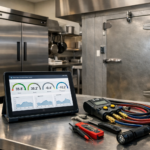
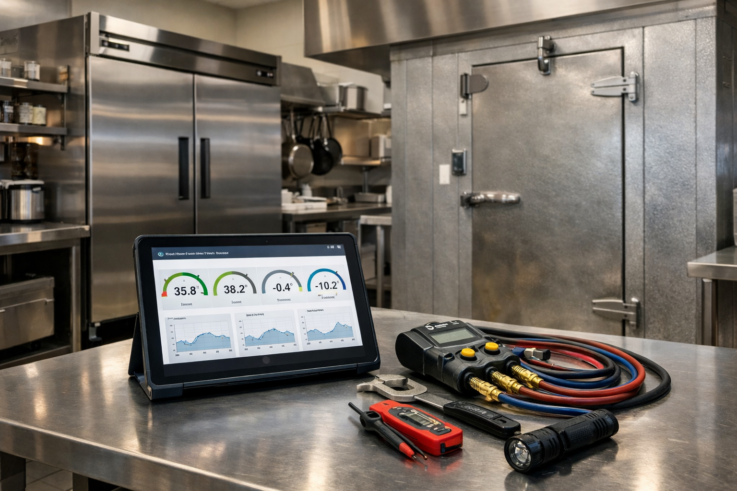
For food businesses in Massachusetts, refrigeration problems rarely happen at a convenient time. A walk-in cooler may drift warm after dinner service in Boston. A walk-in freezer in Worcester may climb overnight after a defrost problem. A beer cave in Lowell or a display case in Quincy may look normal from the sales floor while product temperature slowly rises. A refrigeration temperature alarm and remote refrigeration monitoring system gives owners and managers a warning before a temperature issue becomes a food safety concern, product-loss event, or emergency repair call.
Royal Cooling works with commercial refrigeration equipment such as walk-in coolers, walk-in freezers, reach-in refrigerators, wine coolers, display cases, and specialty storage equipment. For Massachusetts food businesses across the Boston metro, Worcester County, Middlesex County, Suffolk County, Cambridge, Newton, Waltham, Framingham, Springfield, and surrounding areas, the goal is simple: know when temperatures move out of range, understand what the alert means, and have a practical response plan.
This guide explains alarm types, useful monitoring features, installation considerations, alert thresholds, restaurant temperature logging, and when a temperature alarm should trigger a refrigeration service call. If you are comparing options or trying to prevent after-hours product loss, use this as a practical planning guide.
Why Temperature Alarms Are More Than a Convenience
A food safety refrigeration alarm is not only a gadget that beeps when a box gets warm. It is part of a broader refrigeration risk-management plan. A cooler can run slightly warm because of a dirty condenser coil, failing fan motor, low refrigerant charge, door gasket leak, thermostat issue, control problem, or heavy product load. A freezer can warm up because of defrost failure, ice buildup, door heater trouble, compressor short cycling, evaporator fan failure, or electrical issues. Without monitoring, these conditions may go unnoticed until staff arrive the next morning.
Massachusetts businesses face several operating realities that make monitoring especially valuable. Seasonal humidity can increase frost, condensation, and door-sweat problems. Hot summer kitchen conditions can push refrigeration systems harder. Older buildings in Boston, Cambridge, Worcester, Lowell, and Quincy may have equipment rooms or roof access that complicate maintenance. Busy restaurants and stores may open cooler doors constantly during service. In all of these settings, a properly configured alarm gives staff earlier visibility.
Temperature alarms also help with accountability. If a restaurant manager in Cambridge receives alerts showing that a walk-in cooler warmed above its normal range at 11:30 p.m., the response can happen before the morning prep team discovers the issue. If a convenience store in Framingham sees repeated beer cave alarms at the same time every weekend, the cause may be stocking practices, door traffic, blocked airflow, or equipment capacity. Alarm history and temperature logs help separate one-time incidents from patterns that need service or operational changes.
What Type of Temperature Alarm Should a Restaurant Walk-In Cooler Have?
A restaurant walk-in cooler should have a dedicated walk-in cooler alarm system with at least one accurate air sensor, high-temperature alert, optional low-temperature alert, alert delay settings, local display or audible alarm, and remote notifications by app, email, text, or phone platform. For high-value inventory, multiple sensors may be helpful: one near the return air path, one near the warmest storage area, and one away from doors or evaporator discharge air.
The most important design point is that the sensor should monitor the space in a way that reflects product risk. A sensor placed directly in front of the evaporator discharge can read artificially cold. A sensor placed next to a frequently opened door may nuisance alarm. A commercial refrigeration technician can help identify a location that captures true box conditions without creating constant false alerts.
For many restaurants, the best walk-in cooler alarm system includes:
- High-temperature alarm with an adjustable threshold.
- Short delay to avoid false alerts after stocking or door opening.
- Battery backup or power-loss notification where applicable.
- Remote alert delivery to more than one responsible person.
- Temperature history for restaurant temperature logging.
- Sensor calibration checks as part of preventive maintenance.
- Clear instructions for when staff should call for service.
For example, a restaurant in Waltham may set a walk-in cooler alert to notify the kitchen manager first, then the owner if the temperature remains high. A hotel kitchen in Boston may route alerts to engineering or facilities staff. A grocery store in Worcester may need multiple zones monitored separately because produce, dairy, meat, and frozen items have different risk profiles.
Comparison: Common Refrigeration Alarm and Monitoring Options
Not every business needs the same level of monitoring. A small cafe with one reach-in refrigerator may need a simpler alarm than a supermarket with multiple cases, walk-ins, and freezers. The table below compares common options for Massachusetts food businesses.
| Option | Best For | Strengths | Limitations | Service Considerations |
|---|---|---|---|---|
| Local audible temperature alarm | Small kitchens, reach-ins, prep areas staffed during operating hours | Simple, visible or audible warning when staff are present | No after-hours alert unless someone is onsite | Good basic protection, but not enough for many overnight operations |
| Standalone data logger | Restaurant temperature logging, inspections, trend review | Creates temperature history and supports recordkeeping | May not send real-time alerts unless connected | Useful for identifying recurring warm periods or defrost patterns |
| Wi-Fi or cellular remote monitoring | Restaurants, liquor stores, convenience stores, hotels, grocery stores | Sends after-hours alerts and provides trend data | Requires signal reliability, alert setup, and staff response plan | Often the best balance of protection and practicality |
| Integrated building or facility monitoring | Large facilities, supermarkets, institutions, property-managed sites | Centralizes alarms across equipment and locations | More complex setup and coordination | Works well when combined with preventive maintenance and escalation rules |
| Equipment controller with remote access | Advanced walk-ins, rack systems, specialty refrigeration | May monitor temperatures, compressor activity, defrost, and faults | Requires proper configuration and technician familiarity | Can help a technician diagnose problems faster |
How Can I Get Alerts If My Walk-In Freezer Warms Up After Hours?
To get alerts after hours, install a freezer temperature alarm or connected remote refrigeration monitoring system that sends notifications when the freezer rises above the chosen threshold for a set period. Alerts should go to more than one person, such as the general manager, owner, facility manager, or night operations contact. If the system can also report power loss, sensor failure, or communication failure, that is even better.
A walk-in freezer is often more urgent than a cooler because inventory value can be high and warming may indicate a serious mechanical issue. However, alarm delay settings matter. A freezer door left open during loading should not necessarily trigger an immediate emergency call if the temperature recovers quickly. On the other hand, a freezer that keeps climbing, alarms repeatedly, or fails to pull down after the door is closed should be treated as a service concern.
For after-hours planning, Royal Cooling recommends a written escalation path. The first alert might prompt a manager to verify that the door is closed, check whether power is on, and confirm that staff did not leave product blocking fans. If the temperature continues rising, if ice buildup is visible, if the evaporator fans are not running, or if the compressor is short cycling, the next step is to contact a commercial refrigeration technician. For businesses with critical inventory, the plan may include moving product to backup storage while service is being arranged.
Do Convenience Stores Need Remote Monitoring for Beer Caves and Display Cases?
Many convenience stores, liquor stores, and small markets benefit from remote monitoring for beer caves, display cases, reach-in coolers, and walk-ins. A beer cave may not always create the same food safety urgency as a meat or dairy cooler, but warm product can still cause customer complaints, inventory disruption, and lost sales. Display cases can be especially tricky because they are exposed to door openings, stocking activity, lighting, and customer traffic.
For a liquor store in Cambridge, a convenience store in Lowell, or a market in Quincy, remote monitoring helps identify whether an issue is operational or mechanical. If a beer cave warms only during large deliveries and recovers quickly, staff procedures may need adjustment. If the temperature climbs every afternoon in July, the refrigeration system may be struggling with load, dirty coils, poor airflow, or failing components. If one display case warms while others remain stable, a technician may look for case-specific issues such as fan failure, control problems, blocked honeycombs, or refrigerant restrictions.
Remote refrigeration monitoring can also reduce uncertainty for multi-site operators and property managers. Instead of relying on someone to notice a warm case during a walkthrough, managers can review temperature trends, alarms, and recovery times. That information helps prioritize preventive maintenance and identify equipment that needs attention before it becomes an emergency refrigeration repair situation.
Where Sensors Should Be Installed
Sensor placement affects the value of every alarm. A poorly placed sensor can cause nuisance alerts, hide real problems, or provide readings that do not match product conditions. In most commercial refrigeration applications, sensors should be placed away from direct fan discharge, away from doors when possible, and in a representative area of the box or case. For large walk-ins, more than one sensor may be needed.
Common placement considerations include:
- Walk-in coolers: Place sensors in a stable air area that represents stored product, not directly in the evaporator discharge stream.
- Walk-in freezers: Avoid locations where frost, impact, or product movement will damage the sensor.
- Reach-in refrigerators: Keep sensors away from the back wall if that area is unusually cold or from the door if it creates nuisance readings.
- Display cases: Monitor the product zone, not just the coldest supply air location.
- Wine coolers: Use stable sensor locations and avoid direct airflow that may not reflect bottle temperature.
- Beer caves: Consider warmest-zone monitoring, especially near doors or high-traffic areas.
A technician may also compare sensor readings with a calibrated thermometer and the equipment controller. If the monitoring system says one thing and the refrigeration control says another, calibration, placement, or sensor failure may be involved.
When Should a Temperature Alarm Trigger a Refrigeration Service Call?
A temperature alarm should trigger a refrigeration service call when the equipment does not recover after basic checks, alarms repeat, the temperature continues rising, there are visible mechanical symptoms, or the product is at risk. Not every alarm means the compressor has failed. But repeated or worsening alarms should not be ignored.
Before calling, staff can perform safe, non-invasive checks:
- Confirm the door is fully closed and gaskets are sealing.
- Check whether the unit has power and the controller display is on.
- Look for product blocking airflow around evaporator fans or case discharge areas.
- Note whether fans are running, if safe and visible.
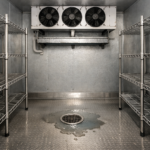
- Check for heavy frost, ice buildup, water leaks, or unusual noises.
- Review recent stocking, deliveries, door traffic, or cleaning activity.
- Document the alarm time, current temperature, and whether it is still rising.
Call a commercial refrigeration technician if the temperature keeps climbing, the unit trips alarms more than once, the evaporator is iced over, a breaker trips again after reset, the compressor sounds abnormal, the freezer is softening product, or the cooler cannot return to normal range. For urgent product risk, ask about emergency refrigeration repair and explain the equipment type, temperature trend, product load, and any alarm history. You can contact Royal Cooling at 781-899-4441 or use the contact page to request help.
Remote Monitoring Helps Prevent Emergency Repairs, But It Does Not Replace Maintenance
A monitoring system is an early-warning tool, not a substitute for preventive maintenance. If a walk-in cooler has dirty condenser coils, weak fan motors, loose electrical connections, refrigerant issues, or failing door gaskets, the alarm may tell you there is a problem, but it cannot correct the underlying cause. That is why monitoring works best when paired with scheduled refrigeration maintenance.
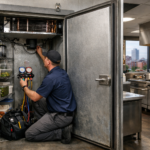
During preventive service, a technician may inspect condenser and evaporator coils, check fan operation, verify defrost function, inspect door gaskets and closers, review temperature controls, look for oil stains or refrigerant leak indicators, test electrical components, review drain performance, and compare operating temperatures to expected performance. For monitored systems, the technician can also review alarm history and temperature trends.
Trend data is valuable. A cooler that recovers more slowly each week may have a developing airflow or refrigeration problem. A freezer that alarms after every defrost cycle may have a defrost timing, termination, heater, or drain issue. A display case that warms during peak afternoon sun may need airflow corrections, coil cleaning, control adjustment, or load review. Temperature logs turn vague complaints into actionable diagnostics.
Repair vs. Replace: What Temperature Logs Can Reveal
Temperature monitoring can help Massachusetts businesses decide whether a repair is practical or whether replacement should be considered. If a relatively new walk-in cooler has occasional alarms tied to a bad door gasket or failed fan motor, walk-in cooler repair may be the right step. If an older freezer repeatedly alarms despite repairs, has inefficient operation, suffers from recurring ice buildup, and struggles during normal load, replacement planning may be more cost-effective over time.
Alarm history can support that decision. Look at how often the equipment alarms, how long recovery takes, whether the same symptoms return, and whether repair costs are increasing. A commercial refrigeration technician can compare the monitoring data with equipment age, condition, parts availability, energy performance, and business risk. For critical equipment such as a walk-in freezer serving a restaurant, hotel, or grocery department, replacement may be considered sooner if repeated failures threaten inventory and operations.
Monitoring devices themselves also have repair-versus-replace decisions. A standalone alarm with failing batteries or unreliable sensors may be inexpensive to replace. A remote monitoring gateway with communication failures may need network troubleshooting, antenna relocation, cellular service review, or replacement. If you rely on alarms for after-hours protection, test the system regularly and do not assume it is working because it worked once.
What a Commercial Refrigeration Technician Checks After an Alarm
When Royal Cooling responds to a temperature alarm concern, the process typically starts with the symptoms and the trend. Was the alarm high temperature, low temperature, power loss, communication failure, or sensor fault? Did the equipment recover? Did the alarm happen after a delivery, defrost cycle, cleaning, or heavy service period? The answers guide the inspection.
A technician may check:
- Actual box temperature with a calibrated instrument.
- Controller setpoint, differential, and sensor accuracy.
- Evaporator fan operation and airflow restrictions.
- Condenser coil cleanliness and condenser fan operation.
- Compressor operation, amperage, short cycling, and abnormal sounds.
- Defrost schedule, termination, heaters, and drain performance.
- Door gaskets, hinges, closers, strip curtains, and infiltration issues.
- Refrigerant circuit indicators, such as frost patterns and possible leak signs.
- Electrical connections, contactors, relays, capacitors, and safeties.
- Monitoring sensor placement, calibration, and communication reliability.
This diagnostic approach helps avoid guesswork. The alarm is the starting point, not the full diagnosis. The repair could be as simple as correcting airflow or replacing a door gasket, or it could involve electrical controls, defrost components, fan motors, refrigerant diagnostics, or walk-in freezer service.
Best Practices for Massachusetts Restaurants, Stores, Hotels, and Facility Managers
If you operate refrigeration equipment in Massachusetts, consider these best practices:
- Assign alarm responsibility. Decide who receives alerts, who checks the equipment, and who calls for service.
- Use escalation. Send alerts to more than one person if the first contact does not respond.
- Keep contact information current. Staff turnover can make alarms useless if notifications go to an old employee.
- Review logs weekly. Do not wait for a failure to look at restaurant temperature logging data.
- Test alarms. Confirm that alerts are received and that battery backup or communication features work.
- Document corrective action. Record whether staff closed a door, moved product, called service, or found an equipment issue.
- Schedule preventive maintenance. Monitoring is most effective when equipment is cleaned, checked, and calibrated.
Royal Cooling supports commercial refrigeration, walk-in coolers, walk-in freezers, wine coolers, reach-in refrigerators, freezer repair, and preventive refrigeration maintenance. If you are reviewing options for commercial refrigeration temperature monitoring in Massachusetts, visit our service area page or call 781-899-4441 to discuss your equipment and location.
FAQ: Commercial Refrigeration Temperature Alarms and Monitoring
What type of temperature alarm should a restaurant walk-in cooler have?
A restaurant walk-in cooler should have an adjustable high-temperature alarm, remote notifications, alert delays to reduce false alarms, reliable sensor placement, and temperature logging. Larger or high-value coolers may need multiple sensors and escalation alerts.
How can I get alerts if my walk-in freezer warms up after hours?
Use a connected freezer temperature alarm or remote refrigeration monitoring system that sends text, app, email, or platform alerts. Configure alerts to notify more than one responsible person and include a plan for checking doors, power, airflow, and product risk.
Do convenience stores need remote monitoring for beer caves and display cases?
Remote monitoring is often useful for convenience stores, beer caves, and display cases because it identifies warm product conditions, recurring airflow issues, and after-hours failures. It is especially helpful for stores with high inventory value or limited overnight staffing.
When should a temperature alarm trigger a refrigeration service call?
Call for service when the temperature keeps rising, the unit does not recover, alarms repeat, product is at risk, ice buildup is visible, fans are not operating, breakers trip, or the equipment makes unusual noises. Provide the technician with alarm times and temperature trends.
Can temperature monitoring replace preventive maintenance?
No. Monitoring warns you about temperature problems, but preventive maintenance addresses causes such as dirty coils, failing fans, bad gaskets, defrost issues, electrical problems, and refrigerant concerns. The best protection uses both monitoring and scheduled service.
Where should refrigeration temperature sensors be placed?
Sensors should be placed in representative product zones, away from direct evaporator discharge, doors, or unusual hot and cold spots. Walk-ins, display cases, beer caves, and wine coolers may require different placement strategies based on airflow and product layout.
Can temperature logs help decide whether to repair or replace equipment?
Yes. Logs show alarm frequency, recovery time, recurring patterns, and worsening performance. A technician can use that data along with equipment age, condition, repair history, and business risk to recommend repair, upgrades, or replacement planning.
Talk With Royal Cooling About Refrigeration Monitoring
A refrigeration temperature alarm is most valuable when it is chosen correctly, installed thoughtfully, tested regularly, and tied to a service plan. Whether you run a restaurant in Boston, a grocery operation in Worcester, a hotel kitchen in Cambridge, a liquor store in Lowell, a facility in Quincy, or a food business in Newton, Waltham, Framingham, Springfield, or nearby Massachusetts communities, Royal Cooling can help you evaluate practical monitoring options.
For help with remote refrigeration monitoring, walk-in cooler repair, walk-in freezer service, freezer repair, wine coolers, reach-ins, or preventive maintenance, call Royal Cooling at 781-899-4441 or request service through our contact page. We can help you turn alarm data into a clear action plan before a temperature problem becomes a product-loss emergency.