Commercial Refrigeration Repair in Boston Metro: Warning Signs Thatแ์ๆ
Short Answer: Which Commercial Refrigeration Problems Need Same-Day Attention?
Massachusetts businesses should request urgent commercial refrigeration repair when temperatures rise above safe holding ranges, product begins thawing, alarms will not clear, ice blocks airflow, a compressor or fan stops, refrigerant leak signs appear, or electrical odors are present. Restaurants, grocery stores, hotels, and convenience stores in the Boston metro should protect inventory, limit door openings, record temperatures, and call a qualified commercial refrigeration technician.
Why Fast Refrigeration Triage Matters for Massachusetts Businesses
Commercial refrigeration problems rarely happen at a convenient time. A walk-in cooler may start warming during a Friday dinner rush in Boston, a reach-in refrigerator may struggle during a catering prep day in Cambridge, or a grocery store freezer case may begin thawing during a busy weekend in Worcester County. When perishable inventory, food safety, customer service, and operating hours are at stake, the right question is not only what failed. The more urgent question is whether the problem needs same-day commercial refrigeration repair.
This guide is written for Massachusetts businesses that need a practical way to judge urgency before inventory loss gets worse. It applies to restaurants, commercial kitchens, supermarkets, grocery stores, liquor stores, convenience stores, hotels, facility managers, property managers, and businesses with wine coolers, walk-in coolers, walk-in freezers, reach-in refrigerators, and other food-service refrigeration systems.
Royal Cooling helps businesses think through the situation clearly: Is the box still holding temperature? Is the product warming quickly? Is there a safety concern? Is one piece of equipment down, or are multiple refrigerated cases affected? The answers help determine whether you need emergency refrigeration repair, a priority diagnostic visit, or a planned maintenance appointment.
If your cooler or freezer is already warming and product is at risk, call Royal Cooling at 781-899-4441 or use the contact page to request help. Service timing depends on scheduling and availability, but urgent temperature-loss situations should be treated as high priority.
Warning Signs That Need Same-Day Commercial Refrigeration Repair
Not every noise, drip, or brief temperature change is an emergency. However, certain symptoms are strong indicators that a restaurant refrigeration repair, grocery store refrigeration repair, walk-in cooler repair, or walk-in freezer service call should not wait for a routine appointment.
1. The Box Temperature Is Rising and Not Recovering
A temporary temperature bump can happen after heavy door traffic or a large warm delivery. The bigger concern is a cooler or freezer that keeps climbing and does not recover after doors remain closed. For many Massachusetts restaurants and food retailers, this is the clearest warning sign that same-day triage is needed.
Possible causes include a failed evaporator fan, dirty condenser coil, restricted airflow, low refrigerant charge, control failure, bad door gasket, defrost problem, failing compressor, or electrical issue. Because these problems can escalate quickly, do not keep opening the door to check. Use the display, a calibrated thermometer, or remote monitoring if available, and document the time and temperature trend.
2. Product Is Softening, Thawing, Sweating, or Losing Quality
If frozen product feels soft, ice cream loses firmness, seafood or meat cases show surface warming, or packaged goods feel wet from condensation, treat the situation as urgent. A freezer that is no longer maintaining product temperature may still feel cold to a person standing in the space, but the product may already be moving toward unsafe or unsellable conditions.
This is especially important for restaurants in Boston and Quincy, grocery operators in Lowell or Framingham, and hotel kitchens in Waltham or Newton where large inventory loads can represent significant financial risk. A commercial refrigeration technician can evaluate whether the issue is airflow, defrost, refrigeration circuit performance, controls, or another fault.
3. Alarms Are Sounding or the Controller Shows Persistent Faults
Modern walk-in coolers, walk-in freezers, wine coolers, prep tables, and display cases may show high-temperature alarms, probe faults, defrost faults, pressure switch trips, or controller error codes. An alarm that clears after a known event, such as a door left open, may simply need monitoring. An alarm that returns, will not reset, or appears with rising temperatures should be escalated.
Write down the alarm code, current temperature, setpoint, and what was happening before the alarm started. Do not repeatedly reset equipment without understanding the cause. Repeated resets can mask a serious electrical, compressor, or safety control issue.
4. The Walk-In Freezer Is Icing Up or Airflow Is Blocked
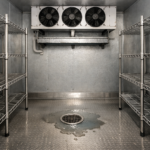
Ice on the evaporator coil, ceiling, fan guards, door frame, or product boxes can signal more than a nuisance. Heavy ice can block airflow, stop fans, prevent heat exchange, and cause temperatures to rise even while the system appears to be running. For walk-in freezer service, a large ice buildup often needs prompt attention because blocked airflow can quickly affect the entire box.
Common causes include a defrost heater failure, bad termination control, failed fan delay, air leak through a gasket or door closer, clogged drain, or low refrigerant. Chipping ice aggressively can damage coils, refrigerant lines, and panels. If ice is interfering with operation, call a technician rather than turning a manageable repair into a larger leak or equipment damage.
5. You Smell Burning, See Sparks, or Notice Electrical Problems
Electrical odors, hot panels, tripped breakers, smoke, buzzing contactors, melted wiring, or repeated breaker trips require immediate caution. Shut down equipment only if it is safe and permitted by your facility procedures, keep staff away from the hazard, and contact a qualified professional. Electrical symptoms are not a wait-and-see situation.
A commercial refrigeration system depends on motors, relays, contactors, pressure controls, defrost heaters, fans, and compressors. When electrical components fail, they may create fire risk, equipment damage, and unexpected shutdowns. For safety-related symptoms, involve the appropriate technician or electrician promptly.
6. Multiple Refrigerated Units Fail at the Same Time
If several reach-ins, cases, or walk-ins are warming at once, the cause may be a shared electrical issue, rack refrigeration issue, remote condenser problem, building power problem, control system failure, or ambient condition affecting equipment. This is common in grocery store refrigeration repair and larger commercial kitchens where multiple fixtures depend on shared infrastructure.
Multiple-unit failure should be treated as urgent because the inventory exposure is larger and the root cause may affect more systems over time. Businesses in Suffolk County, Middlesex County, and Worcester County should identify which equipment is affected, what temperatures are showing, and whether any recent electrical, construction, cleaning, or maintenance work occurred.
Urgency Comparison Table: Call Now or Monitor?
| Symptom | Likely Urgency | What It May Indicate | Best Next Step |
|---|---|---|---|
| Temperature rising and not recovering | High | Refrigeration failure, airflow issue, control problem, compressor issue | Limit door openings, document temperatures, request urgent service |
| Product thawing or sweating | High | Loss of product temperature, freezer failure, case performance problem | Protect inventory and call for emergency refrigeration repair guidance |
| Heavy ice on evaporator or fans | High to moderate | Defrost failure, air leak, drain issue, fan problem | Do not chip coils; schedule walk-in freezer service promptly |
| Brief temperature rise after delivery | Monitor if recovering | Door traffic or warm product load | Keep doors closed and confirm recovery trend |
| Burning smell, sparks, hot wiring, repeated breaker trips | Emergency | Electrical fault or unsafe component failure | Keep staff clear and call qualified service immediately |
| One fan noisy but temperature stable | Priority but not always emergency | Worn motor, loose blade, bearing issue | Schedule repair before it becomes a temperature-loss event |
What Should Massachusetts Businesses Do When a Cooler or Freezer Starts Warming Up?
When a commercial cooler or freezer starts warming up, your first steps should reduce risk without damaging the equipment. The goal is to preserve temperature, protect people, protect inventory, and give the technician useful information.
- Limit door openings. Every opening adds heat and humidity, especially during summer humidity in Massachusetts or a busy kitchen rush.
- Record temperatures and times. Note the setpoint, actual temperature, product condition, and when the problem started.
- Check obvious airflow obstructions. Make sure product is not blocking evaporator fans or discharge air paths.
- Look for door issues. A door stuck open, torn gasket, broken closer, or ice on the threshold can cause rapid warming.
- Listen and observe. Are fans running? Is the compressor running? Is there unusual buzzing, clicking, grinding, or silence?
- Do not keep resetting breakers. A repeated trip means something needs diagnosis.
- Follow your food safety policy. Move product only if your procedures allow it and you have a verified colder location.
- Call a professional. For commercial refrigeration repair Massachusetts businesses should rely on technicians who understand refrigeration circuits, electrical controls, defrost systems, airflow, and commercial food-service demands.
If you operate in Boston metro communities such as Cambridge, Quincy, Newton, Waltham, or Framingham, give your technician as much detail as possible when you call. For larger sites in Worcester, Lowell, Springfield, or regional facilities, note whether the issue affects one room, one case, a rack, or a broader building area.
When Should a Restaurant Call for Emergency Refrigeration Repair?
A restaurant should call for emergency refrigeration repair when a cooler, freezer, prep table, undercounter unit, or walk-in is no longer protecting product temperature and the issue cannot be explained by a brief door-opening event. Restaurants run on narrow service windows. If the line cooler fails before lunch, the beer cooler warms before dinner, or the walk-in cooler rises overnight, waiting can disrupt service and create disposal decisions.
For restaurant refrigeration repair, call promptly when any of these apply:
- The walk-in cooler is above setpoint and still climbing.
- Protein, dairy, prepared foods, or frozen product is warming.
- The kitchen has no backup refrigeration capacity.
- A prep table or reach-in used for active service cannot hold temperature.
- The freezer is thawing or showing excessive frost.
- There is a burning smell, electrical trip, or compressor short cycling.
- Health inspection, catering, event, or high-volume service timing increases the risk of disruption.
Royal Cooling works with commercial refrigeration equipment used by restaurants, commercial kitchens, liquor stores, convenience stores, supermarkets, grocery stores, hotels, and facilities. To discuss an urgent issue, call 781-899-4441 or reach out through Royal Cooling鈥檚 contact page.
How Do I Know If My Walk-In Cooler Failure Is an Emergency?
A walk-in cooler failure is an emergency when the box temperature is rising enough to threaten product, the system is not recovering, or there are safety-related symptoms. It is also urgent when the cooler supports critical operations and you have no reliable backup space. A florist cooler, beverage cooler, wine cooler, produce cooler, and restaurant walk-in may all have different product risk, but the same principle applies: if temperature control is failing, do not wait for the problem to become obvious product loss.
Walk-in cooler repair often involves more than adding refrigerant or adjusting a thermostat. A technician may need to evaluate the evaporator coil, condenser coil, refrigerant charge, expansion valve, solenoid valve, drain line, temperature controller, defrost settings, fan motors, door gaskets, hinges, closers, and electrical connections. The failure could be mechanical, electrical, airflow-related, control-related, or caused by poor maintenance conditions.
If the cooler is only slightly above setpoint after a large delivery but steadily recovering, you may be able to monitor closely. If the cooler is getting warmer each hour, alarms are sounding, or product condition is changing, request service.
Equipment-Specific Examples Across Boston Metro and Massachusetts
Different businesses experience refrigeration emergencies in different ways. A grocery store refrigeration repair call in Middlesex County may involve display cases and a remote condensing unit. A restaurant in Suffolk County may be dealing with a walk-in cooler door that no longer seals during humid weather. A property manager in Worcester County may have a tenant with a failing reach-in freezer. The equipment type helps define urgency.
Walk-In Coolers
Urgent signs include rising box temperature, fans not running, water around the evaporator, coil ice, door not closing, controller alarms, or a compressor that will not start. Walk-in cooler repair should be scheduled quickly when the box supports daily restaurant, hotel, or retail operations.
Walk-In Freezers
Urgent signs include soft product, ice cream not holding, snow buildup, repeated defrost problems, suction-line ice, or a freezer that seems to run continuously without reaching setpoint. Walk-in freezer service is especially time-sensitive because thawing product can be costly and difficult to stabilize.
Reach-In Refrigerators and Prep Tables
Line equipment often fails under heavy use because of blocked coils, worn gaskets, fan problems, thermostat issues, or compressor stress. If a unit holds active ingredients during service, treat a temperature problem as operationally urgent.
Wine Coolers and Beverage Coolers
Wine, beer, and beverage coolers may not always carry the same food safety urgency as protein coolers, but product quality, customer experience, and inventory value still matter. Liquor stores, restaurants, hotels, and private wine storage owners should call when temperature swings persist, humidity is abnormal, or the system stops cooling.
Repair vs. Replace: How Urgency Changes the Decision
In an emergency, the first goal is usually stabilization. Once the immediate issue is diagnosed, the technician can help you decide whether repair or replacement makes more sense. A repair may be practical when the equipment is generally in good condition, parts are available, and the failure is isolated. Replacement may be worth discussing when equipment has repeated compressor failures, severe corrosion, obsolete controls, chronic refrigerant leaks, inefficient operation, or repair costs that keep stacking up.
For example, replacing a failed fan motor, door gasket, controller sensor, contactor, or defrost component may restore reliable operation. On the other hand, an older system with a leaking evaporator coil, failing compressor, and poor box condition may need a broader plan. A qualified commercial refrigeration technician should explain what failed, what caused the failure if known, what repair is recommended, and whether preventive maintenance could reduce future breakdowns.
What a Commercial Refrigeration Technician Checks During an Urgent Visit
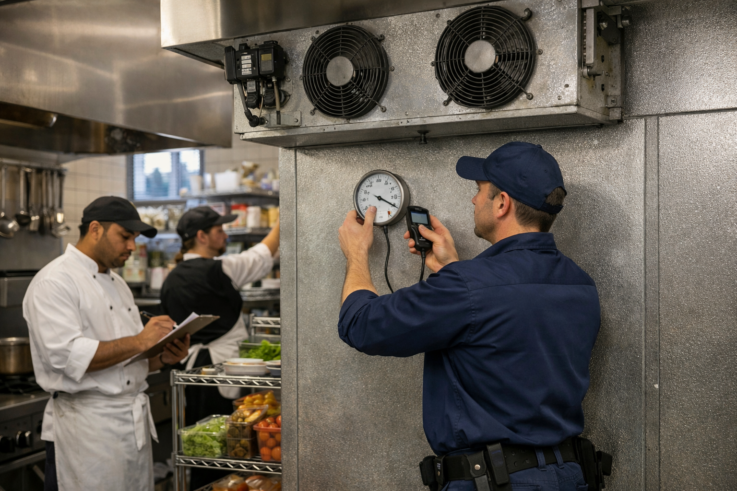
During an urgent diagnostic visit, a technician does more than look at the thermostat. Commercial refrigeration systems are interconnected, and a symptom at the box may originate at the evaporator, condenser, compressor, controls, defrost system, door assembly, or electrical circuit.
- Temperature and setpoint verification: Actual box temperature, controller reading, probe placement, and thermometer accuracy.
- Airflow: Evaporator fan operation, blocked shelves, ice on coil, dirty coils, and product loading patterns.
- Condensing unit: Compressor operation, condenser fan, coil cleanliness, pressures, and ambient conditions.
- Electrical components: Contactors, relays, capacitors, wiring, fuses, breakers, defrost heaters, and safety controls.
- Refrigeration circuit: Refrigerant pressures, superheat/subcooling where applicable, metering device behavior, restrictions, and leak indicators.
- Defrost system: Timer or controller settings, heater function, termination, fan delay, drain pan, and drain line.
- Doors and box condition: Gaskets, hinges, closers, thresholds, panel condition, air infiltration, and moisture patterns.
- Operating history: Recent maintenance, prior repairs, delivery schedule, door traffic, cleaning, and construction activity.
This process helps avoid guesswork. It also helps prevent a temporary restart from being mistaken for a complete fix when an underlying fault remains.
How Preventive Maintenance Reduces Emergency Refrigeration Repair
Emergency repair will always be part of commercial refrigeration because components wear, weather changes, and equipment works hard. Preventive maintenance reduces the frequency and severity of failures by catching problems before they shut down operations.
A practical preventive maintenance program may include condenser coil cleaning, evaporator inspection, drain cleaning, fan motor checks, electrical tightening where appropriate, gasket inspection, temperature calibration, defrost verification, refrigerant leak checks, and review of operating conditions. In Massachusetts, seasonal changes matter. Hot and humid summer weather can strain condensers and increase moisture load, while winter conditions can affect outdoor condensing units and controls.
Businesses with critical refrigeration assets should consider scheduled maintenance instead of relying only on emergency calls. If you operate multiple sites or high-value inventory in Boston metro, Suffolk County, Middlesex County, or Worcester County, ask Royal Cooling about preventive refrigeration maintenance options through the contact page. You can also review the broader service area for Massachusetts coverage context.
Call Royal Cooling When Refrigeration Failure Cannot Wait
If your commercial cooler, freezer, walk-in, reach-in, grocery case, or wine cooler is warming up, the safest business decision is fast triage. Do not wait until product quality is clearly compromised or the system stops completely. Gather temperature readings, limit door openings, protect inventory according to your internal policy, and contact an experienced refrigeration team.
Royal Cooling provides commercial refrigeration support for Massachusetts businesses, including Boston metro customer types such as restaurants, commercial kitchens, convenience stores, liquor stores, supermarkets, hotels, facility managers, property managers, and businesses with walk-in coolers, walk-in freezers, reach-ins, and specialty refrigeration. For urgent commercial refrigeration repair in Massachusetts, call 781-899-4441 or request service through Royal Cooling鈥檚 contact page.
Frequently Asked Questions
What commercial refrigeration problems require same-day service?
Rising temperatures, thawing product, persistent alarms, heavy coil ice, compressor failure symptoms, refrigerant leak indicators, electrical odors, and multiple units warming at once all warrant same-day attention or urgent triage.
When should a restaurant call for emergency refrigeration repair?
A restaurant should call when a walk-in, prep table, freezer, or reach-in cannot hold temperature, product is at risk, service will be disrupted, or there are electrical or compressor-related warning signs.
How do I know if my walk-in cooler failure is an emergency?
It is an emergency if the temperature keeps climbing, the unit is not recovering, alarms continue, product condition is changing, or the cooler supports critical operations with no backup storage.
What should Massachusetts businesses do when a cooler or freezer starts warming up?
Limit door openings, record temperatures, check for obvious airflow or door problems, protect inventory under your food safety policy, avoid repeated resets, and contact a commercial refrigeration technician.
Can I troubleshoot a commercial cooler before calling a technician?
You can safely check door closure, blocked airflow, displayed alarms, temperature history, and whether fans appear to run. Avoid opening panels, handling refrigerant, bypassing controls, or repeatedly resetting breakers.
What causes walk-in freezers to warm up even though they are running?
Common causes include iced evaporator coils, failed defrost components, weak fans, dirty condensers, low refrigerant, metering device issues, door air leaks, or a compressor that is running but not pumping properly.
Is emergency refrigeration repair different for grocery stores than restaurants?
The diagnostic principles are similar, but grocery stores may have more display cases, remote condensers, rack systems, and larger inventory exposure. Multiple-case warming should be treated as urgent.
Should I repair or replace a failing commercial refrigeration system?
Repair often makes sense for isolated component failures on equipment in good condition. Replacement may be worth considering when the system is old, repeatedly failing, leaking, inefficient, or costly to maintain.