Walk-In Cooler Power Outage Plan for Massachusetts Restaurants and “ch
Short answer: If a Massachusetts restaurant, market, or commercial kitchen has a walk-in cooler power outage, keep the door closed, note the outage time, begin temperature logs, protect high-risk foods, and avoid resetting equipment repeatedly. If power returns but the cooler does not restart, makes unusual noises, trips breakers, or cannot pull back to safe temperature, call Royal Cooling at 781-899-4441 for commercial refrigeration service.
Walk-In Cooler Power Outage Massachusetts Plan: Why You Need One Before the Lights Go Out
A walk-in cooler power outage in Massachusetts can happen during a summer thunderstorm in Boston, a winter storm in Worcester County, a utility issue in Cambridge, a building electrical problem in Quincy, or a tripped breaker in a busy commercial kitchen. For restaurants, liquor stores, grocery stores, convenience stores, hotels, supermarkets, commissaries, and institutional kitchens, the outage is more than an inconvenience. It can threaten refrigerated inventory, food safety, daily operations, and customer trust.
The most important part of a restaurant cooler outage plan is making decisions based on temperature, time, equipment condition, and product type. A walk-in box that stays closed may hold temperature for a period of time, but every location is different. Cooler size, insulation condition, door gasket condition, product load, ambient kitchen temperature, and whether the evaporator fans and condenser restart properly all matter. A backup plan for a walk-in cooler should tell staff who to call, where thermometers and logs are kept, what products to prioritize, and when a commercial refrigeration technician should inspect the system.
Royal Cooling helps Massachusetts businesses with commercial refrigeration, walk-in coolers, walk-in freezers, reach-in refrigerators, wine coolers, freezer repair, and preventive refrigeration maintenance. If you are in the Boston metro area, Middlesex County, Suffolk County, Worcester County, or nearby communities such as Lowell, Newton, Waltham, Framingham, or Springfield, use this guide as a practical outage checklist and call 781-899-4441 when the equipment may need professional diagnosis.
The First 15 Minutes: What to Do Immediately When a Walk-In Cooler Loses Power
When staff discover a cooler is dark, warm, or alarming, the first reaction is often to open the door and investigate. That can make the problem worse. The first step is to protect the cold air you already have.
- Keep the walk-in cooler door closed. Limit access to one trained employee. Do not allow line cooks, cashiers, or delivery staff to browse the cooler during the outage.
- Record the time the outage was discovered. If known, record when power actually went out. If a data logger or monitoring system is available, save the alarm history.
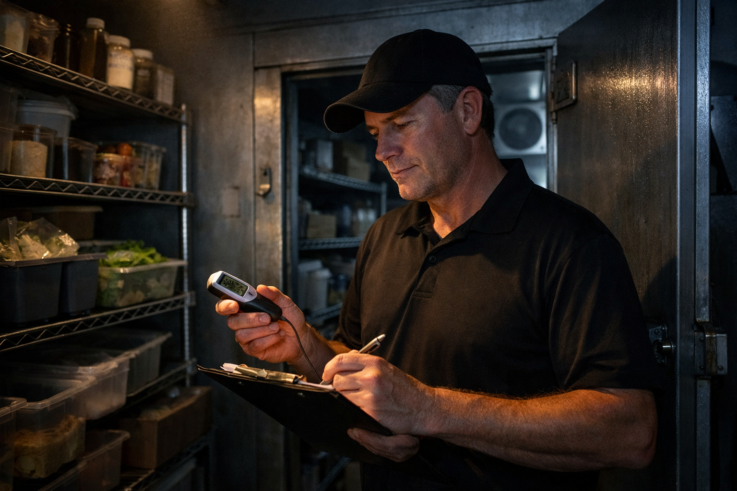
- Check the thermometer or temperature monitoring system. Record air temperature and, when possible, product temperature using a calibrated probe thermometer.
- Separate critical products mentally before moving anything. TCS foods such as dairy, cooked meats, seafood, cut produce, prepared sauces, and ready-to-eat items usually require stricter handling than sealed beverages or shelf-stable products.
- Do not prop the door open. Even if staff are worried, an open door speeds temperature rise and adds moisture to the box.
- Check whether the outage is building-wide or equipment-specific. Look for loss of lights, other equipment not operating, tripped GFCI devices, or panel issues only if it is safe and your staff are authorized.
- Avoid repeated breaker resets. A breaker that trips again may indicate an electrical fault, compressor issue, fan motor problem, or water intrusion. Repeated resets can damage equipment or create a safety risk.
If there is a burning smell, smoke, sparking, melted wiring, standing water around electrical components, or a panel that feels hot, stop troubleshooting and contact the appropriate electrical professional or emergency service. After electrical safety is addressed, a commercial refrigeration technician can check the refrigeration system.
How Long Can Food Stay Safe in a Walk-In Cooler During a Power Outage?
The safest answer is: use measured temperatures, not guesses. A closed walk-in cooler may stay cold for a while, but there is no universal time that applies to every Massachusetts restaurant or market. A heavily stocked cooler with good insulation, tight gaskets, and no door openings may hold temperature longer than a lightly stocked cooler with worn door gaskets, sweating walls, or a hot kitchen next to the cookline.
For walk-in cooler food safety, many operators use the food code principle that cold-held TCS foods should generally be held at 41°F or below. If TCS food has been above 41°F for too long, especially around the four-hour cumulative mark, it may need to be discarded. Always follow your internal food safety plan, local health department direction, and applicable Massachusetts food safety requirements. When in doubt, do not serve questionable product.
| Situation | What it may mean | Recommended action |
|---|---|---|
| Cooler stayed at or below 41°F and outage was brief | Food may remain acceptable if product temperatures confirm safe holding | Document readings, keep door closed, monitor pull-down after restart |
| Air temperature rose above 41°F but product temperatures are still at or below 41°F | Some products may still be protected, but risk is increasing | Probe representative foods, log results, reduce door openings, prepare for possible relocation |
| TCS foods have been above 41°F for an extended period | Food safety risk may be unacceptable | Follow health department and food safety policy; discard unsafe product when required |
| Cooler temperature is rising after power returns | Refrigeration system may not be running or may be damaged | Call for emergency refrigeration repair and move product if safe backup storage is available |
| Freezer product is thawing or has no ice crystals | Walk-in freezer service may be needed and product disposition must be evaluated | Record temperatures, follow your food safety policy, call a technician if the freezer does not recover |
Do not rely only on the wall thermostat. Thermostats and display controls can be inaccurate, poorly located, or affected by door openings. Use a calibrated probe thermometer for product checks and document the product, location in the cooler, time, and reading. Grocery stores and convenience stores with open refrigerated cases connected to a remote system should also check case temperatures, product temperatures, and controller alarms.
Build a Backup Plan for Your Walk-In Cooler
A backup plan for a walk-in cooler should be simple enough for staff to follow during a busy dinner rush or a storm outage. It should be posted where managers can find it and reviewed during training. The goal is to protect food, reduce equipment damage, and create a clear point when Royal Cooling or another responsible service provider is called.
1. Assign roles before an outage
Decide who is authorized to make food safety decisions, who contacts the landlord or utility, who checks the electrical panel, and who calls the commercial refrigeration technician. In multi-tenant buildings in Boston, Cambridge, Waltham, and Newton, restaurant managers may need to coordinate with property managers or facility managers because the issue may involve a shared electrical room, rooftop condensing unit, or building controls.
2. Keep the right tools ready
- Calibrated probe thermometers
- Temperature log sheets or digital logging access
- Flashlights or battery lighting that does not require leaving cooler doors open
- Labels for marking product status
- Emergency contact list for Royal Cooling, property management, utility providers, and internal decision-makers
- Insulated transport containers if your business has approved alternate cold storage
3. Identify backup storage options
Some businesses have multiple walk-ins, reach-in refrigerators, refrigerated trucks, or nearby sister locations. Others do not. If you plan to move food, confirm that the backup unit is already at safe temperature and has enough capacity for air circulation. Do not overload a working cooler so tightly that evaporator airflow is blocked. Poor airflow can create a second refrigeration problem.
4. Plan for generators carefully
Generators can help some businesses, but they must be properly sized, safely installed, and compatible with the refrigeration equipment. Walk-in coolers have startup loads that may be higher than running loads. A generator that is too small, improperly connected, or unstable can cause compressor short cycling, nuisance trips, control board issues, or motor stress. Work with qualified electrical and refrigeration professionals before relying on generator backup for commercial refrigeration power outage protection.
What Should You Check After Power Comes Back On?
When power returns, the outage is not automatically over. Many compressor failures and service calls happen after power restoration because equipment starts under stress, controls reset, breakers trip, or fans fail to restart. Restaurants, grocery stores, liquor stores, hotels, and convenience stores should monitor the walk-in cooler closely for the next several hours.
- Confirm the evaporator fans are running. If fans inside the box are not moving air, the cooler may not pull down evenly.
- Listen for the compressor and condenser fan. A silent condensing unit, clicking, humming, grinding, or short cycling can indicate a problem.
- Check the controller display. Look for high-temperature alarms, probe errors, defrost messages, or communication faults.
- Watch the temperature trend. The box should move steadily back toward setpoint. A brief lag can be normal, but rising temperature after restart is not.
- Inspect for water or ice. Power interruptions can interrupt defrost cycles, clog drains, create ice on coils, or leave water near electrical components.
- Check door gaskets and closers. During an outage, staff may rush in and out. A door left slightly open can undo recovery quickly.
- Document product temperatures again. Food safety decisions should be based on logs, not assumptions.
Grocery stores and convenience stores should also check reach-in cases, beer caves, walk-in beverage coolers, prep coolers, and freezer cases. After power comes back on, verify that each case is actually cooling and not only displaying lights. If a remote rack, rooftop condenser, or shared system serves multiple cases, one electrical or control issue can affect several zones.
When Should You Call a Commercial Refrigeration Technician After a Cooler Outage?
Call a commercial refrigeration technician promptly if the cooler outage is not clearly limited to a short building-wide power interruption, or if the equipment does not recover as expected. High service-call intent situations include any sign that the refrigeration system is not restarting, not pulling down, or may have suffered electrical or mechanical stress.
Contact Royal Cooling at 781-899-4441 for emergency refrigeration repair or walk-in cooler repair if you notice:
- The walk-in cooler remains above safe holding temperature after power returns.
- The condensing unit is not running, or the compressor hums but does not start.
- Breakers trip repeatedly or fuses blow.
- There is a burnt smell, melted wiring, buzzing contactor, or visible electrical damage.
- Evaporator fans are off, noisy, iced over, or running intermittently.
- The system short cycles, starts and stops rapidly, or locks out on a control board.
- The cooler temperature drops very slowly or warms again after initially cooling.
- The suction line, evaporator coil, or drain pan shows unusual ice buildup.
- A walk-in freezer is softening product or cannot maintain freezer temperatures.
- A wine cooler, reach-in refrigerator, or beer cooler was affected and holds high-value inventory.
If you are unsure whether to call, consider the value of the inventory, the risk of losing service, and the cost of waiting. A technician can often identify whether the issue is electrical, mechanical, airflow-related, refrigerant-related, or control-related. For businesses in Boston, Worcester, Lowell, Quincy, Framingham, and other Massachusetts communities, quick documentation and a clear service call can reduce confusion during an already stressful outage.
For non-emergency planning, you can also reach Royal Cooling through the contact page. To learn more about coverage, visit the Royal Cooling service area.
What a Refrigeration Technician Checks After a Commercial Refrigeration Power Outage
A professional inspection is more than flipping a switch. Commercial refrigeration equipment has compressors, contactors, relays, capacitors, fan motors, pressure controls, defrost controls, sensors, drains, coils, and wiring that can all be affected by power loss or unstable voltage. A technician will typically evaluate the system in a sequence that protects equipment and identifies the root cause.
Electrical and control checks
The technician may verify incoming voltage, inspect disconnects and breakers, test contactors and capacitors, check control boards, review thermostat or controller settings, and look for loose wiring or overheated terminals. If the outage was caused by a building electrical problem, the refrigeration tech may coordinate findings with the facility manager or electrician.
Compressor and condenser checks
The condensing unit is the heart of the system. The technician may check whether the compressor starts properly, whether condenser fans are operating, whether coils are blocked with debris, and whether head pressure appears abnormal. Dirty condenser coils can make recovery harder after an outage, especially during humid Massachusetts summer weather.
Evaporator and airflow checks
Inside the walk-in, the technician may inspect evaporator fans, coil condition, ice buildup, drain pan, drain line, and airflow restrictions. Overloaded shelves, boxes stacked against the evaporator, or a failed fan can cause warm zones even when the condensing unit is running.
Refrigerant and performance checks
If the cooler is running but not cooling correctly, the technician may evaluate pressures, superheat, subcooling, temperature split, and signs of refrigerant leaks. A power outage does not cause every refrigerant problem, but it can reveal an existing weakness when the system struggles to recover.
Defrost and drain checks
Outages can interrupt scheduled defrost cycles. A freezer or low-temperature system may come back with ice that blocks airflow. Drains can refreeze or clog, leading to water on the floor, ice sheets, or coil icing. Walk-in freezer service may be needed if the system cannot return to proper operation.
Repair vs. Replace After a Cooler Outage
Most walk-in cooler power outage problems are repairable, especially when the box, insulation, and major equipment are in reasonable condition. However, an outage can expose chronic issues that were already developing. Royal Cooling can help you compare repair versus replacement based on equipment age, condition, refrigerant type, compressor health, coil condition, electrical reliability, and the cost of repeated downtime.
| Factor | Repair may make sense when… | Replacement may be worth discussing when… |
|---|---|---|
| Equipment age | The system is relatively modern and parts are available | The equipment is near the end of expected service life or has obsolete parts |
| Failure type | A fan motor, contactor, capacitor, sensor, door gasket, or control issue is isolated | Major compressor failure, coil deterioration, or repeated electrical failures are present |
| Performance history | The cooler held setpoint reliably before the outage | The cooler had chronic warm temperatures, ice issues, short cycling, or high energy use |
| Inventory risk | Downtime risk is manageable with a good backup plan | Repeated failures threaten high-value food, beverage, floral, or wine inventory |
| Maintenance condition | Coils, fans, drains, gaskets, and controls are in maintainable condition | Poor airflow, rust, damaged panels, water intrusion, or failing insulation are widespread |
A technician should explain what failed, what is needed now, and what may become a future risk. For a restaurant in Suffolk County, a hotel kitchen in Middlesex County, or a market in Worcester County, the right answer depends on business continuity as much as equipment cost.
Preventive Maintenance That Reduces Outage Damage
You cannot prevent every Massachusetts storm, grid event, or building electrical failure. You can reduce the chance that a short outage becomes a major refrigeration loss. Preventive refrigeration maintenance keeps the system cleaner, safer, and more likely to recover when power returns.
- Clean condenser coils. Dust, grease, cottonwood, and debris make the system run hotter and recover slower.
- Inspect evaporator fans. Weak fan motors reduce airflow and create uneven temperatures.
- Check door gaskets, hinges, and closers. Air leaks allow heat and humidity into the box, especially in busy kitchens.
- Verify thermostat and sensor accuracy. A bad sensor can hide unsafe temperature conditions.
- Clear drains. Clogged drains lead to water, ice, and potential slip hazards.
- Review defrost settings. Incorrect defrost timing can cause ice buildup or unnecessary temperature swings.
- Test alarms and monitoring. Staff should know when a cooler is trending warm, not discover it hours later.
- Document recurring issues. Short cycling, nuisance breaker trips, and overnight temperature fluctuations should be addressed before an emergency.
Seasonal maintenance is especially important before Massachusetts summer heat and before winter storm periods. Businesses in dense Boston metro buildings, older properties in Cambridge or Worcester, and high-volume kitchens in places such as Lowell, Newton, Waltham, and Framingham may have added electrical load, rooftop access challenges, or ventilation issues that make proactive service valuable.
Massachusetts Restaurant Cooler Outage Plan Checklist
Use this checklist as a starting point for your own standard operating procedure. Adapt it to your menu, product mix, local health department requirements, and facility layout.
- Keep cooler and freezer doors closed.
- Record outage discovery time and known outage start time.
- Assign one manager to temperature logging and one to communications.
- Check product temperatures with a calibrated thermometer.
- Separate TCS food decisions from lower-risk beverage or packaged product decisions.
- Do not reset breakers repeatedly.
- Contact property management or the utility if the outage appears building-related.
- Call Royal Cooling at 781-899-4441 if equipment does not restart, trips, alarms, or fails to pull down.
- After power returns, monitor temperature trend until the cooler is stable.
- Document all food safety decisions and service findings.
This plan is useful for restaurants, commissaries, hotels, supermarkets, convenience stores, liquor stores with beer caves, and property managers responsible for tenant refrigeration. It also applies to specialty equipment such as wine coolers, reach-in refrigerators, and walk-in freezer systems that may be affected by the same power event.
FAQ: Walk-In Cooler Power Outages in Massachusetts
What should a Massachusetts restaurant do if a walk-in cooler loses power?
Keep the door closed, record the outage time, start temperature logs, check product temperatures with a calibrated thermometer, and limit access. If the cooler does not restart correctly or cannot pull back to safe temperature after power returns, call Royal Cooling at 781-899-4441.
How long can food stay safe in a walk-in cooler during a power outage?
There is no single safe time for every cooler. Use product temperatures and your food safety plan. TCS foods generally need to be held at 41°F or below, and food that has been above safe temperature too long may need to be discarded.
When should I call a commercial refrigeration technician after a cooler outage?
Call when the cooler stays warm, trips breakers, makes unusual noises, has fan or compressor problems, shows electrical damage, or does not steadily return to setpoint after power is restored. These symptoms can indicate a repair issue beyond basic outage recovery.
What should grocery stores and convenience stores check after power comes back on?
Check walk-in coolers, beer caves, reach-in cases, freezer cases, controller alarms, product temperatures, evaporator fans, condenser operation, and any remote rack or rooftop equipment serving multiple cases. Document readings before deciding what product can be sold.
Can I use a generator for my walk-in cooler?
Possibly, but it must be properly sized and safely connected. Walk-in coolers can have high startup loads, and poor power quality can damage compressors or controls. Plan generator use with qualified electrical and refrigeration professionals before an outage.
Should I move food to another cooler during an outage?
Only move food if the alternate cooler is already at safe temperature, has enough capacity, and the move can be done quickly. Overloading a backup cooler can block airflow and create another temperature problem.
Why is my walk-in cooler not cooling after power returned?
Possible causes include a tripped breaker, failed contactor, bad capacitor, compressor lockout, fan motor failure, control issue, iced evaporator coil, dirty condenser coil, or refrigerant-related problem. A commercial refrigeration technician can diagnose the system safely.
Does Royal Cooling service both walk-in coolers and walk-in freezers?
Yes. Royal Cooling services commercial refrigeration equipment including walk-in coolers, walk-in freezers, reach-in refrigerators, wine coolers, and related freezer repair and preventive maintenance needs for Massachusetts businesses.
Need Help After a Walk-In Cooler Power Outage?
If your Massachusetts business is dealing with a commercial refrigeration power outage, do not wait until product loss becomes unavoidable. Keep doors closed, document temperatures, protect food safety, and call Royal Cooling at 781-899-4441 if the system is not recovering normally. For service questions, use the contact page, or review the service area for Massachusetts coverage context.