Commercial Refrigeration Installation Planning in Massachusetts: S. S,
Short Answer: How to Plan a Commercial Refrigeration Installation in Massachusetts
For commercial refrigeration installation in Massachusetts, start by sizing equipment around your product load, delivery schedule, door openings, temperature requirements, and available space. Then confirm airflow, drainage, electrical capacity, condenser location, and technician service access before ordering. In older Boston metro, Worcester, Cambridge, and mixed-use buildings, layout planning can prevent costly changes after delivery.
Why Installation Planning Matters Before You Buy Refrigeration Equipment
Commercial refrigeration is not a plug-and-play purchase for most Massachusetts businesses. A walk-in cooler, walk-in freezer, reach-in refrigerator, wine cooler, prep table, or undercounter unit must fit the business operation, the building, and the service environment. The right equipment can protect inventory, support food safety procedures, reduce emergency refrigeration repair calls, and make preventive maintenance easier. The wrong equipment can create tight aisles, short cycling, warm product, icing, nuisance alarms, drainage problems, and expensive access issues.
Royal Cooling helps Massachusetts businesses think through commercial refrigeration installation before equipment is ordered, delivered, or built into a space. That planning is especially important for restaurants, commercial kitchens, liquor stores, convenience stores, supermarkets, grocery stores, hotels, facility managers, property managers, and homeowners with specialty wine coolers or freezers.
Buildings across the Boston metro area, Worcester County, Middlesex County, and Suffolk County often present real-world constraints: narrow basements, older masonry, limited roof access, shared utility rooms, low ceiling heights, tight alleyways, multi-tenant mechanical areas, and strict delivery windows. Restaurants in Cambridge, Quincy, Newton, Waltham, Framingham, Lowell, Springfield, Worcester, and Boston may all face different installation limitations depending on the property. A qualified commercial refrigeration contractor should evaluate those conditions before recommending a system.
Common Massachusetts Site Constraints That Affect Refrigeration Installation
Many commercial refrigeration problems begin before the first service call. They start with an installation that was squeezed into a difficult space without enough attention to heat rejection, drainage, electrical load, or service clearance. In Massachusetts, the challenge is often not just choosing the equipment; it is making the equipment work reliably inside an older or space-constrained building.
Older buildings and tight delivery paths
In Boston, Cambridge, Worcester, and similar urban areas, a walk-in box or reach-in case may need to pass through narrow doors, stairs, elevators, hallways, or loading areas. A walk-in cooler installation should be planned around panel dimensions, floor conditions, final box footprint, door swing, aisle access, and whether the unit will be indoor, outdoor, or remote-condensing.
Mixed-use properties
Restaurants, markets, and convenience stores in mixed-use properties may share walls, ceilings, basements, and roofs with residential or office tenants. That can affect condenser location, noise considerations, vibration, heat discharge, and access for a commercial refrigeration technician. Planning ahead helps avoid placing a condenser where it recirculates hot air, disturbs neighboring tenants, or becomes difficult to reach during service.
Limited back-of-house space
Commercial kitchen refrigeration must be designed around workflow. A cooler door that blocks a prep aisle, a freezer that forces staff to carry cases across the cookline, or a reach-in refrigerator installed too close to a wall can slow service and create maintenance problems. Layout should support receiving, storage, prep, cooking, bar service, and trash flow without blocking airflow or technician access.
Refrigeration Equipment Sizing: How Big Should the System Be?
Refrigeration equipment sizing is one of the most important planning steps. Oversized equipment can short cycle, struggle with humidity control, and wear components prematurely. Undersized equipment may run constantly, fail to recover after deliveries, and trigger temperature alarms during busy periods. The best size depends on product type, storage volume, temperature target, usage pattern, and building conditions.
How do I know what size walk-in cooler my Massachusetts business needs?
To estimate the size of a walk-in cooler, start with what you store, how much product arrives at once, how often deliveries occur, and how staff access the cooler throughout the day. A restaurant with daily produce and dairy deliveries may need a different layout than a convenience store storing beverages, a caterer holding prepared food, or a liquor store with specialty product.
A commercial refrigeration contractor will typically look at:
- Product volume: Cases, kegs, trays, boxes, or pallets stored at peak inventory.
- Temperature range: Medium-temperature cooler storage, low-temperature freezer storage, wine storage, or specialty product requirements.
- Pull-down needs: Whether the system is expected to cool warm product or only hold already-chilled inventory.
- Door openings: How often staff enter, how long doors remain open, and whether strip curtains or air curtains are appropriate.
- Shelving and aisle space: Product must be accessible without blocking evaporator airflow.
- Future growth: A business planning expanded menu items, catering, delivery, or higher sales volume may need extra capacity.
For Massachusetts restaurants and markets, it is also important to consider seasonal changes. Summer heat, heavy tourism periods, outdoor dining, school schedules, holidays, and event traffic can increase refrigeration load. A system that barely keeps up in April may struggle during July humidity or a busy weekend in Boston, Worcester, Lowell, or Quincy.
What Restaurants Should Consider Before Installing a Walk-In Freezer
Walk-in freezer installation requires even more planning than cooler installation because freezers involve lower temperatures, frost control, insulated floors or floor panels, door heaters, defrost cycles, and drainage considerations. A freezer that is placed in the wrong area or installed without proper details may develop ice buildup, door sealing problems, slippery floors, warm product, and expensive compressor strain.
Restaurants should consider the following before installing a walk-in freezer:
- Floor and threshold design: Freezers often need insulated floors, ramps, or recessed construction depending on the site.
- Door swing and traffic: Freezer doors should not open into high-traffic prep zones or block emergency egress paths.
- Defrost and drainage: Defrost water must be managed correctly to avoid ice, standing water, or clogs.
- Evaporator placement: Air should circulate around stored product without blowing directly at an open doorway.
- Condenser location: Heat rejection must be planned so the freezer does not fight its own hot discharge air.
- Electrical load: Freezers may require dedicated circuits, disconnects, and coordination with electrical contractors.
- Service access: Technicians need room to inspect coils, fans, motors, drain lines, heaters, controls, and refrigerant components.
For restaurant refrigeration installation in Massachusetts, the best result usually comes from coordinating the refrigeration contractor early with the general contractor, electrician, plumber, hood contractor, kitchen designer, and property manager. Waiting until equipment is delivered can limit options and increase labor costs.
Layout Planning: Airflow, Drainage, Doors, and Workflow
A good refrigeration layout protects both temperature performance and daily operations. Even the best equipment can perform poorly if warm air is trapped around a condenser, evaporator airflow is blocked, drains are poorly routed, or the equipment is boxed in with no maintenance access.
Airflow around evaporators and condensers
Evaporator coils inside walk-in coolers and freezers need room to move air across the box. Shelving, stacked product, cardboard, and hanging items should not block supply or return airflow. Blocked evaporators can cause warm spots, coil icing, long run times, and product temperature variation.
Condensing units also need adequate airflow. A condenser in a hot closet, a cramped basement, or an enclosed mechanical room can recirculate discharge heat. That can increase head pressure, raise energy use, stress the compressor, and lead to emergency refrigeration repair during peak heat.
Drainage and condensate management
Commercial refrigeration equipment produces condensate and defrost water. Drain lines must be routed, pitched, trapped, heated where necessary, and protected from freezing or clogging. In Massachusetts winters, exterior or poorly conditioned drain routes may require extra planning. In older buildings, connecting to existing drainage may require coordination to avoid odors, backups, and water damage.
Door placement and staff movement
A walk-in cooler or freezer door should support the way employees receive, stock, prep, and serve product. If the door opens into a narrow hallway or blocks a prep table, staff may prop it open longer than necessary. That raises humidity, creates frost, increases compressor run time, and can shorten gasket and hinge life.
How Much Service Clearance Does Commercial Refrigeration Equipment Need?
Service clearance varies by manufacturer, equipment type, and installation design, so the exact requirement should come from the equipment manual and local site review. As a practical planning rule, commercial refrigeration equipment needs enough space for a technician to safely remove panels, clean coils, test electrical components, access valves, inspect drain lines, and replace motors, controls, fans, gaskets, or compressors without dismantling the surrounding building.
For many reach-in refrigerators, prep tables, and self-contained units, clearance is needed around air intake and discharge areas as well as the service panels. For walk-in cooler installation and walk-in freezer installation, technicians need access to evaporators, condensing units, line sets, controls, drain piping, and electrical disconnects. Rooftop or remote condensers may also require safe access paths and code-compliant working space.
When space is tight, service access should be discussed before the layout is finalized. If a unit is installed flush against a wall, built under permanent millwork, or placed behind fixed shelving, future repairs can take longer and cost more. Poor access can also delay urgent work during a temperature emergency.
Installation Planning Comparison: New Installation vs Replacement
| Planning Area | New Installation | Replacement Installation | Why It Matters |
|---|---|---|---|
| Equipment sizing | Based on menu, inventory, delivery schedule, and future growth | Should not automatically copy the old size if operations changed | Prevents short cycling, warm product, and constant run time |
| Layout | Can be designed around workflow from the beginning | May need to work within existing walls, drains, and doors | Improves staff efficiency and reduces door-open time |
| Electrical | Can be coordinated before rough-in | Existing circuits must be evaluated for load and condition | Reduces nuisance trips and unsafe wiring conditions |
| Drainage | Drain routes can be planned early | Old drains may be undersized, clogged, poorly pitched, or unheated | Helps prevent leaks, ice, odors, and water damage |
| Service access | Clearance can be built into the plan | Access may be limited by previous construction | Faster maintenance and less disruption during repairs |
| Downtime planning | Can be scheduled before opening | Must protect existing inventory during switchover | Critical for restaurants, markets, hotels, and convenience stores |
Should a Massachusetts Business Repair Old Refrigeration Equipment or Plan a New Installation?
Repair can make sense when the equipment is relatively young, properly sized, accessible, and has an isolated issue such as a failed fan motor, bad control, door gasket problem, clogged drain, or refrigerant leak that can be corrected. Replacement planning becomes more important when the system is aging, inefficient, undersized, repeatedly failing, difficult to access, or no longer fits the business operation.
Massachusetts business owners should consider a new installation when they see patterns such as:
- Frequent walk-in cooler repair or walk-in freezer service calls
- Rising utility bills without a clear operational change
- Temperature swings after deliveries or during busy service
- Recurring ice buildup, condensation, or water on floors
- Compressor short cycling, long run times, or repeated overload trips
- Obsolete parts or refrigerant concerns
- Equipment that blocks workflow or cannot be safely serviced
- Business growth that has outpaced the original refrigeration capacity
A commercial refrigeration technician can help compare repair and replacement options by checking system condition, age, accessibility, operating pressures, electrical readings, coil condition, door seals, controls, and maintenance history. The goal is not always to replace equipment. The goal is to make a practical decision that protects inventory, staff workflow, and operating continuity.
What a Technician Checks During a Pre-Installation Site Visit
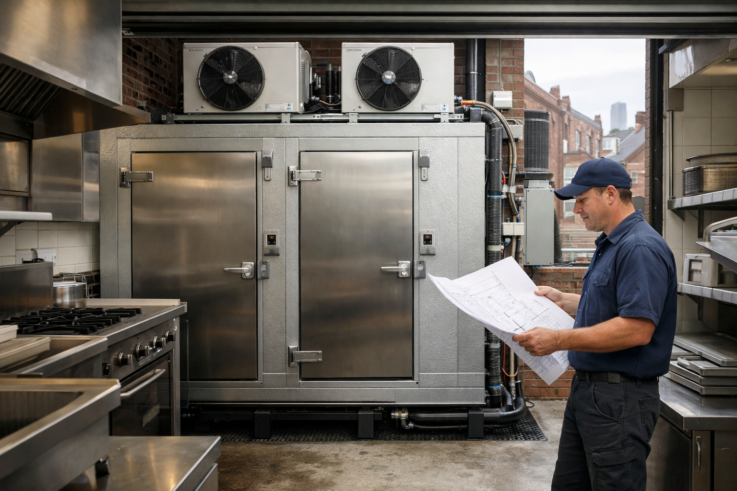
A thorough site evaluation gives the contractor the information needed to recommend the right equipment and installation approach. For commercial refrigeration installation Massachusetts projects, Royal Cooling may review the space, equipment goals, and building conditions before recommending next steps.
Typical inspection points include:
- Business use: Restaurant, grocery store, liquor store, convenience store, hotel, commercial kitchen, facility, or property type.
- Product requirements: Cooler, freezer, wine cooler, reach-in refrigerator, prep unit, display case, or specialty storage.
- Room measurements: Floor area, ceiling height, door sizes, aisle widths, and delivery path.
- Existing equipment: Age, condition, capacity, refrigerant type, accessibility, and failure history.
- Electrical service: Panel capacity, circuits, disconnects, voltage, phase, and coordination needs.
- Drainage: Floor sinks, drain routing, pitch, traps, heat tape needs, and freeze exposure.
- Airflow: Evaporator location, condenser placement, mechanical room ventilation, and heat rejection.
- Structural considerations: Floor condition, rooftop access, mounting points, penetrations, and vibration concerns.
- Service clearance: Safe working space for preventive maintenance and future repairs.
- Downtime plan: Temporary storage, phasing, delivery timing, and inventory protection during replacement.
This process is especially valuable when replacing equipment in an operating restaurant or market. A planned installation can reduce disruption compared with waiting for a complete failure that forces emergency decisions.
Maintenance Tips After Installation
Once the equipment is installed, preventive maintenance helps protect the investment. Commercial refrigeration maintenance should be scheduled around the equipment type, usage level, environment, and manufacturer recommendations. Busy kitchens, dusty storage rooms, high-grease environments, and beverage-heavy operations may need more frequent attention.
- Keep evaporator and condenser coils clean and unobstructed.
- Do not stack boxes against fans or air returns.
- Check door gaskets, hinges, closers, and sweeps regularly.
- Monitor temperatures and investigate repeated alarms.
- Keep drain lines clear and watch for standing water or ice.
- Do not store product in front of service panels or disconnects.
- Train staff not to prop doors open during stocking.
- Schedule preventive maintenance before peak summer demand when possible.
For businesses in Boston metro, Worcester County, Middlesex County, Suffolk County, and surrounding Massachusetts communities, a proactive maintenance plan can help reduce unplanned downtime and identify small issues before they become after-hours emergencies.
Emergency Signs That Need Prompt Refrigeration Service
Some symptoms should be addressed quickly because they can affect product temperature, safety procedures, or equipment reliability. Call a commercial refrigeration technician if you notice:
- Cooler or freezer temperature rising and not recovering
- Product feeling soft, warm, or inconsistent
- Heavy frost on evaporator coils or around freezer doors
- Water leaking, standing water, or ice forming near drains
- Burning smell, tripped breakers, or electrical buzzing
- Compressor running constantly or repeatedly shutting off
- Fans not spinning or making loud noise
- Alarm notifications from temperature monitoring systems
If you are planning a new installation or dealing with repeated refrigeration issues, contact Royal Cooling at 781-899-4441 or visit the contact page. To confirm whether your location is within the service area, see Royal Cooling’s service area.
Frequently Asked Questions
How do I know what size walk-in cooler my Massachusetts business needs?
Size depends on peak inventory, product type, delivery schedule, shelving layout, door openings, and future growth. A contractor should measure the space, review operations, and calculate refrigeration load instead of guessing from square footage alone.
What should restaurants consider before installing a walk-in freezer?
Restaurants should plan floor insulation, door swing, defrost drainage, evaporator placement, condenser location, electrical requirements, and service access. Freezers also need careful frost and moisture control to prevent ice, door problems, and temperature issues.
How much service clearance does commercial refrigeration equipment need?
Clearance depends on the equipment and manufacturer requirements, but technicians need safe access to panels, coils, fans, drains, valves, electrical components, and controls. Avoid building units into spaces where panels cannot be removed or airflow is blocked.
Should a Massachusetts business repair old refrigeration equipment or plan a new installation?
Repair may be practical for isolated failures on equipment that is properly sized and serviceable. Replacement planning is wise when failures are frequent, parts are obsolete, energy use is rising, access is poor, or the system no longer fits business demand.
Can a walk-in cooler be installed in an older Boston or Cambridge building?
Often yes, but the project needs careful planning. Delivery paths, floor condition, ceiling height, electrical service, drainage, condenser placement, ventilation, and service access should be reviewed before equipment is ordered.
Who should install commercial kitchen refrigeration in Massachusetts?
Use a qualified commercial refrigeration contractor familiar with walk-in coolers, walk-in freezers, reach-ins, condensers, line sets, controls, drainage, and preventive maintenance. The contractor should understand Massachusetts building constraints and food-service operations.
What causes new refrigeration equipment to perform poorly after installation?
Common causes include incorrect sizing, blocked airflow, poor condenser location, undersized electrical service, bad drainage, excessive door openings, inadequate insulation, and lack of service clearance for maintenance or repairs.
Plan Your Massachusetts Refrigeration Installation With Royal Cooling
Commercial refrigeration installation is a major operational decision for restaurants, commercial kitchens, liquor stores, convenience stores, supermarkets, grocery stores, hotels, property managers, and facilities. The best time to solve sizing, layout, airflow, drainage, and access problems is before the equipment is ordered.
If you are planning walk-in cooler installation, walk-in freezer installation, restaurant refrigeration installation, reach-in replacement, wine cooler service, freezer repair, or preventive refrigeration maintenance in Massachusetts, Royal Cooling can help you evaluate the space and plan next steps. Call 781-899-4441 or request service through the Royal Cooling contact page.