Commercial Refrigeration Repair or Replacement: How Massachusetts Busi
Short answer: Massachusetts businesses should repair commercial refrigeration when the unit is newer, the problem is isolated, parts are available, and temperature recovery is reliable after service. Replacement is usually smarter when walk-in coolers, freezers, reach-ins, or wine coolers are older, repeatedly failing, inefficient, leaking refrigerant, or putting inventory, food safety, and business operations at risk.
Choosing between commercial refrigeration repair or replacement Massachusetts businesses can trust is not just a mechanical decision. It is an operating-cost, food-safety, inventory-protection, and customer-service decision. A restaurant in Boston, a liquor store in Waltham, a hotel kitchen in Cambridge, a convenience store in Quincy, or a supermarket in Worcester cannot afford guesswork when cold storage becomes unreliable.
In many cases, one service call from a qualified commercial refrigeration technician is enough to restore performance. A failed fan motor, dirty condenser coil, misadjusted temperature control, iced evaporator, worn door gasket, clogged drain, contactor failure, or small electrical issue may be repairable without replacing the whole system. In other cases, repeated breakdowns are a sign that replacement planning is overdue.
This guide explains how Massachusetts restaurants, commercial kitchens, liquor stores, convenience stores, supermarkets, hotels, facility managers, property managers, and specialty storage owners can make a practical decision. If you need a professional evaluation, Royal Cooling can inspect the equipment, explain repair options, and help you plan replacement when it makes more sense. Call 781-899-4441 or visit the contact page to request service.
Why the Repair-or-Replace Decision Matters for Massachusetts Businesses
Commercial refrigeration is mission-critical equipment. When a walk-in cooler or reach-in refrigerator runs warm, the cost is not limited to the repair invoice. Operators may face product loss, interrupted prep, emergency purchases, staff downtime, lost sales, and health-code concerns. In Massachusetts, equipment also has to handle demanding seasonal conditions: humid summers in the Boston metro, cold-weather operation on outdoor condensing units, temperature swings in shoulder seasons, and busy service loads during weekends, holidays, events, and tourist periods.
The right choice depends on more than equipment age. A five-year-old reach-in refrigerator that has been neglected in a hot kitchen may be a worse candidate for repair than a well-maintained older walk-in cooler with a simple fan issue. A freezer serving a grocery store in Framingham has different risk exposure than a small undercounter cooler holding bottled beverages. A wine cooler protecting high-value inventory in Newton needs different temperature and humidity consistency than a general storage box.
That is why a professional diagnosis matters. A technician should identify the root cause, not just reset an alarm or add refrigerant. If the underlying issue is poor airflow, a failing compressor, refrigerant restrictions, oversized loads, air leaks, control problems, or an aging condensing unit, the repair-or-replace recommendation changes.
When Commercial Refrigeration Repair Is Usually the Better First Step
Commercial refrigeration repair is often the right move when the equipment is still within a reasonable service life, the cabinet or box is structurally sound, and the failure is limited to one serviceable component. For many businesses, a timely repair protects inventory and delays capital spending without sacrificing reliability.
Repair may be the smarter choice when:
- The equipment is relatively new. If a reach-in, walk-in system, or freezer has years of expected life remaining, repairing a failed component is often sensible.
- The failure is isolated. Fan motors, relays, contactors, controls, thermostats, door gaskets, hinges, drain heaters, defrost timers, and some sensors are commonly serviceable.
- Temperature problems started suddenly. A sudden warm box after a door was left open, a fan stopped, or a breaker tripped may not mean the equipment is at the end of its life.
- Parts are available. If replacement parts can be sourced without excessive delay, repair may reduce downtime and avoid an unnecessary equipment purchase.
- The system has been maintained. A unit with clean coils, documented preventive maintenance, correct refrigerant charge, and normal operating pressures is a better repair candidate.
- The repair cost is modest compared with replacement. If a repair restores reliable operation at a fraction of installed replacement cost, repair can be financially sound.
Examples include reach-in refrigerator repair for a failed evaporator fan in a cafe, walk-in freezer service for a defrost issue at a restaurant, or restaurant refrigeration service for a dirty condenser coil and weak door gasket. In each case, the problem may look serious to staff because the temperature is rising, but the actual fix may be targeted and cost-effective.
When Replacement Planning Becomes the Smarter Move
Commercial refrigeration replacement becomes more attractive when the equipment is unreliable, inefficient, obsolete, or expensive to keep alive. Replacement is not only about buying a new box or condensing unit. It is about reducing risk, improving performance, supporting food safety, and avoiding a pattern of emergency repairs.
Replacement planning may be the better decision when:
- The same unit has repeated breakdowns. If staff are constantly calling for emergency refrigeration repair, the equipment may be costing more than it appears.
- The compressor is failing on an older system. Compressor replacement can be worthwhile in some cases, but on older equipment it may not solve coil, control, refrigerant, or structural problems.
- Refrigerant leaks keep returning. Repeated leaks can indicate deteriorated coils, vibration problems, corrosion, or poor long-term economics.
- The system uses refrigerant that is expensive or harder to source. Refrigerant availability and regulatory changes can make repeated repairs less appealing.
- The box envelope is failing. Saturated insulation, damaged panels, poor doors, floor problems, or severe air leaks can undermine even a new refrigeration system.
- Energy use is excessive. Older equipment can run longer, struggle to recover temperature, and add heat to kitchens or mechanical areas.
- The equipment no longer matches the business. A growing restaurant, busy convenience store, or expanded catering operation may have outgrown its cooler or freezer capacity.
For a walk-in cooler replacement, the decision might include evaluating insulated panels, doors, evaporators, condensing units, controls, drains, electrical service, code considerations, access, and installation timing. For a reach-in refrigerator, replacement may be more practical if the cabinet is rusting, gaskets no longer seal well, temperatures are inconsistent, and repair costs are stacking up.
Repair vs. Replacement Comparison Table
| Decision Factor | Repair May Make Sense When… | Replacement May Make Sense When… |
|---|---|---|
| Equipment age | The unit is newer or has a strong maintenance history. | The unit is older and major components are nearing end of life. |
| Repair frequency | This is the first significant issue in a long time. | Breakdowns are recurring during busy periods or after recent repairs. |
| Failure type | The issue is a fan, control, gasket, relay, drain, or other serviceable part. | The compressor, coil, cabinet, insulation, or multiple components are failing. |
| Product risk | The unit recovers temperature quickly after repair. | Warm temperatures are threatening food, beverages, flowers, wine, or frozen goods. |
| Energy performance | Run times and operating pressures are normal after service. | The system runs constantly, short cycles, or cannot hold setpoint efficiently. |
| Parts and refrigerant | Parts are available and refrigerant support is practical. | Parts are obsolete, delayed, or refrigerant costs make repairs unattractive. |
| Business plans | The current capacity still fits your operation. | You are renovating, expanding, changing menus, or adding inventory volume. |
Should I Repair or Replace My Walk-In Cooler in Massachusetts?
For many Massachusetts operators, the walk-in cooler is the backbone of the business. A restaurant in Boston, a grocery store in Lowell, a brewery kitchen in Worcester County, or a hotel in Suffolk County may rely on that cooler every hour of the day. The decision starts with separating the box from the refrigeration system.
If the insulated panels, ceiling, floor, and door are in good condition, a technician may recommend repairing or replacing individual refrigeration components instead of replacing the entire walk-in. Walk-in cooler repair might involve replacing an evaporator fan motor, repairing a refrigerant leak, cleaning coils, adjusting the expansion valve, correcting airflow, replacing a thermostat, or servicing the condensing unit.
Walk-in cooler replacement becomes more likely when panels are damaged, insulation is saturated, the door frame is failing, floors are unsafe, or the cooler is too small for current volume. It can also make sense when an old condensing unit and evaporator are both near failure. In that case, putting money into one component may only postpone the next major expense.
Ask these questions before approving another repair: Has this cooler had multiple service calls in the last year? Does it recover temperature after deliveries? Are employees finding condensation, warm spots, ice buildup, or door sealing problems? Does the unit struggle during humid Massachusetts summer weather? Are parts still available? If several answers point to chronic failure, replacement planning may reduce risk.
When Is a Commercial Refrigerator Too Old to Keep Repairing?
A commercial refrigerator is too old to keep repairing when age, reliability, and cost begin working against the business. There is no single age that applies to every unit. Usage matters. A reach-in refrigerator in a high-volume sandwich shop in Cambridge may cycle far more often than a beverage cooler in a lightly used office pantry. A freezer in a convenience store may have constant door openings, while a hotel banquet cooler may experience heavy seasonal peaks.
Instead of using age alone, consider the pattern:
- Does the unit need service several times per year?
- Are repair costs increasing because components are harder to access or source?
- Does the refrigerator fail to maintain safe product temperature during normal use?
- Are staff using workarounds such as reducing inventory, blocking sections, or moving product overnight?
- Is the cabinet rusting, sweating, leaking, or losing door alignment?
- Is the compressor noisy, overheating, short cycling, or running nearly nonstop?
If an older unit has multiple symptoms, continued repairs may be a poor use of capital. A technician can still perform a diagnostic visit, but the recommendation may shift from immediate repair to temporary stabilization plus replacement planning.
Is It Better to Replace a Reach-In Refrigerator or Repair It Again?
For a reach-in refrigerator repair, the answer depends on the cabinet condition, compressor health, cost of parts, and business risk. Repair is often appropriate for door gaskets, hinges, fan motors, controls, clogged drains, condensate issues, and some electrical failures. These repairs can restore performance without replacing an otherwise useful cabinet.
Replacement may be better when the reach-in has a weak compressor, damaged cabinet, rusted interior, poor door alignment, recurring leaks, or a history of warm temperatures after previous service. In restaurants, reach-ins also experience heavy use from frequent door openings, hot kitchen air, and staff loading warm product. If the cabinet cannot maintain temperature during service, it may be hurting workflow and creating product risk.
Before replacing a reach-in, restaurant owners should confirm the size, door swing, electrical requirements, ventilation clearance, storage style, shelving, casters, kitchen layout, and delivery path. A new unit that does not fit the kitchen or cannot ventilate properly may create problems from day one.
What Restaurant Owners Should Consider Before Replacing Refrigeration Equipment
Replacement can be a smart investment, but it should be planned carefully. Massachusetts restaurant owners, facility managers, and store operators should think beyond the equipment price. The total project may include removal of old equipment, access constraints, electrical work, drain requirements, permits if applicable, after-hours scheduling, refrigeration line sets, controls, start-up, and staff training.
Before replacing refrigeration equipment, consider:
- Capacity: Does the new cooler, freezer, reach-in, or wine cooler match current inventory and growth plans?
- Temperature range: Are you storing fresh food, frozen product, beverages, floral items, wine, or specialty inventory?
- Location: Will the equipment operate in a hot kitchen, basement, outdoor enclosure, loading area, or retail floor?
- Access: Can technicians reach condensing units, coils, drains, filters, and controls for future service?
- Downtime: How will you protect inventory during installation or changeout?
- Maintenance: Will you schedule preventive maintenance so the new system does not suffer the same problems?
- Serviceability: Are replacement parts and trained service technicians available for the equipment you choose?
If you are unsure where to start, Royal Cooling can help evaluate existing equipment, explain repair options, and discuss replacement planning. You can learn more about coverage through the service area page.
What a Commercial Refrigeration Technician Checks During a Repair-or-Replace Evaluation
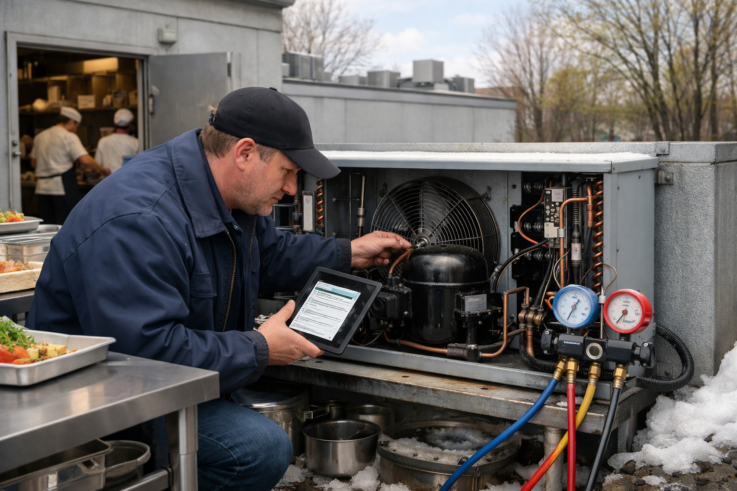
A proper evaluation is more than looking at the thermostat. A qualified commercial refrigeration technician should inspect operating conditions, system components, airflow, and the business environment. This helps distinguish a repairable issue from a system that is no longer reliable.
Typical inspection steps include:
- Verifying box temperature, product temperature concerns, and thermostat or controller readings.
- Checking evaporator coil condition, airflow, fan operation, and signs of ice blockage.
- Inspecting condenser coil cleanliness, condenser fan operation, location, and ventilation.
- Measuring refrigerant pressures and temperatures when appropriate.
- Looking for oil stains, corrosion, vibration, or other signs of refrigerant leaks.
- Testing defrost timers, heaters, sensors, drain lines, and termination controls on freezers.
- Inspecting door gaskets, hinges, closers, thresholds, and strip curtains on walk-ins.
- Checking electrical components such as contactors, relays, capacitors, wiring, fuses, and controls.
- Reviewing compressor operation, noise, overheating, short cycling, and amp draw.
- Asking about loading patterns, delivery schedules, staff habits, and recent service history.
The best recommendation connects technical findings with business reality. A convenience store in Middlesex County may need a different strategy than a fine dining restaurant in Boston or a supermarket in Springfield. The technician should explain what failed, what caused it, what repair would involve, and whether replacement is worth considering.
Emergency Signs You Should Not Ignore
Some refrigeration problems can wait for scheduled service, while others require urgent attention. Call for professional help if you notice:
- Walk-in cooler or freezer temperatures rising and not recovering.
- Product starting to soften, sweat, thaw, or feel warmer than expected.
- Burning smells, electrical buzzing, tripped breakers, or visible wiring damage.
- Heavy ice buildup on evaporator coils, fans, drain pans, or door openings.
- Compressor short cycling, loud knocking, or failure to start.
- Water leaking onto floors where it could create slip hazards or damage property.
- Multiple units affected at once, which may indicate electrical, control, or environmental issues.
For emergency refrigeration repair, do not keep opening doors to check the equipment. Reduce door openings, document temperatures, move critical inventory if you have a safe backup location, and call a refrigeration professional. Royal Cooling can be reached at 781-899-4441.
Maintenance Tips That Can Delay Replacement
Even the best equipment will fail early if it is neglected. Regular maintenance helps Massachusetts businesses extend equipment life, reduce emergency calls, and make better repair-or-replace decisions. It also gives owners documented insight into developing problems before they interrupt service.
- Keep condenser coils clean and free from grease, dust, cardboard, and storage clutter.
- Maintain clear airflow around condensing units, reach-ins, and ventilation grilles.
- Inspect door gaskets and closers so warm, humid air is not pulled into cold spaces.
- Train staff not to block evaporator fans or overload shelves.
- Check drains for clogs, algae, ice, or standing water.
- Watch for condensation, frost patterns, temperature drift, and unusual sounds.
- Schedule professional preventive maintenance before peak summer demand and before major business seasons.
- Keep a service history so replacement decisions are based on facts, not memory.
Preventive service is especially valuable in busy areas such as Boston metro, Worcester County, Middlesex County, and Suffolk County where restaurants, stores, hotels, and facilities may run refrigeration equipment continuously. A planned maintenance visit is usually less disruptive than a weekend breakdown during peak business.
Local Massachusetts Considerations
Massachusetts businesses face varied refrigeration conditions. Coastal humidity can contribute to condensation and corrosion. Urban locations in Boston, Cambridge, and Quincy may have tight mechanical access, rooftop equipment, limited loading space, and strict scheduling constraints. Suburban sites in Newton, Waltham, Framingham, and Lowell may have mixed rooftop, alley, basement, or back-of-house installations. Larger facilities in Worcester or Springfield may need coordinated planning across multiple departments or tenants.
These local factors affect both repair and replacement. A repair may be straightforward mechanically but difficult logistically if access is limited. A replacement may require careful timing to avoid disrupting a restaurant dinner rush, hotel banquet schedule, supermarket delivery window, or convenience store peak period. When choosing an HVAC contractor or refrigeration provider, look for a company that understands commercial refrigeration systems, customer operations, Massachusetts weather, and the urgency of protecting inventory.
How Royal Cooling Helps You Decide
Royal Cooling provides commercial refrigeration service for businesses that need practical answers, not guesswork. Whether you are weighing one more repair against replacement, dealing with a walk-in freezer that cannot keep product hard, or planning upgrades for a restaurant, store, hotel, or facility, the goal is to help you make a decision that fits your risk, budget, and timeline.
Royal Cooling services commercial refrigeration, walk-in freezers, walk-in coolers, wine coolers, reach-in refrigerators, freezer repair needs, and preventive refrigeration maintenance. If repair is reasonable, you should understand what is being repaired and why. If replacement is smarter, you should understand the equipment, installation considerations, and how to avoid repeating the same problems.
Need help deciding? Call 781-899-4441 or use the contact page to request a commercial refrigeration evaluation in Massachusetts.
FAQs About Commercial Refrigeration Repair or Replacement in Massachusetts
Should I repair or replace my walk-in cooler in Massachusetts?
Repair is usually best if the box is structurally sound, parts are available, and the issue is limited to a serviceable component. Replacement may be smarter if panels, insulation, doors, coils, or the condensing unit are failing or if breakdowns are frequent.
When is a commercial refrigerator too old to keep repairing?
It may be too old when repairs are recurring, parts are hard to source, temperatures remain unreliable, energy use is excessive, or major components such as the compressor and coils are near failure. Age matters, but reliability and total cost matter more.
Is it better to replace a reach-in refrigerator or repair it again?
Repair can make sense for gaskets, fans, controls, drains, and minor electrical issues. Replacement may be better if the cabinet is damaged, the compressor is weak, refrigerant leaks keep returning, or prior repairs have not restored dependable temperatures.
What should restaurant owners consider before replacing refrigeration equipment?
Restaurant owners should consider capacity, temperature range, kitchen layout, ventilation, electrical requirements, delivery access, downtime, product protection, maintenance needs, and whether the new equipment can be serviced easily in the future.
Can preventive maintenance help avoid replacement?
Preventive maintenance can extend equipment life by keeping coils clean, airflow clear, doors sealed, drains open, controls calibrated, and components inspected. It cannot prevent every failure, but it often reduces emergency repairs and helps identify replacement needs earlier.
What are signs I need emergency refrigeration repair?
Urgent warning signs include rising box temperatures, thawing product, electrical smells, tripped breakers, heavy ice buildup, compressor short cycling, water leaks, or any refrigeration failure that puts inventory, food safety, or business operations at immediate risk.
Does a refrigerant leak mean I need replacement?
Not always. A single accessible leak may be repairable. Repeated leaks, corroded coils, obsolete refrigerant, or leaks on older equipment may make replacement more practical than continuing to pay for refrigerant and labor.
Final Takeaway: Repair the Right Problems, Replace at the Right Time
The best decision is not always the cheapest immediate option or the newest equipment. The best decision is the one that protects inventory, supports safe operation, reduces surprise downtime, and makes financial sense for your Massachusetts business. A targeted repair can be exactly right for a newer or well-maintained system. Replacement can be the better investment when the equipment is unreliable, inefficient, obsolete, or undersized.
If you are deciding between commercial refrigeration repair or replacement in Massachusetts, Royal Cooling can help you evaluate the equipment and choose the next step with confidence. Call 781-899-4441 or visit /contact/ to request service or a replacement consultation.