Restaurant Cooler Temperature Danger Zone: What to Do Before Food Spoils
Short Answer: What to Do When a Restaurant Cooler Enters the Temperature Danger Zone
If your restaurant cooler rises above 41°F, start a temperature log immediately, keep the door closed, move time and temperature control for safety foods to another working cooler if available, and call a commercial refrigeration technician if the temperature does not quickly recover. Do not guess on food safety. Follow your food safety plan, Massachusetts health guidance, and discard food held in unsafe conditions for too long.
Why the Restaurant Cooler Temperature Danger Zone Matters
The restaurant cooler temperature danger zone is an urgent operational problem, not a minor inconvenience. For most refrigerated foods that require cold holding, the safe target is 41°F or below. Once a walk-in cooler, reach-in refrigerator, prep table, beer cooler, or display case starts drifting above that range, the kitchen has to manage two issues at the same time: food safety and equipment failure.
In a busy Massachusetts restaurant, the risk can escalate quickly. A walk-in cooler in Boston may be opened constantly during lunch service. A cafe in Cambridge might have dairy, eggs, cut fruit, sauces, and prepared grab-and-go items in one reach-in. A bar in Quincy may depend on undercounter refrigeration during a packed weekend shift. If the commercial cooler is not holding temperature, the operator needs a clear process before product quality, inspection readiness, and revenue are affected.
This guide is written for restaurant owners, chefs, kitchen managers, hotel foodservice teams, convenience stores, liquor stores, grocery stores, and other commercial kitchen operators across Massachusetts. It explains what to do first, what not to do, how to perform basic cooler temperature troubleshooting, and when to call Royal Cooling for emergency refrigeration repair.
Immediate Action Checklist Before Food Spoils
When a cooler alarm sounds or a thermometer reads above 41°F, stay calm and move through a documented response. The goal is to reduce temperature gain, protect inventory, and give your service technician useful information.
- Confirm the temperature with a reliable thermometer. Check the built-in display, then verify with a calibrated thermometer placed in the warmest product area if safe to do so.
- Record the time and temperature. Write down when the issue was noticed, the air temperature, and product temperatures where appropriate. This helps your person in charge make food-safety decisions.
- Keep doors closed. Do not keep opening the walk-in to check whether it feels cold. Every door opening adds warm, humid kitchen air.
- Move high-risk food if you have safe backup refrigeration. Transfer TCS foods such as meat, seafood, dairy, cooked rice, sauces, cut produce, and prepared foods to another cooler that is holding 41°F or below.
- Separate questionable product. Label and isolate food that may have been exposed to unsafe temperatures until a trained manager decides whether it can be used or must be discarded.
- Reduce heat load. Stop placing hot pans, warm deliveries, or uncovered containers into the affected cooler.
- Check simple causes. Look for a blocked door, torn gasket, failed fan, iced coil, dirty condenser area, or tripped breaker. Do not open sealed refrigeration components.
- Call for service if recovery is not immediate. If the cooler continues rising, fluctuates repeatedly, or has mechanical symptoms, schedule restaurant refrigerator repair right away.
If you are in Massachusetts and your restaurant cooler is already above safe temperature, call Royal Cooling at 781-899-4441 or use the contact page to request help. If you are planning coverage for multiple locations, review the Royal Cooling service area.
How Long Can Food Stay in a Commercial Cooler That Is Not Cold Enough?
The safest answer is this: you need to know how long the food has been above 41°F, how high the temperature reached, and what type of food is involved. If the time is unknown, the risk is higher. A product that briefly rises during loading is different from a walk-in that sat at 55°F overnight.
Many restaurant food-safety programs use strict time and temperature rules for TCS food, and Massachusetts food establishments should follow their approved procedures, local health department expectations, and the person in charge. In general, if food has been in the danger zone too long, it should not be served. Do not rely on smell, appearance, or taste to determine safety.
| Cooler Condition | Food Safety Action | Refrigeration Action |
|---|---|---|
| Air temperature briefly above 41°F after a delivery or heavy service | Check product temperatures, limit door openings, document time, and verify recovery | Monitor for fast pull-down; inspect door closure, loading, and airflow |
| Cooler holding 43°F to 48°F and not dropping | Move TCS foods to safe refrigeration if available; separate questionable items | Call a commercial refrigeration technician if basic checks do not correct it |
| Cooler at 50°F or higher | Treat as urgent; document time, product temps, and follow discard rules if limits are exceeded | Request emergency refrigeration repair; avoid continued loading |
| Unknown time above 41°F, such as overnight failure | Do not assume food is safe; follow management and health-code discard procedures | Call for diagnosis before restarting full use |
| Repeated temperature swings during service | Increase monitoring and protect high-risk product | Investigate airflow, doors, controls, fans, defrost, refrigerant, and compressor performance |
The key point is not to wait for the cooler to fail completely. A drifting temperature can mean a developing problem with the condensing unit, evaporator fan, thermostat, defrost system, door gasket, or refrigerant circuit. Early service can sometimes prevent a full inventory loss.
Cooler Temperature Troubleshooting for Restaurant Managers
Some checks can be done safely by a manager or trained employee before a technician arrives. These steps are not a substitute for professional service, but they can prevent avoidable damage and help identify operational issues.
1. Check Door Closure and Gaskets
Walk-in cooler doors take a beating in restaurants. If the door does not latch, if the closer is weak, or if the gasket is torn, warm humid air enters the box. That can raise temperature, create condensation, and cause coil icing. Look for gaps around the door, broken hinges, ice near the threshold, or a sweep that no longer seals.
2. Look for Blocked Airflow
Cold air needs space to circulate. Boxes stacked against the evaporator, pans pushed into fan discharge, or shelving packed too tightly can cause warm pockets. If one section of the cooler is cold and another is warm, airflow may be part of the issue. Keep product away from evaporator fans and do not block return-air paths.
3. Inspect the Evaporator Fans
In a walk-in cooler, the evaporator fans should move air across the coil and throughout the box. If fans are not spinning, are noisy, or are blowing weakly, the cooler may not pull down to temperature. Fan problems require service because electrical parts, motors, controls, and ice buildup may be involved.
4. Check for Ice on the Coil
A light frost pattern can be normal in some conditions, but a coil packed with ice is a warning sign. Ice can be caused by air leaks, failed defrost components, low refrigerant charge, a bad fan motor, a clogged drain, or leaving the door open. Do not chip ice off the coil with a tool; puncturing tubing can turn a repair into a major refrigerant leak.
5. Review Recent Activity
Ask what changed. Was there a large delivery of warm product? Did staff load hot prep into the cooler? Was the door propped open? Did the problem begin after cleaning, construction, or a power interruption? Details like these help a commercial refrigeration technician separate operational heat load from mechanical failure.
6. Check the Condensing Unit Area
If accessible and safe, look at the condensing unit. A blocked or dirty condenser, restricted ventilation, or a fan that is not running can cause high head pressure and poor cooling. Restaurants in dense Boston metro neighborhoods often have rooftop equipment, basement mechanical areas, alleys, or tight utility spaces where airflow and cleanliness matter.
What Causes a Restaurant Cooler to Fluctuate in Temperature During Service?
Temperature swings during lunch or dinner service are common warning signs. Some causes are operational, and others are mechanical. The pattern matters. A cooler that rises during every rush and recovers quickly may be overloaded or opened too often. A cooler that rises and does not recover likely has a refrigeration problem.
- Frequent door openings: High-volume restaurants in Boston, Cambridge, Newton, and Waltham often open walk-ins constantly during service. Each opening brings heat and humidity.
- Warm product loading: Adding large amounts of warm beverages, prepared food, or deliveries can overwhelm the system temporarily.
- Blocked evaporator airflow: Overpacked shelves prevent air circulation and cause uneven product temperatures.
- Failing door gaskets or closers: Leaks create a steady load the system may not overcome.
- Dirty condenser coil: Heat rejection drops, compressor stress rises, and cooling capacity falls.
- Low refrigerant or refrigerant leak: The unit may run constantly but never reach setpoint.
- Defrost control issues: Too much defrost time warms the box; too little defrost can leave an iced coil.
- Sensor or thermostat problems: A bad control can misread box temperature or short-cycle the system.
- Compressor or fan motor failure: Mechanical components may be weak, intermittent, or overheating.
Because restaurants operate under high demand, a small weakness can show up first during service. That is why preventive maintenance is important for walk-in coolers, walk-in freezers, reach-in refrigerators, wine coolers, beer coolers, prep tables, and display cases.
When Should I Call for Emergency Refrigeration Repair?
Call for emergency refrigeration repair when the cooler is above safe holding temperature and not recovering, when food inventory is at risk, or when there are symptoms that suggest mechanical failure. Waiting until the next business day can be costly if the cooler continues to climb overnight.
Contact Royal Cooling at 781-899-4441 if you notice any of the following:
- The box is above 41°F and rising.
- The cooler has stayed above setpoint after doors are closed and product loading has stopped.
- The compressor runs continuously but the cooler does not get cold.
- The unit short-cycles, clicks, hums, trips a breaker, or shuts off unexpectedly.
- Evaporator fans are not running or are making loud noise.
- There is heavy ice on the evaporator coil.
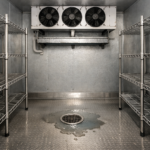
- There is water on the floor, repeated condensation, or a blocked drain.
- You smell burning, see damaged wiring, or suspect an electrical issue.
- A walk-in freezer is softening product or a freezer temperature is climbing rapidly.
- A health inspection, catering schedule, delivery, or peak service period is approaching.
Restaurants, bars, cafes, hotels, supermarkets, liquor stores, and commercial kitchens across Massachusetts depend on refrigeration to stay open. In dense areas such as Boston, Cambridge, Quincy, Newton, and Waltham, downtime can disrupt reservations, deliveries, prep schedules, and staff planning in a single shift.
What a Commercial Refrigeration Technician Checks
When Royal Cooling responds to a commercial cooler not holding temperature, the technician looks at the entire system, not just the thermostat. A walk-in cooler is a heat-transfer system. If any part of that process is restricted, misread, underpowered, or dirty, box temperature can rise.
A professional diagnosis may include:
- Temperature verification: Air temperature, product temperature, supply and return air readings, and controller settings.
- Electrical checks: Voltage, amperage, contactors, relays, capacitors, wiring, safety controls, and breaker behavior.
- Refrigerant circuit evaluation: Operating pressures, superheat, subcooling, refrigerant charge condition, and signs of leaks.
- Compressor assessment: Start components, running condition, overheating, short cycling, and oil or mechanical concerns.
- Condenser inspection: Coil cleanliness, fan operation, airflow, ambient conditions, and equipment placement.
- Evaporator inspection: Frost pattern, fan motors, defrost operation, drain pan, drain line, and airflow restrictions.
- Controls and sensors: Thermostat calibration, temperature probes, controllers, defrost timers, and alarms.
- Box condition: Door gaskets, hinges, sweeps, closers, panels, penetrations, and insulation issues.
Good restaurant refrigerator repair is not guesswork. Replacing parts without confirming the cause can leave the same temperature danger zone problem in place. A technician should identify why the cooler failed, explain the repair options, and recommend steps to reduce repeat failures.
Repair vs. Replace: How to Decide
Not every temperature emergency means the cooler needs replacement. Many problems can be repaired: a bad fan motor, faulty thermostat, clogged drain, failed door gasket, dirty condenser, defrost issue, or electrical component failure. For newer equipment or critical kitchen assets, repair is often the fastest path back to operation.
Replacement may be worth discussing when the system has repeated compressor failures, refrigerant leaks in difficult or deteriorated coils, obsolete parts, poor energy performance, undersized capacity, or a cabinet or box that no longer seals properly. A busy restaurant in Framingham or Worcester may also outgrow the refrigeration capacity it originally installed, especially after menu expansion, delivery growth, or increased beverage volume.
The best decision balances food safety risk, repair cost, equipment age, downtime, efficiency, and how critical the unit is to your business. Royal Cooling can help evaluate commercial refrigeration equipment including walk-in coolers, walk-in freezers, reach-in refrigerators, freezer repair needs, wine coolers, and other foodservice refrigeration assets.
Prevention: How to Keep Coolers Out of the Danger Zone
Emergency repairs are sometimes unavoidable, but many temperature failures start as maintenance issues. A planned refrigeration program helps catch small problems before the cooler enters the danger zone during a Friday dinner rush or before a holiday delivery.
- Log temperatures daily. Trend changes before they become emergencies.
- Clean condenser coils on schedule. Grease, lint, and dust reduce heat rejection.
- Inspect door gaskets and closers. Replace worn seals before they cause icing and warm air infiltration.
- Keep evaporator airflow clear. Train staff not to stack product against fans.
- Check drain lines. Clogs can cause water, ice, and sanitation concerns.
- Verify defrost performance. Incorrect defrost settings can warm the box or allow coil ice.
- Watch for noise changes. Fan motors, compressors, and contactors often give warning signs.
- Schedule preventive maintenance. Have a technician inspect controls, electrical components, refrigerant performance, coils, fans, and box condition.
For restaurants and commercial kitchens in Massachusetts, food safety refrigeration is part of day-to-day risk management. Preventive maintenance is especially valuable for high-volume operations in the Boston metro, older buildings in Suffolk County and Middlesex County, and multi-unit operators coordinating service across several locations.
Massachusetts Refrigeration Help for Restaurants and Commercial Kitchens
Royal Cooling provides commercial refrigeration service for restaurants, bars, cafes, hotels, grocery stores, convenience stores, liquor stores, supermarkets, facility managers, property managers, and select residential customers with wine coolers or freezers. Service needs vary from a single reach-in refrigerator to a full walk-in cooler and freezer setup supporting a high-volume kitchen.
Royal Cooling serves Massachusetts customers and is familiar with the urgency of refrigeration issues in dense, high-demand areas such as Boston, Cambridge, Quincy, Newton, Waltham, Framingham, Worcester, Lowell, and Springfield. The company works with commercial refrigeration equipment where downtime can affect food safety, staff workflow, deliveries, and customer service.
If your cooler is in the restaurant cooler temperature danger zone, do not wait for the next temperature log to confirm what you already suspect. Protect the food, document the condition, reduce heat gain, and call for professional help. For emergency troubleshooting or repair scheduling, call 781-899-4441 or visit Royal Cooling contact.
FAQ: Restaurant Cooler Temperature Danger Zone
What should a restaurant do if a walk-in cooler rises above safe temperature?
Confirm the temperature with a calibrated thermometer, start a written log, keep doors closed, move TCS food to another cooler holding 41°F or below if available, and separate questionable items. If the walk-in does not recover quickly or shows mechanical symptoms, call a commercial refrigeration technician.
How long can food stay in a commercial cooler that is not cold enough?
It depends on how long the food has been above 41°F, how warm it became, and the type of food. Follow your food safety plan and local health guidance. If the time is unknown or limits are exceeded, do not serve the food.
When should I call for emergency refrigeration repair for a restaurant cooler?
Call when the cooler is above 41°F and not dropping, when temperature is rising quickly, when the compressor or fans are not operating normally, when ice blocks the coil, or when valuable inventory is at risk. Electrical smells, breaker trips, and overnight failures are also urgent signs.
What causes a restaurant cooler to fluctuate in temperature during service?
Common causes include frequent door openings, warm deliveries, overloading shelves, blocked airflow, bad door gaskets, dirty condenser coils, weak fan motors, defrost problems, low refrigerant, and thermostat or sensor issues. A technician can determine whether the issue is operational or mechanical.
Can I keep using a cooler that is slightly above 41°F?
Do not ignore it. A brief rise after loading may recover, but a cooler that stays above 41°F can put food safety at risk. Document temperatures, check product temperature, reduce door openings, and call for service if the unit does not return to safe range.
Should I turn the cooler thermostat lower during an emergency?
Lowering the setpoint may not fix the cause and can sometimes mask a failing component. If the cooler cannot hold its normal setpoint, the problem may involve airflow, refrigerant, defrost, dirty coils, fans, controls, or the compressor. Use logs and call for diagnosis.
Does Royal Cooling service walk-in coolers and freezers in Massachusetts?
Yes. Royal Cooling provides commercial refrigeration service for walk-in coolers, walk-in freezers, reach-in refrigerators, wine coolers, and related equipment for restaurants and commercial customers in Massachusetts service areas. Call 781-899-4441 to discuss your location and equipment issue.
Final CTA: Do Not Let a Warm Cooler Become a Food Loss Event
A restaurant cooler temperature emergency needs both fast food-safety action and proper mechanical diagnosis. If your walk-in cooler, reach-in refrigerator, prep table, wine cooler, or freezer is not holding temperature, Royal Cooling can help you identify the cause and plan the next step.
Call Royal Cooling at 781-899-4441 for commercial refrigeration support in Massachusetts, or request service through the contact page. To see general coverage information, visit the service area page.