Restaurant Refrigeration Failure After Hours in Massachusetts: What to
Short answer: If a restaurant cooler fails after closing in Massachusetts, keep the doors closed, verify power and temperature, document readings, move critical inventory only if you can do so safely, and call a qualified commercial refrigeration technician. For urgent after hours commercial refrigeration repair Massachusetts restaurants can contact Royal Cooling at 781-899-4441 for guidance and service scheduling.
A refrigeration failure after the dinner rush is one of the most stressful problems a restaurant, bar, hotel kitchen, liquor store, grocery store, or convenience store can face. The team may be cleaning down the line, counting drawers, or locking up when someone notices the walk-in cooler feels warm, the reach-in refrigerator is above setpoint, or the walk-in freezer is softening product. At that moment, the goal is simple: protect people, protect inventory, avoid making the equipment damage worse, and get professional help on the way.
This guide is written for Massachusetts commercial kitchens that need practical steps before a technician arrives. It applies to restaurants in Boston, Cambridge, Quincy, Newton, Waltham, Framingham, Worcester, Lowell, Springfield, and surrounding communities across the Boston metro, Suffolk County, Middlesex County, and Worcester County. It is not a substitute for food safety rules or a technician diagnosis, but it can help you make calm, useful decisions during an after-hours refrigeration emergency.
Why Restaurant Refrigeration Fails After Hours
Many refrigeration problems are discovered after closing because doors have been opened all day, the kitchen is still hot from service, and the equipment has been working under heavy load for hours. A walk-in cooler that seemed slightly slow to recover during lunch may finally drift above temperature late at night. A walk-in freezer with ice buildup may hold through the day, then struggle after the last delivery or prep cycle. A reach-in refrigerator with a weak door gasket may run continuously until the compressor overheats or trips a control.
Common causes of after-hours commercial refrigeration problems include dirty condenser coils, failed evaporator fans, worn door gaskets, blocked airflow, thermostat or controller problems, electrical faults, refrigerant leaks, compressor issues, defrost failures, clogged drains, and doors left open during cleaning or restocking. Some issues are minor and can be corrected quickly by a commercial refrigeration technician. Others require more involved restaurant cooler repair, walk-in cooler repair, walk-in freezer service, or freezer repair.
The key is not to guess. Your job before emergency refrigeration repair arrives is to gather useful information and prevent additional losses. Avoid opening panels, cutting wires, adding refrigerant, bypassing safeties, or repeatedly resetting breakers. Those actions can create safety risks and make diagnosis harder.
Is It an Emergency? Quick Decision Table
Not every warm reading has the same level of urgency, but commercial kitchens should treat refrigeration instability seriously. Use this table to decide how quickly to act while you contact a service provider and follow your internal food safety procedures.
| Situation | Likely urgency | What to do before service |
|---|---|---|
| Walk-in cooler temperature is rising and product is stored inside | High | Keep doors closed, record temperature, check power, call for emergency refrigeration repair. |
| Walk-in freezer product is softening or frost is melting | High | Limit access, document readings, avoid chipping ice aggressively, request walk-in freezer service. |
| Reach-in refrigerator is warm but another approved cooler is available | Moderate to high | Move product safely if procedures allow, label affected inventory, schedule restaurant cooler repair. |
| Unit is off after cleaning and breaker is tripped once | Potentially high | Do not repeatedly reset; check for obvious water or cord issues and call a technician if it trips again. |
| Temperature is slightly high after heavy door opening but falling steadily | Monitor closely | Keep door closed, recheck at short intervals, call if recovery stalls or temperature rises again. |
| Burning smell, smoke, sparking, or hot electrical components | Immediate safety concern | Keep staff away, shut down only if safe, call appropriate emergency help and a qualified technician. |
What to Do First If a Cooler Fails After Closing
1. Confirm the Problem Without Over-Opening Doors
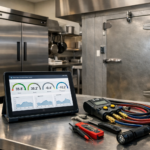
Start with the simplest facts. Look at the controller or thermometer, then use a reliable secondary thermometer if one is available. Compare the displayed temperature to the actual product-area temperature. Do not keep opening the walk-in door to “see if it feels cold.” Every door opening adds heat and humidity, especially in a warm Massachusetts kitchen after service.
Write down the time, displayed temperature, and what you observed. For example: “10:42 p.m., walk-in cooler display 48°F, evaporator fans not running, compressor sound outside intermittent.” These details help the commercial refrigeration technician prioritize the call and arrive with a better understanding of the symptoms.
2. Check Power Safely
Look for obvious power issues. Is the controller lit? Are interior lights on? Did someone switch off a disconnect during cleaning? Has a GFCI outlet tripped on a small reach-in refrigerator? Is a breaker clearly tripped? If a breaker tripped once, you may be able to note it, but do not repeatedly reset it. Repeated trips may indicate a short, failed motor, compressor issue, or water intrusion, and forcing it can create more damage.
If you smell burning, see sparks, notice melted wiring, or hear unusual electrical buzzing, keep employees away and do not touch the equipment. Electrical problems in commercial refrigeration systems should be handled by qualified professionals.
3. Keep Doors Closed and Reduce Load
The fastest way to lose remaining cold air is to keep checking the box. Assign one person to manage access. Post a note on the cooler door if staff are still in the building. Do not load warm product into a failing walk-in cooler or freezer. If you just received a delivery, separate the newly delivered product from inventory that was already cold and follow your receiving and food safety procedures.
For bars, hotels, and restaurants with multiple refrigeration zones, consider whether high-value or high-risk inventory can be moved to another functioning unit. Only do this if the receiving unit has capacity and is maintaining safe temperature. Overloading the backup cooler can cause a second failure.
4. Document Inventory and Temperatures
Good notes matter. Record product temperatures when required by your internal policy, the time the issue was discovered, who was notified, and any steps taken. If you later need to decide what can be kept, discarded, credited, or reviewed with management, accurate records are far better than memory after a stressful night.
A commercial refrigeration service call is also easier when you can describe the timeline. Did the unit fail suddenly, or has it been struggling for several days? Did the problem start after a power outage, deep cleaning, delivery, or recent maintenance? Did the equipment make grinding, clicking, buzzing, or short cycling sounds? These clues can point to airflow issues, failed fans, low refrigerant charge, control problems, or compressor trouble.
How to Protect Food Inventory While Waiting for Emergency Refrigeration Repair
Protecting inventory is one of the main reasons to call for after-hours service quickly. Follow your food safety plan and local health requirements. From an equipment standpoint, the safest general approach is to preserve the cold environment that remains, avoid unnecessary door opening, and move product only when you have a better controlled location available.
- Prioritize high-risk inventory. Seafood, meats, dairy, prepared foods, and temperature-sensitive ingredients usually require the most attention.
- Use functioning equipment carefully. If another walk-in cooler, reach-in refrigerator, or refrigerated prep table is stable, move only what it can handle without blocking airflow.
- Do not block evaporator fans. Whether in the failed unit or a backup unit, blocked airflow causes uneven temperatures and longer recovery times.
- Separate affected product. Label or group items that were in the failed unit so management can review them properly.
- Avoid adding heat. Do not place hot pans, warm deliveries, or recently cooked product into a struggling cooler.
- Keep a temperature log. Record times and readings until the unit is repaired and stable.
If you are unsure whether food is safe, do not rely on smell or appearance. Use your internal food safety policy and applicable regulatory guidance. Royal Cooling can address the refrigeration system, but food disposition decisions belong to the operator and the relevant food safety standards.
What Not to Do During an After-Hours Refrigeration Failure
Panic repairs can turn a manageable restaurant cooler repair into a larger equipment failure. Avoid these common mistakes while waiting for Boston metro refrigeration repair or service elsewhere in Massachusetts:
- Do not chip heavy ice with sharp tools. You can puncture an evaporator coil or refrigerant line, creating a more serious leak.
- Do not hose down electrical areas. Water and refrigeration controls do not mix.
- Do not bypass door switches, pressure controls, or safety devices. These are there to protect the system and the people around it.
- Do not keep resetting breakers. A breaker that trips repeatedly is warning you of a fault.
- Do not add refrigerant yourself. Refrigerant work requires proper tools, training, and compliance.
- Do not overload a backup cooler. Airflow restrictions can cause another temperature problem.
When Is a Walk-In Cooler Failure an Emergency for a Commercial Kitchen?
A walk-in cooler failure is an emergency when product temperature is rising, the unit cannot maintain setpoint, staff see signs of electrical danger, the failure affects the next day’s opening, or the business lacks enough backup refrigeration. For a restaurant in Boston or Cambridge with a full walk-in after weekend service, a warm box after closing can threaten thousands of dollars of inventory and disrupt prep for the next shift. For a hotel kitchen in Worcester or a grocery operator in Quincy, the operational impact can be immediate.
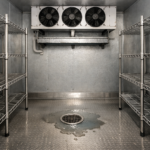
Other emergency signs include warm air blowing from the evaporator, evaporator fans not running, compressor short cycling, ice covering the coil, water pooling near the unit, unusual burning odors, alarms from the temperature monitoring system, or a freezer that is no longer keeping product hard. In these cases, calling for emergency refrigeration repair is appropriate even if the business is closed to customers.
Who Repairs Restaurant Refrigeration After Hours in Boston Metro?
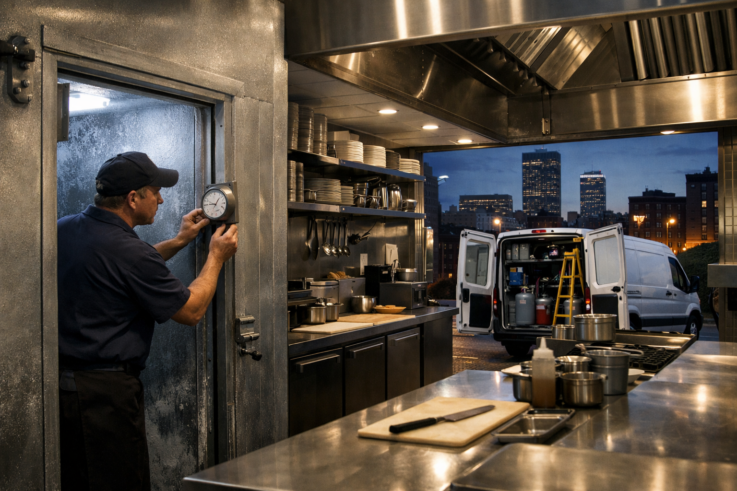
After-hours restaurant refrigeration should be handled by a qualified HVAC contractor or commercial refrigeration technician familiar with walk-in coolers, walk-in freezers, reach-in refrigerators, prep tables, condensers, evaporators, controllers, and commercial kitchen operating conditions. Royal Cooling provides commercial refrigeration services for Massachusetts businesses and can be contacted at 781-899-4441 for urgent refrigeration problems, including Boston metro refrigeration repair needs.
When you call, be ready to share the business name, city, equipment type, approximate temperature, symptoms, whether product is inside, and any safety concerns. If you are in Boston, Cambridge, Waltham, Newton, Framingham, Worcester, Lowell, Springfield, Quincy, or another Massachusetts community, clear information helps the service team understand the urgency and plan the next step. You can also reach Royal Cooling through the contact page for non-phone inquiries.
Repair or Replace: What If the Unit Is Older?
An after-hours failure does not automatically mean replacement. Many walk-in cooler repair calls involve components that can be repaired or replaced, such as fan motors, contactors, thermostats, defrost controls, door gaskets, expansion valves, or condensate drain parts. However, replacement may be worth discussing if the equipment is very old, has repeated compressor failures, uses obsolete components, has severe corrosion, or no longer matches the kitchen’s capacity needs.
A good technician will focus first on stabilizing the immediate problem. Once the emergency is under control, ask for a practical assessment. If the repair is minor and the box is otherwise in good condition, repair is often the sensible path. If the system has recurring refrigerant leaks, poor efficiency, unreliable temperature control, and frequent emergency calls, replacement planning may reduce risk over time.
What a Commercial Refrigeration Technician Checks on Arrival
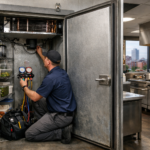
When a technician arrives for after hours commercial refrigeration repair in Massachusetts, the diagnostic process usually starts with safety and symptoms. The technician may verify voltage, inspect disconnects and breakers, check controller settings, examine the condenser and evaporator, confirm fan operation, inspect the coil condition, test temperature sensors, look for frost patterns, evaluate pressures where appropriate, and check for signs of refrigerant leaks or compressor problems.
For walk-in freezer service, the technician may also review the defrost system, heaters, termination controls, drain line, door heaters, and gaskets. For restaurant cooler repair on a reach-in or prep table, they may inspect door seals, airflow paths, condenser cleanliness, capillary or metering components, and thermostat calibration. If the issue involves a wine cooler, beverage cooler, or specialty refrigeration system, stable temperature and humidity control may be part of the evaluation.
The technician’s goal is to identify the root cause, not simply force the unit to run for a few minutes. A cooler that runs but cannot remove heat may have a very different problem from a cooler that will not start at all. Clear notes from your team can shorten the diagnostic path.
Preventive Maintenance That Reduces After-Hours Failures
Preventive refrigeration maintenance cannot eliminate every emergency, but it can reduce avoidable failures. Many after-hours calls trace back to issues that developed over time: dirty condenser coils, loose electrical connections, worn gaskets, failing fan motors, blocked drains, iced coils, poor airflow, or controls drifting out of calibration. Massachusetts kitchens also face seasonal load changes. Hot, humid summer weather can make marginal equipment fail faster, while winter conditions can expose control or head pressure issues on some systems.
A maintenance plan for commercial refrigeration may include coil cleaning, fan inspection, electrical checks, temperature verification, door gasket review, drain cleaning, defrost checks, refrigerant leak evaluation, and review of operating conditions. It also gives managers a chance to discuss recurring symptoms before they become emergencies. If your restaurant, liquor store, supermarket, hotel, or facility has had multiple urgent calls, ask Royal Cooling about preventive maintenance options during your next service visit.
Massachusetts Service Context: Restaurants, Bars, Hotels, and Commercial Kitchens
Commercial refrigeration service in Massachusetts requires an understanding of dense urban kitchens, older buildings, rooftop condensers, basement walk-ins, mixed-use properties, and tight delivery schedules. A restaurant in Boston may have limited roof access after hours. A Cambridge cafe may rely on compact reach-in refrigerators with little backup capacity. A Worcester hotel may need walk-in freezer service without disrupting banquet prep. A Framingham grocery store, Waltham bar, or Quincy convenience store may have multiple systems with different product risks.
Royal Cooling serves commercial refrigeration customers across Massachusetts service areas. To see whether your location is within the current coverage area, visit the service area page. If you have an active refrigeration failure after closing, call 781-899-4441 and be prepared to describe the equipment, symptoms, and temperature readings.
FAQ: After-Hours Commercial Refrigeration Repair in Massachusetts
What should a Massachusetts restaurant do if a cooler fails after closing?
Keep the cooler doors closed, confirm the temperature with a reliable thermometer, check for obvious power issues, document readings, protect inventory according to your food safety plan, and call a commercial refrigeration technician for emergency refrigeration repair.
Who repairs restaurant refrigeration after hours in Boston metro?
A qualified commercial refrigeration technician or HVAC contractor with restaurant equipment experience should handle after-hours repairs. Royal Cooling provides commercial refrigeration service for Massachusetts businesses and can be reached at 781-899-4441 for urgent refrigeration issues.
How can I protect food inventory while waiting for emergency refrigeration repair?
Limit door openings, log temperatures, avoid adding warm product, move high-risk inventory only to a stable approved cooler with enough capacity, and separate affected items for management review under your food safety procedures.
When is a walk-in cooler failure an emergency for a commercial kitchen?
It is an emergency when temperatures are rising, product is at risk, the unit will affect opening prep, there is no backup refrigeration, alarms are active, or there are safety signs such as burning smells, sparking, or repeated breaker trips.
Can I reset the breaker if my walk-in freezer shuts off?
If a breaker has tripped, note it and use caution. Do not repeatedly reset it. Repeated tripping can indicate an electrical fault, failed motor, compressor problem, or moisture issue that needs professional diagnosis.
Should I move everything into another cooler?
Only move inventory if the backup cooler is operating correctly and has enough space for airflow. Overloading a second unit can cause another temperature problem. Prioritize critical items and follow your food safety plan.
What information should I give the technician when I call?
Share your location, equipment type, temperature readings, how long the issue has been happening, whether product is inside, any noises or alarms, recent cleaning or power events, and any safety concerns.
Can preventive maintenance prevent after-hours cooler failures?
Preventive maintenance cannot prevent every failure, but it can reduce avoidable emergencies by identifying dirty coils, weak fans, worn gaskets, drain problems, electrical issues, and temperature control concerns before they cause downtime.
Call Royal Cooling Before the Problem Gets Worse
If your walk-in cooler, walk-in freezer, reach-in refrigerator, wine cooler, or commercial freezer fails after closing, do not wait until morning and hope the temperature recovers. Take the basic steps above, keep staff safe, protect inventory, and contact a qualified commercial refrigeration company. For after hours commercial refrigeration repair Massachusetts businesses can call Royal Cooling at 781-899-4441 or use the contact page. Royal Cooling supports restaurants, bars, hotels, grocery operations, liquor stores, convenience stores, facility managers, and commercial kitchens across Massachusetts service areas.