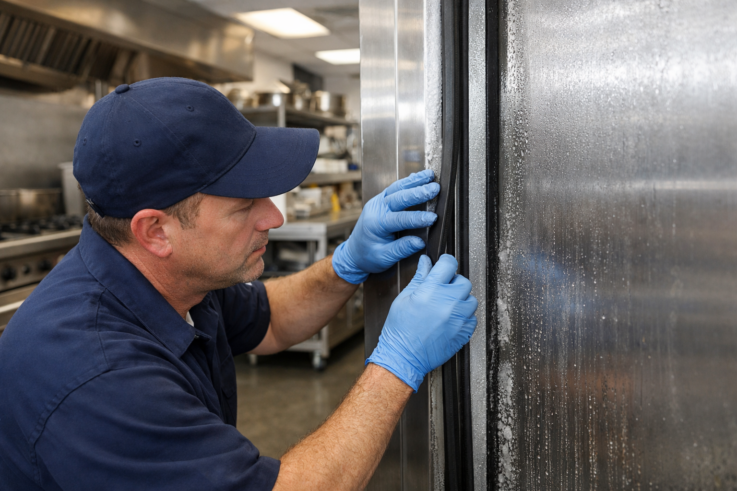
Walk-In Cooler Gasket Replacement in Massachusetts: Signs, Costs, and
Short answer: If your walk-in cooler gasket is cracked, torn, loose, hardened, flattened, or letting warm air into the box, it is time to schedule walk-in cooler gasket replacement in Massachusetts. A bad seal can cause warm temperatures, frost, condensation, longer compressor run times, and food safety risk for restaurants, markets, convenience stores, liquor stores, and commercial kitchens.
For many Massachusetts food businesses, the walk-in cooler door is opened hundreds of times per day. Prep cooks move in and out during lunch service, delivery teams stock product, grocery staff pull cases, and liquor store employees access chilled beverages throughout the day. That constant traffic is exactly why the door gasket matters. A gasket is a relatively small component, but it is one of the main barriers between your refrigerated space and humid, warmer building air.
When a gasket no longer seals, your walk-in cooler may still appear to be running. The evaporator fans may blow, the compressor may cycle, and the thermostat may light up. But the box can struggle to hold temperature because warm air is entering around the door. Over time, this can lead to product temperature concerns, frost around the frame, condensation on nearby surfaces, higher energy use, and added strain on refrigeration components.
Royal Cooling helps Massachusetts businesses diagnose and repair commercial refrigeration problems, including walk-in cooler door gasket repair, commercial refrigerator gasket replacement, door alignment issues, walk-in freezer service, reach-in refrigerator problems, wine cooler service, and preventive refrigeration maintenance. If you are seeing air leaks, sweating, frost, or temperature drift, call 781-899-4441 or request service through the contact page.
Why Walk-In Cooler Gaskets Matter for Massachusetts Businesses
A walk-in cooler gasket is the flexible seal mounted around the door. When the door closes, the gasket compresses against the frame to reduce air infiltration. In a busy commercial kitchen or retail environment, that seal protects temperature stability and helps the refrigeration system work as designed.
In Massachusetts, walk-ins often face seasonal challenges. During humid summer weather in Boston, Cambridge, Quincy, Lowell, or Framingham, warm moisture-laden air can rush into the cooler when the door seal is weak. In winter, temperature swings between loading areas, kitchens, and back rooms can still create condensation and door frame issues. Businesses in Worcester County, Middlesex County, Suffolk County, and the Boston metro area may also deal with older buildings, uneven floors, heavy delivery schedules, and high-traffic kitchens that wear door hardware faster.
A tight gasket helps reduce:
- Walk-in cooler air leaks around the door perimeter
- Warm product temperatures or slow temperature recovery after deliveries
- Frost buildup near the door, hinges, threshold, or evaporator
- Condensation on floors, walls, door frames, or nearby shelving
- Compressor strain caused by excessive run time
- Food safety risk when the box cannot maintain proper holding conditions
- Ice or slippery floor hazards near the entrance
Because gasket problems can mimic thermostat, fan, refrigerant, or compressor issues, it is important to inspect the door seal before assuming the worst. A qualified commercial refrigeration technician in Massachusetts can evaluate the gasket, door closer, hinges, sweep, threshold, frame heat if applicable, and box temperature performance together.
How Do I Know If My Walk-In Cooler Gasket Needs to Be Replaced?
Most gasket failures start small. A corner pulls loose. A section becomes compressed. A tear appears where carts or product boxes hit the door. Staff may notice the door is harder to close or that it pops open slightly after a busy service period. These early signs are easy to ignore, but they can quickly turn into performance problems.
Common signs of a bad walk-in cooler gasket
- Visible cracks, tears, or missing sections: Any break in the sealing surface can allow air infiltration.
- Gasket pulling away from the door: Loose retainers or damaged gasket darts can prevent the seal from sitting properly.
- Flattened or hardened gasket material: Over time, gaskets lose flexibility and no longer compress evenly.
- Light visible around the door: If you can see light through the seal when the door is closed, air is likely leaking.
- Condensation or sweating near the frame: Moist air may be meeting cold surfaces because the seal is failing.
- Frost or ice at the door opening: This often indicates warm, humid air entering the cooler or freezer.
- Door does not latch or close firmly: The gasket may be damaged, or the hinges and closer may need adjustment.
- Cooler runs longer than usual: A leaking gasket can increase load on the refrigeration system.
- Temperature alarms or warm readings: A bad gasket can be one reason a walk-in struggles to hold setpoint.
A quick visual inspection can reveal obvious damage, but not every leak is visible. A gasket may look acceptable from a distance and still fail because it is compressed, warped, dirty, or not aligned with the frame. If your staff repeatedly wipes up moisture near the door or your cooler recovers slowly after rush periods, it may be time for professional restaurant cooler gasket service.
Can a Bad Door Gasket Make a Walk-In Cooler Run Warm?
Yes. A bad door gasket can absolutely make a walk-in cooler run warm, especially in high-traffic restaurants, convenience stores, grocery stores, and hotels. The refrigeration system is designed to remove heat from a controlled space. When the door gasket leaks, the system has to remove heat and moisture that should not be entering in the first place.
Here is what often happens: warm air leaks around the door, the evaporator coil absorbs more heat and moisture, frost can form, airflow may become restricted, and the compressor runs longer to catch up. During heavy use, the cooler may never fully recover before the next door opening. Staff may see the thermostat drift upward, product may feel warmer than expected, and temperature logs may show inconsistent readings.
However, a warm walk-in is not always only a gasket issue. Other possible causes include dirty condenser coils, failed evaporator fans, refrigerant leaks, control problems, door closer failure, damaged hinges, drain line issues, or undersized equipment for the load. That is why gasket replacement should be part of a full diagnostic approach rather than a guess.
Why Is There Frost or Condensation Around My Walk-In Cooler Door?
Frost and condensation are two of the most common clues that air is entering where it should not. When humid Massachusetts air reaches cold surfaces around the door, moisture condenses. In a freezer or very cold area, that moisture can freeze into frost or ice. In a cooler, you may see wet floors, sweating metal, mold-prone gasket surfaces, or water dripping near the threshold.
Common causes include:
- Damaged or compressed gasket material
- Door not closing completely after staff use
- Weak door closer or worn hinges
- Frame misalignment from impact or building movement
- Dirty gasket surfaces preventing full contact
- Damaged threshold or sweep
- High kitchen humidity or poor air circulation near the cooler entrance
- On freezers, problems with door heaters or anti-sweat components
If condensation is limited to a small area and the gasket is dirty, cleaning may help. If frost keeps returning, if the door does not seal after cleaning, or if temperatures are affected, call a commercial refrigeration technician. Recurring frost is a symptom, not a normal condition to ignore.
Should Restaurant Staff Replace Walk-In Cooler Gaskets Themselves or Call a Technician?
Some businesses consider replacing gaskets in-house because the part looks simple. In a few cases, a trained maintenance employee may be able to install a standard replacement gasket if the correct part is available and the door is otherwise in good condition. But many walk-in cooler problems involve more than the gasket itself.
A professional technician can verify whether the gasket is actually the cause, identify the correct profile and dimensions, check the door alignment, inspect hinges and closers, confirm temperature performance, and make sure the new seal seats properly. This matters because an incorrectly sized or poorly installed gasket can still leak. It may also make the door hard to close, interfere with latching, or mask a deeper door frame problem.
For Massachusetts restaurants, commercial kitchens, grocery stores, liquor stores, convenience stores, supermarkets, hotels, and facilities with compliance responsibilities, calling a technician is usually the safer choice when the cooler is running warm, product is at risk, or frost and condensation are recurring.
What Affects Walk-In Cooler Gasket Replacement Cost?
The cost of walk-in cooler gasket replacement Massachusetts service depends on the equipment, the gasket type, the number of doors, access conditions, and whether other door components need repair. Royal Cooling can evaluate your cooler and provide a service recommendation based on the actual condition of the door and refrigeration system.
Cost factors to expect
- Gasket size and profile: Walk-in doors use different gasket profiles. Custom or less common profiles may cost more than standard parts.
- Single door vs multiple doors: Replacing gaskets on several walk-ins, reach-ins, or prep refrigerators changes labor and parts requirements.
- Condition of the door: A warped door, damaged frame, worn hinge, or weak closer may require adjustment or repair.
- Cooler vs freezer: Freezer doors may involve frost, heaters, ice buildup, and more involved diagnostics.
- Urgency: Service outside standard scheduling or involving active temperature risk may require priority dispatch planning.
- Cleaning and prep work: Heavy grease, mold, debris, or damaged gasket channels can add time.
- Diagnostic needs: If the cooler is running warm, the technician may need to check fans, coils, refrigerant, controls, and airflow, not just the gasket.
For budgeting, it is best to think in terms of the full repair outcome rather than only the gasket part. A lower-cost gasket installed on a misaligned door may not solve the problem. A complete door seal service may include inspection, correct part identification, removal, cleaning, installation, heat-forming or seating the gasket where appropriate, hinge/closer adjustment, and temperature verification.
Repair, Clean, Adjust, or Replace? A Practical Comparison
| Condition | Likely Action | Why It Matters | When to Call a Tech |
|---|---|---|---|
| Gasket is dirty but flexible and intact | Clean and inspect | Food debris and grease can prevent full contact with the frame | If leaks continue after cleaning |
| Small area is loose from the door | Reseat or repair if gasket and retainer are still usable | A loose corner can create a focused air leak | If the gasket will not stay seated or the retainer is damaged |
| Gasket is cracked, torn, brittle, or flattened | Replace gasket | Damaged material cannot seal reliably | Schedule commercial refrigerator gasket replacement |
| Door rubs, sags, or does not latch | Adjust hinges, closer, latch, or frame before or during gasket work | A new gasket will not fix a misaligned door by itself | Call a commercial refrigeration technician |
| Frost, condensation, and warm temperatures occur together | Full diagnostic service | The issue may involve air leaks plus refrigeration performance problems | Call promptly to reduce product risk |
| Walk-in freezer door has ice buildup around frame | Inspect gasket, heaters, closer, hinges, and air infiltration | Freezer ice can worsen quickly and affect safe access | Schedule walk-in freezer service |
How Often Should Commercial Cooler Door Gaskets Be Inspected?
Commercial cooler door gaskets should be checked visually by staff at least monthly, and more often in high-traffic kitchens or retail stores. During busy seasons, daily or weekly quick checks can catch small issues before they cause warm temperatures. Professional inspection should also be included during preventive maintenance visits.
A simple staff inspection can include:
- Look for tears, cracks, brittleness, or flattened areas.
- Check that the gasket is fully seated in the door channel.
- Wipe away food debris, grease, syrup, dust, or residue.
- Confirm the door closes by itself if a closer is installed.
- Watch for light, frost, condensation, or air movement around the frame.
- Log any temperature changes or repeated alarms.
Professional preventive maintenance goes further. A technician can inspect the refrigeration system as a whole, including condenser cleanliness, evaporator condition, fan operation, controls, defrost performance, drain function, refrigerant-related symptoms, door hardware, and gasket performance. This is especially valuable for businesses where one walk-in supports a large amount of inventory.
What a Royal Cooling Technician Checks During Gasket Service
When Royal Cooling responds to a gasket concern, the goal is not just to replace rubber. The goal is to help the cooler seal correctly and operate reliably. Depending on the symptoms, a technician may check:
- Gasket condition: Tears, cracks, deformation, compression, loose sections, and incorrect profile.
- Door alignment: Whether the door sits squarely against the frame and closes evenly.
- Hinges and closers: Worn hardware can stop a good gasket from sealing.
- Latch operation: The latch must hold the door in the correct sealed position.
- Threshold and sweep: Air can leak under the door as well as around the sides.
- Frame condition: Dents, impact damage, corrosion, or shifted panels can affect sealing.
- Temperature performance: The cooler should recover and hold appropriate temperatures after the door issue is addressed.
- Frost or condensation patterns: Moisture location helps identify the source of infiltration.
- Related refrigeration components: If the cooler is warm, fans, coils, controls, and other components may need evaluation.
This complete approach is important for walk-in cooler repair because a door seal issue can be both a cause and a symptom. For example, ice buildup can prevent the door from closing, but the original cause may have been a torn gasket, failed closer, or freezer heater problem.
When Gasket Problems Become Urgent
Not every worn gasket is an emergency, but some symptoms should be handled quickly. Call for service promptly if:
- The walk-in cooler is running warm or cannot hold safe product temperature.
- Temperature alarms continue after the door is closed.
- Frost or ice is preventing the door from sealing or closing.
- Water near the door is creating a slip hazard.
- The compressor appears to run continuously.
- Product quality is at risk during service hours or after a delivery.
- The door will not latch, stay closed, or close by itself.
If you are unsure whether the issue is urgent, document the box temperature, product condition, door symptoms, and when the problem started. Then call 781-899-4441. Royal Cooling can help determine the appropriate next step for emergency refrigeration repair or scheduled service.
Maintenance Tips to Extend Walk-In Cooler Gasket Life
Door gaskets are wear items, but good habits can help them last longer and reduce repeat air leaks.
- Clean gaskets regularly: Use appropriate cleaning methods for food-service areas and avoid harsh tools that cut or deform the seal.
- Do not kick doors open: Foot traffic, carts, and product boxes can tear corners and crush gasket material.
- Keep the threshold clear: Debris at the bottom of the door can stop the gasket from sealing.
- Train staff to close doors fully: A door left slightly open can create frost and temperature issues quickly.
- Report condensation early: Moisture near the door is often the first visible sign of a leak.
- Include gaskets in PM visits: Preventive maintenance should cover door seals, hinges, closers, and temperature performance.
- Address hardware problems: A sagging door can destroy a new gasket prematurely.
These steps are practical for restaurants in Boston, grocery stores in Worcester, convenience stores in Waltham, liquor stores in Quincy, hotel kitchens in Cambridge, and commercial facilities throughout Massachusetts. Royal Cooling serves businesses across the region and can help plan recurring refrigeration maintenance through the service area page.
When to Call Royal Cooling for Walk-In Cooler Door Seal Replacement
You should call Royal Cooling when gasket damage is visible, when the cooler is running warm, when frost or condensation returns after cleaning, or when the door does not close and seal correctly. You should also call if staff are repeatedly adjusting the thermostat to compensate for temperature drift. Lowering the setpoint will not fix walk-in cooler air leaks; it can make the refrigeration system work harder while the underlying problem continues.
Royal Cooling provides commercial refrigeration service for Massachusetts businesses, including walk-in coolers, walk-in freezers, wine coolers, reach-in refrigerators, freezers, and preventive refrigeration maintenance. Whether you operate a restaurant in Newton, a market in Framingham, a convenience store near Lowell, a facility in Springfield, or a commercial kitchen in the Boston metro area, a door gasket issue is worth addressing before it becomes a larger repair.
To schedule walk-in cooler door seal replacement, gasket inspection, or commercial refrigeration diagnostics, call 781-899-4441 or visit the Royal Cooling contact page. If you are comparing service options, look for a provider who understands commercial refrigeration systems, not just the gasket part. The right repair should improve sealing, support temperature stability, and reduce unnecessary strain on your equipment.
Frequently Asked Questions
How do I know if my walk-in cooler gasket needs to be replaced?
Your gasket likely needs replacement if it is torn, cracked, brittle, flattened, loose, or letting light or air through around the door. Condensation, frost, warm temperatures, and long run times are also common warning signs.
Can a bad door gasket make a walk-in cooler run warm?
Yes. A leaking gasket lets warm, humid air enter the cooler, increasing the refrigeration load. The box may recover slowly, run longer, build frost, or fail to hold setpoint during busy periods.
Should restaurant staff replace walk-in cooler gaskets themselves or call a technician?
Staff can clean and visually inspect gaskets, but a technician is recommended when the cooler is warm, the door is misaligned, the correct gasket profile is uncertain, or frost and condensation keep returning.
How often should commercial cooler door gaskets be inspected?
Staff should check gaskets at least monthly, and high-traffic operations may benefit from weekly checks. Gaskets should also be inspected during professional preventive maintenance visits.
Why is there frost or condensation around my walk-in cooler door?
Frost or condensation often means warm, humid air is entering around the door. Causes include worn gaskets, weak closers, sagging hinges, dirty seals, damaged thresholds, or frame alignment problems.
What affects the cost of walk-in cooler gasket replacement in Massachusetts?
Cost depends on gasket size and profile, number of doors, labor, door condition, urgency, and whether hinges, closers, latches, or refrigeration diagnostics are also needed.
Can cleaning a gasket fix the problem?
Cleaning can help if debris or grease is preventing a good seal and the gasket is still flexible and intact. If the gasket is torn, brittle, flattened, or loose, replacement is usually needed.
Who should I call for commercial refrigerator gasket replacement in Massachusetts?
Call a commercial refrigeration technician who can inspect the gasket, door hardware, frame, and temperature performance together. Royal Cooling can be reached at 781-899-4441 for service requests in Massachusetts.
Need help with a leaking walk-in cooler door? Call Royal Cooling at 781-899-4441 or submit a request through /contact/. We can inspect the gasket, confirm the cause of the air leak, and recommend the right repair for your Massachusetts commercial refrigeration equipment.