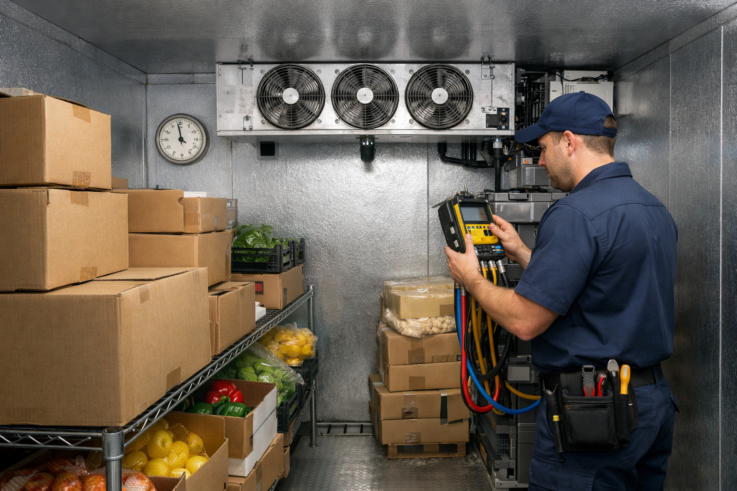
Walk-In Cooler Not Cooling After a Delivery: Causes and What Virginia?
Short Answer: Why Your Walk-In Cooler Gets Warm After a Delivery
If your walk-in cooler is not cooling after delivery, the most common reasons are extended door-open time, warm inventory entering the box, blocked evaporator airflow, or a refrigeration problem that shows up under heavy load. Close the door, stop unnecessary traffic, check airflow around the fans, verify the temperature trend, and call a commercial refrigeration technician if the box does not recover or product safety is at risk.
Why This Happens So Often in Massachusetts Restaurants
For restaurants, hotels, grocery stores, convenience stores, liquor stores, and commercial kitchens across Massachusetts, delivery time is one of the hardest parts of the day for a walk-in cooler. A kitchen in Boston may receive multiple vendor drops during a tight morning prep window. A restaurant in Cambridge or Quincy may have staff moving cases through a narrow service corridor. A hotel kitchen in Worcester or Framingham may load large quantities of dairy, produce, proteins, and prepared foods at once. In each case, the walk-in cooler door may stay open longer than normal, warm product may be added quickly, and airflow paths can become blocked by newly stacked boxes.
When a manager sees the box temperature climbing, it is natural to worry. A restaurant cooler warm after delivery can mean something as simple as a door left open, but it can also expose a failing fan motor, dirty condenser, iced evaporator coil, refrigerant issue, weak door gasket, thermostat problem, or overloaded refrigeration system. The goal is to separate normal recovery from a condition that needs walk-in cooler repair before inventory is compromised.
Royal Cooling provides commercial refrigeration service in Massachusetts for equipment such as walk-in coolers, walk-in freezers, reach-in refrigerators, wine coolers, and related refrigeration systems. If your walk-in cooler not cooling after delivery has become a repeat problem, or if the temperature continues to rise after the delivery is complete, it is time to treat the issue seriously.
Normal Temperature Recovery vs. a Warning Sign
A walk-in cooler does not instantly return to setpoint after a busy delivery. Every time the door opens, humid room air enters. Every warm case, box, keg, or container placed inside adds heat that the system must remove. Recovery time depends on the size of the box, the load, the equipment condition, door traffic, ambient kitchen temperature, and how inventory is stacked.
In a healthy system, you should usually see the temperature stabilize and trend downward once the delivery is finished, the door is closed, and the evaporator fans have clear airflow. If the temperature continues to rise, stays above the safe operating range for an extended period, or triggers repeated alarms, the situation may require emergency refrigeration repair.
Because food safety decisions depend on product type, time, temperature, and local requirements, kitchen managers should follow their internal food safety procedures and applicable health guidance. From a refrigeration standpoint, however, a warm box that does not recover is not something to ignore.
What Massachusetts Restaurants Should Check First
Before calling for walk-in cooler repair, there are several safe, practical checks a manager or trained staff member can perform. Do not remove electrical panels, bypass controls, chip ice from coils with tools, or attempt refrigerant work. These checks are meant to help you identify obvious operational causes and communicate clearly with a commercial refrigeration technician.
1. Confirm the Door Is Fully Closed
A walk-in cooler door left open is one of the most common delivery-related causes of a warm box. During a rush, a box, cart, floor mat, or damaged closer can keep the door from sealing. In dense service areas such as Boston metro, Suffolk County, Middlesex County, and Worcester County, deliveries often happen fast and in tight spaces, which makes this easy to miss.
- Check that the door closes completely without dragging.
- Look for boxes or speed racks blocking the swing path.
- Inspect whether the closer pulls the door shut on its own.
- Feel for warm air leaking around the gasket.
- Look for torn, compressed, or loose gasket sections.
If the door was open for a long period, close it and limit traffic. Watch whether the temperature begins moving in the right direction.
2. Look for Blocked Evaporator Fan Airflow
The evaporator coil and fans inside the walk-in must move cold air through the box. If staff stacks cases directly in front of the fans or tight to the ceiling, airflow can short-circuit or stop reaching parts of the cooler. This is a major reason a walk-in cooler not cooling after delivery may feel warm even though the equipment is running.
- Keep product away from the evaporator discharge and return air path.
- Avoid stacking boxes tight against walls where air needs to circulate.
- Do not pack product up to the ceiling.
- Leave space between rows when possible.
- Move tall stacks away from the fan discharge area.
Can overloading a walk-in cooler block airflow and raise temperatures? Yes. Overloading can prevent cold air from reaching the thermostat, trap heat inside dense product stacks, and cause uneven temperatures. It can also make the system run longer, increasing stress on compressors, fans, and controls.
3. Check Whether Warm Product Was Loaded Too Quickly
Deliveries can include product that is warmer than the walk-in setpoint. Even properly transported items may still add heat to the room. If a large volume of product is loaded all at once, the system needs time to remove that heat. This is especially noticeable in smaller restaurant walk-ins, older boxes, and kitchens with frequent door traffic.
If your restaurant cooler warm after delivery gradually cools back down once the door remains closed, the system may be recovering normally. If this happens every day, though, you may need better loading practices, a preventive maintenance visit, or an equipment evaluation.
4. Check the Thermometer and Temperature Trend
One high reading does not always tell the whole story. Compare the wall thermometer, digital controller, temperature alarm, and any remote monitoring data. A probe near the door or near recently loaded warm product may read higher than the average box temperature.
- Record the temperature when the delivery ends.
- Record another reading after the door has stayed closed.
- Note whether the temperature is rising, flat, or falling.
- Listen for the evaporator fans and condensing unit operation.
- Check whether staff reports warm air, unusual noise, water, ice, or alarms.
If readings conflict, a commercial refrigeration technician can test sensors, controls, thermostat calibration, and system performance.
5. Look for Ice on the Evaporator Coil or Around the Fans
Warm, humid air entering during delivery can contribute to frost or ice, especially if the door stayed open, the gasket leaks, or the defrost system has a problem. Light frost may clear during normal operation or defrost. Heavy ice buildup is different. It can block airflow and make the cooler warmer even while the equipment keeps running.
Do not use sharp tools to remove ice from the coil. Puncturing a coil can create a refrigerant leak and a much larger repair. If ice is blocking fans or airflow, call for professional walk-in cooler repair.
Common Causes and How Urgent They Are
| Possible Cause | What You May Notice | What to Check Safely | Typical Urgency |
|---|---|---|---|
| Door left open during delivery | Temperature rose during receiving; cooler may recover after closure | Door closure, gasket seal, blocked doorway, staff traffic | Monitor closely; call if it does not recover |
| Blocked evaporator airflow | Warm spots, uneven cooling, fans running but box not cooling evenly | Boxes stacked in front of fans, product too close to ceiling or walls | Correct loading; call if temperature remains high |
| Heavy warm product load | Temperature climbs after large delivery, then slowly trends down | Volume of new inventory, product spacing, door-open time | Monitor trend; consider maintenance if frequent |
| Iced evaporator coil | Reduced airflow, visible frost or ice, fans may sound strained | Visual inspection only; do not chip ice from coils | Service recommended, urgent if product is at risk |
| Dirty condenser coil | Long run times, poor recovery, warmer operation during busy periods | Look for grease, dust, lint, blocked condenser area | Service soon; urgent if temperature keeps rising |
| Fan motor or control problem | No airflow, intermittent airflow, unusual noise, warm box | Listen for fans; check for obvious obstructions | Call a commercial refrigeration technician |
| Refrigerant or compressor issue | System runs but cannot reach setpoint, recurring alarms, poor recovery | Document symptoms; do not attempt refrigerant work | Emergency refrigeration repair may be needed |
How Long Should a Walk-In Cooler Take to Recover After the Door Is Open?
There is no single recovery time that applies to every walk-in cooler. A small cooler with a short door opening and light product load may recover relatively quickly. A large delivery into a busy restaurant walk-in in Boston, Cambridge, Lowell, Springfield, Newton, Waltham, or Quincy may take longer, especially if warm product was loaded and staff continues entering the box.
The more important question is whether the temperature is trending downward after the door stays closed. If the box temperature does not improve, or if it improves briefly and then climbs again, you may be dealing with more than normal delivery load. Watch for repeated alarms, product sweating, water on the floor, iced coils, fans not running, or a condensing unit that starts and stops frequently.
If you are unsure whether your walk-in is recovering normally, call Royal Cooling at 781-899-4441. A technician can help determine whether you need a service visit, urgent repair, or preventive maintenance to reduce future temperature swings.
Delivery Practices That Help Prevent Warm Box Problems
Many delivery-related cooling problems can be reduced with better receiving habits. This is especially important for Massachusetts restaurants and commercial kitchens with frequent vendor stops, limited storage space, and high labor pressure during prep periods.
- Stage before opening the cooler: Clear pathways, organize carts, and decide where product will go before the door is open.
- Use a door monitor: Assign one person to keep the walk-in door closed whenever staff are not actively moving product.
- Load quickly but not carelessly: Fast loading helps, but do not block fans or crush airflow paths.
- Keep the fan area open: Mark a no-stack zone below and in front of the evaporator.
- Rotate inventory with airflow in mind: First-in, first-out practices should still leave space for air movement.
- Limit repeated entries after delivery: Once the delivery is put away, keep the door closed so the system can recover.
- Report recurring temperature swings: If every delivery causes a long warm period, the system may need maintenance or evaluation.
When Should a Restaurant Call for Emergency Walk-In Cooler Repair?
A warm walk-in cooler is not always an emergency, but certain symptoms should prompt a call for emergency refrigeration repair. Restaurants, hotels, supermarkets, and commercial kitchens depend on refrigeration to protect inventory and maintain operations. Waiting too long can turn a manageable repair into a larger equipment failure.
Call for service promptly if you notice any of the following:
- The temperature continues rising after the delivery is complete and the door is closed.
- The cooler does not trend downward after a reasonable recovery period.
- Food product or high-value inventory may be at risk.
- The evaporator fans are not running or airflow is very weak.
- The evaporator coil is heavily iced over.
- The condensing unit is not running, is short cycling, or is making unusual noises.
- There is water, ice, or electrical odor near equipment.
- Temperature alarms continue after basic checks.
- The same delivery-related warm-up happens repeatedly.
If the situation feels urgent, contact Royal Cooling at 781-899-4441 or use the contact page. For service-area information, visit Royal Cooling’s service area page.
What a Commercial Refrigeration Technician Checks
When a commercial refrigeration technician responds to a walk-in cooler not cooling after delivery, the service process is more detailed than simply reading the thermostat. The technician will look at the full system: the box, doors, airflow, evaporator, condensing unit, controls, and operating conditions.
Depending on symptoms, a technician may check:
- Door and gasket condition: Air leaks, hinge issues, closer function, sweep condition, and door alignment.
- Evaporator airflow: Fan operation, motor performance, coil condition, ice buildup, and blocked return or discharge air.
- Defrost operation: Defrost timer or controller settings, termination controls, heaters where applicable, and drain performance.
- Condenser condition: Dirt, grease, outdoor debris, fan motor operation, and airflow around the condensing unit.
- Refrigeration pressures and temperatures: Superheat, subcooling, refrigerant charge indicators, and signs of restrictions or leaks.
- Electrical components: Contactors, relays, capacitors, wiring condition, controls, and compressor operation.
- Temperature controls and sensors: Calibration, probe placement, setpoints, differential, and alarm functions.
- Load and usage patterns: Delivery frequency, product volume, door-open time, and storage layout.
This diagnostic process helps determine whether the issue is operational, maintenance-related, or a mechanical failure requiring repair.
Repair vs. Replace: When a Warm Walk-In Points to a Bigger Decision
Many delivery-related temperature issues can be corrected with maintenance, gasket repair, fan replacement, control adjustment, coil cleaning, or refrigerant leak diagnosis. However, if an older system repeatedly struggles to recover after normal deliveries, replacement or equipment upgrades may need to be discussed.
Repair is often appropriate when the box is generally in good condition, the issue is isolated, and parts are available. Replacement or a larger upgrade may make more sense when the refrigeration system is undersized for current operations, the box has significant air leaks or insulation issues, the compressor is failing, or repair costs keep stacking up.
A restaurant that has grown from light service to high-volume delivery and prep may be asking an old cooler to do more than it was designed to handle. A commercial refrigeration service Massachusetts provider can evaluate whether equipment capacity, airflow design, and operating practices match your current business.
Preventive Maintenance Helps Coolers Recover Faster
Preventive maintenance is one of the best ways to reduce panic after deliveries. A clean, properly adjusted system is more likely to recover after door openings and heavy product loading. This is important not only for restaurants, but also for hotels, liquor stores, convenience stores, supermarkets, grocery stores, facility managers, property managers, and commercial kitchens across Massachusetts.
A maintenance visit may include cleaning condenser coils, checking fan motors, inspecting electrical components, confirming temperature controls, checking drains, reviewing defrost operation, inspecting door gaskets, and looking for signs of refrigerant leaks or compressor stress. For walk-in freezer service, additional attention may be given to heaters, ice buildup, door seals, and defrost performance.
Preventive maintenance does not eliminate every emergency, but it can reveal weak components before a busy Friday delivery, holiday weekend, catering event, or hotel banquet creates a crisis.
Massachusetts Service Context: Why Local Conditions Matter
Commercial refrigeration systems do not operate in a vacuum. A walk-in cooler in a compact Boston kitchen may face heat from cooking equipment, limited ventilation, and constant staff traffic. A Cambridge café may have deliveries staged through a narrow back entrance. A Worcester restaurant may receive large weekly inventory drops. A Quincy seafood operation may have high-value product and frequent door openings. Locations in Lowell, Springfield, Newton, Waltham, and Framingham may have different building layouts, outdoor condensing unit exposure, and seasonal temperature swings.
These local operating conditions matter. When Royal Cooling discusses walk-in cooler repair, the goal is not only to fix the failed component. It is also to understand how your Massachusetts kitchen actually uses the equipment and what can be done to prevent the next warm-box event.
FAQ: Walk-In Cooler Not Cooling After Delivery
Why does my walk-in cooler get warm after a food delivery?
A walk-in cooler gets warm after a food delivery because the door may stay open, warm and humid air enters the box, warm product is added, and new inventory can block airflow. If the temperature does not trend downward after the door is closed, there may also be a mechanical or control problem.
How long should a walk-in cooler take to recover after the door is open?
Recovery time depends on the cooler size, product load, door-open time, airflow, and equipment condition. The key sign is the temperature trend. Once the door stays closed, a healthy system should stabilize and begin cooling down. If it keeps rising or stays warm, call for service.
When should a restaurant call for emergency walk-in cooler repair?
Call for emergency walk-in cooler repair if temperatures keep rising, alarms continue, product is at risk, fans are not moving air, the coil is heavily iced, the condensing unit is not operating properly, or the cooler fails to recover after delivery.
Can overloading a walk-in cooler block airflow and raise temperatures?
Yes. Overloading can block evaporator discharge and return airflow, trap heat in product stacks, create warm spots, and force the refrigeration system to run longer. Keep space around fans, walls, and the ceiling so cold air can circulate.
What should I do first if my restaurant cooler is warm after delivery?
Close the door, reduce traffic, check for blocked airflow, confirm the door seal, record temperature readings, and look for alarms, ice, or fan problems. Do not open electrical panels or attempt refrigerant repairs. If the box does not recover, call a commercial refrigeration technician.
Can a dirty condenser make a walk-in cooler recover slowly?
Yes. A dirty condenser coil can reduce heat rejection and make the system struggle during heavy loads, especially after deliveries. Grease, dust, lint, or blocked condenser airflow can lead to long run times and poor temperature recovery.
Does Royal Cooling service walk-in coolers in Massachusetts?
Royal Cooling provides commercial refrigeration service in Massachusetts for walk-in coolers, walk-in freezers, reach-in refrigerators, wine coolers, freezer repair, and preventive refrigeration maintenance. Service-area examples include Boston, Worcester, Cambridge, Lowell, Springfield, Quincy, Newton, Waltham, and Framingham.
Need Help With a Walk-In Cooler Not Cooling After Delivery?
If your walk-in cooler is not cooling after delivery, do not wait until the next alarm to take action. Start with the safe checks above: close the door, clear airflow, document the temperature trend, and protect inventory according to your food safety procedures. If the cooler does not recover, or if you see ice, fan issues, repeated alarms, or signs of equipment failure, Royal Cooling can help.
Call 781-899-4441 to speak with Royal Cooling about walk-in cooler repair, emergency refrigeration repair, preventive maintenance, or commercial refrigeration service in Massachusetts. You can also reach out through the contact page or review the service area for more information.