Walk-In Cooler Refrigerant Leak Symptoms: What MassachusettsBusinesses
Short answer: what a walk-in cooler refrigerant leak looks like
A walk-in cooler refrigerant leak often shows up as rising box temperature, a unit that runs constantly, weak cooling, uneven frost on the evaporator coil, oily residue near refrigerant lines, bubbling or hissing sounds, or repeated temperature loss after service. Massachusetts businesses should protect product, record temperatures, avoid constant resets, and call a qualified commercial refrigeration technician for leak testing and repair.
Why refrigerant leak symptoms need fast attention in Massachusetts
For restaurants, grocery stores, liquor stores, convenience stores, hotels, and commercial kitchens in Massachusetts, a warming walk-in cooler is not just an inconvenience. It can threaten perishable inventory, interrupt service, create staff stress, and force expensive emergency decisions during the busiest part of the day. A suspected walk-in cooler refrigerant leak is especially urgent because adding refrigerant without finding and repairing the leak does not solve the underlying problem.
Royal Cooling helps businesses think through the next step when a walk-in cooler not cooling issue points to low charge, refrigerant loss, or hidden system damage. The signs can be subtle at first. A prep cooler may seem fine in the morning but drift warmer during lunch. A beer cave or liquor store walk-in may hold temperature overnight but struggle when doors open during business hours. A supermarket back-room cooler may need repeated service visits because the system keeps losing charge. In Boston metro, Worcester County, Middlesex County, Suffolk County, and across Massachusetts, fast diagnosis matters because product load, humidity, traffic, and outdoor temperature can all increase the strain on commercial refrigeration equipment.
This guide explains the most common low refrigerant symptoms, what to do before service, what a technician checks, and when the issue becomes an emergency refrigeration repair call. It is written for business owners and facility managers who need practical next steps, not guesswork.
Common symptoms of a walk-in cooler refrigerant leak
A refrigerant leak can mimic several other refrigeration problems, including dirty coils, bad fans, failing controls, or door air leaks. However, some patterns should raise concern and prompt professional commercial refrigeration leak repair.
1. The walk-in cooler is not cooling or is slowly warming
The most obvious symptom is a walk-in cooler not cooling to its normal operating range. At first, the cooler may be only a few degrees warmer than usual. Then it may begin losing ground during busy periods, after deliveries, or when the kitchen is hot. Refrigerant is the medium that carries heat out of the box. If the system has lost enough charge, it cannot absorb and reject heat properly, even if the compressor and fans are still running.
2. The system runs for unusually long periods
When refrigerant is low, the equipment often runs longer while delivering less cooling. Staff may notice that the condensing unit seems to run all day, the evaporator fans rarely stop, or the cooler sounds busier than normal. Long run times can increase wear on the compressor and other components, so this symptom should not be ignored.
3. Uneven frost or ice on the evaporator coil
A refrigerant leak does not always create a fully iced coil. In many cases, the frost pattern is uneven. You may see ice only at the beginning of the coil, one corner of the coil, or around a distributor tube. That partial frost pattern can be a clue that the refrigerant circuit is starved. Heavy ice can also be caused by airflow, defrost, or door issues, so a technician should verify the cause before any repair decision is made.
4. Hissing, bubbling, or oil stains
Some leaks make a faint hissing or bubbling sound, especially if the opening is larger or in an accessible part of the line set, coil, valve, or fitting. Oil residue can also be a clue. Refrigerant oil travels through the system with the refrigerant, so an oily spot on tubing, near a service valve, around a braze joint, or on a coil may indicate a leak point. Do not touch suspected refrigerant lines or attempt to tighten fittings without training.
5. Repeated service calls for the same temperature problem
If your cooler works after service but warms again days or weeks later, the underlying issue may not have been fully resolved. A system that keeps needing refrigerant needs leak detection, not just another top-off. This is a common reason Massachusetts restaurants and retailers call Royal Cooling for a second look at walk-in cooler repair.
6. Higher energy use or stressed equipment
Low charge can make a system operate inefficiently. The compressor may run hotter or longer. Controls may cycle oddly. The cooler may recover slowly after doors are opened. While your utility bill alone does not prove a leak, increasing energy use combined with temperature trouble is worth investigating.
What causes refrigerant leaks in commercial walk-in coolers?
Refrigeration systems work in a demanding environment. Restaurant kitchens, back rooms, loading areas, and convenience store storage spaces are busy places. Over time, vibration, corrosion, impact, improper prior repairs, aging components, or installation issues can create small openings in the refrigerant circuit.
- Vibration and metal fatigue: Compressors and piping vibrate during operation. If lines are unsupported or rubbing against a surface, leaks can develop.
- Corrosion: Moisture, cleaning chemicals, salt, acidic food environments, and poor airflow can contribute to corrosion on coils or tubing.
- Mechanical damage: Stock carts, ladders, pallets, shelving, or maintenance work can strike refrigerant lines or coils.
- Failing service valves or fittings: Valve cores, flare fittings, caps, and joints can leak if worn, damaged, or improperly sealed.
- Evaporator or condenser coil leaks: Coils can develop pinholes or damage after years of service, especially in harsh environments.
- Previous repair quality: Poor brazing, incorrect parts, or rushed work can create repeat leak points.
Because the cause can be hidden inside the evaporator, on the roof, behind panels, or at a line set connection, leak diagnosis requires tools and refrigeration experience. A refrigeration technician Massachusetts businesses hire should be prepared to test, document findings, and recommend a repair path based on the equipment condition.
What Massachusetts businesses should do before the technician arrives
If you suspect a refrigerant leak, your goal is to protect inventory, preserve evidence of the problem, and avoid actions that make diagnosis harder. These steps apply to restaurants in Cambridge, supermarkets in Worcester, liquor stores in Quincy, convenience stores in Lowell, commercial kitchens in Newton, hotels in Waltham, and similar facilities across the state.
- Check and record temperatures: Write down the box temperature, product temperature if your procedures require it, and the time readings were taken. Continue logging at reasonable intervals.
- Limit door openings: Reduce traffic in and out of the walk-in. Assign one person to retrieve necessary items if possible.
- Move product if needed: If temperatures are moving toward unsafe or unacceptable limits for your products, follow your internal food safety or inventory procedures and relocate product to another working cooler or approved backup storage.
- Do not keep resetting the system: Repeated power cycling can mask symptoms and may stress components. If equipment trips a breaker or safety control, call for service.
- Look but do not disassemble: You can note visible ice, oily residue, unusual sounds, or warm air discharge, but do not remove covers, cut ice with tools, or open refrigerant components.
- Share the service history: Tell the technician if refrigerant was recently added, if the unit has had repeat visits, or if a coil, valve, compressor, or control was replaced.
If the cooler is serving high-value inventory or critical food service operations, call Royal Cooling at 781-899-4441 or use the contact page to request help. For broader coverage details, visit the Massachusetts service area page.
Symptom comparison: refrigerant leak or another problem?
The table below can help you understand why professional diagnosis matters. It does not replace an on-site inspection, but it can help you communicate symptoms clearly when calling for emergency refrigeration repair.
| Symptom | Possible refrigerant leak clue | Other possible causes | What to do next |
|---|---|---|---|
| Cooler temperature rising slowly | System is low on charge and cannot remove enough heat | Dirty condenser, failed fan, heavy load, controls issue | Log temperature, reduce door openings, call a commercial refrigeration technician |
| Partial frost on evaporator coil | Starved coil from low refrigerant | Airflow restriction, expansion valve issue, defrost problem | Do not chip ice; schedule diagnostic service |
| Hissing or oily residue | Leak at line, coil, valve, or fitting | Oil from unrelated mechanical work, normal noise mistaken for leak | Photograph location if safe, then call for leak inspection |
| Works after refrigerant is added, then warms again | Unrepaired leak is allowing charge to escape | Incorrect initial diagnosis or multiple faults | Request leak testing and repair, not a simple top-off |
| Runs constantly but cools poorly | Low refrigerant reduces system capacity | Compressor wear, airflow issue, high ambient conditions | Schedule refrigeration diagnostics before compressor damage escalates |
Is it safe to keep using a walk-in cooler with low refrigerant?
It is not wise to treat low refrigerant as a normal operating condition. Whether product can remain in the cooler depends on your inventory, measured temperatures, time, and internal safety procedures. From an equipment standpoint, continued operation with low charge can stress the compressor, cause poor oil return, increase run times, and lead to larger repairs. From a business standpoint, the cooler may keep drifting warmer until product has to be moved or discarded.
If the box is still close to normal temperature, you may be able to limit use while waiting for service. If temperatures are rising quickly, if product is at risk, if alarms are active, or if the system is tripping controls, treat it as urgent. A qualified commercial refrigeration technician can determine whether the unit should be shut down, repaired, or temporarily managed while parts are sourced.
Why a walk-in cooler keeps losing temperature after service
One of the most frustrating scenarios for Massachusetts business owners is a cooler that seems repaired, then warms again. This can happen when the service addressed a symptom rather than the root cause. If refrigerant was added but no leak was repaired, the system may cool temporarily and then return to the same problem. If a leak was repaired but the system was not properly evacuated, charged, or checked under operating conditions, performance may still be inconsistent.
Other issues can also appear after a repair. A restricted metering device, weak compressor, condenser airflow problem, failed fan motor, sensor issue, or control problem may exist alongside a leak. That is why experienced commercial refrigeration leak repair involves more than finding one oily joint. The technician should evaluate the refrigeration circuit, airflow, controls, coil condition, and operating pressures in context.
What a refrigeration technician checks during a suspected leak call
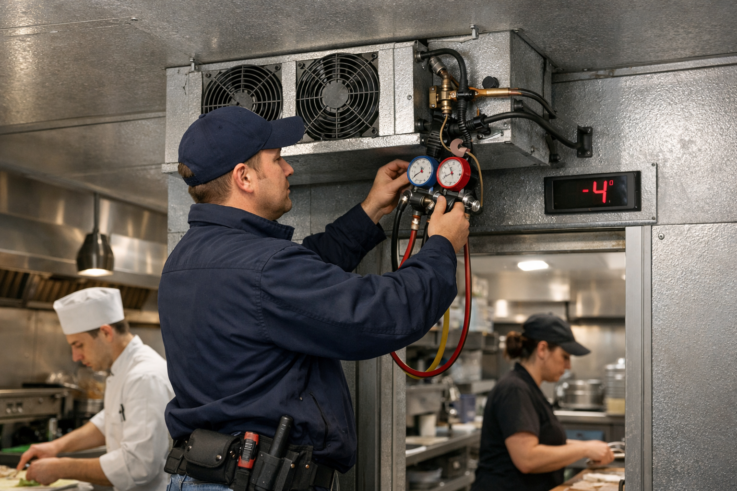
When Royal Cooling responds to a suspected walk-in cooler refrigerant leak, the process typically focuses on confirming the complaint, protecting the equipment, and identifying the repair path. The exact procedure depends on equipment type, refrigerant, access, system condition, and urgency, but a professional diagnostic visit may include:
- Temperature and operating review: Box temperature, setpoint, product load, door activity, and complaint history.
- Visual inspection: Evaporator, condenser, line set, service valves, fittings, oil staining, coil damage, and signs of impact or corrosion.
- Airflow checks: Evaporator fans, condenser fans, blocked coils, obstructions, and abnormal frost patterns.
- Electrical and control checks: Thermostat or controller operation, contactors, safeties, defrost controls, and compressor operation.
- Refrigeration readings: Pressures, temperatures, superheat, subcooling, and system behavior when safe and appropriate.
- Leak detection: Electronic leak detection, soap bubbles, pressure testing, or other methods appropriate for the equipment and refrigerant.
- Repair recommendation: Tightening, valve core replacement, brazing, component replacement, coil replacement, evacuation, charging, and follow-up verification where applicable.
A properly handled leak repair should be documented clearly so owners, managers, or facility teams know what was found and what was done. If your business manages several sites in places like Boston, Framingham, Waltham, Worcester, or Springfield, consistent documentation also helps with future preventive maintenance planning.
Repair versus replacement: when does a leak change the decision?
Not every refrigerant leak means the walk-in cooler must be replaced. Many leaks can be repaired. The better question is whether repair is the most sensible option given the age, condition, access, refrigerant type, part availability, and total operating reliability of the equipment.
Repair may make sense when the leak is accessible, the system is otherwise in good condition, the compressor is healthy, and the cost of parts and labor is reasonable compared with the value of the equipment and inventory it protects. Replacement may be worth discussing when the evaporator coil is severely corroded, the condenser is near the end of its service life, the compressor has been stressed by repeat low-charge operation, or the cooler has had recurring repairs that interrupt business.
This decision can also apply to related equipment. Royal Cooling services walk-in freezers, provides walk-in freezer service, works on reach-in refrigerators, supports wine coolers, and performs commercial freezer repair. A leak in a small reach-in may lead to a different decision than a leak in a critical supermarket walk-in. A good HVAC contractor with commercial refrigeration experience will explain the tradeoffs without pushing a one-size-fits-all answer.
How to reduce the chance of future refrigerant leaks
No maintenance program can prevent every leak, but regular attention can reduce risk and catch early warning signs before a cooler fails during a Friday dinner rush or a holiday delivery. Massachusetts facilities should build refrigeration checks into normal operations and scheduled service.
- Keep coils clean and accessible: Dirt, grease, and blocked airflow make systems run hotter and longer, increasing stress.
- Protect refrigerant lines: Make sure lines are not used as hanging points and are protected from carts, pallets, and shelving.
- Watch for oil spots: Train staff to report oily residue, new stains, or unusual sounds near refrigeration equipment.
- Track temperature trends: A cooler that recovers more slowly than it used to may be showing an early issue.
- Schedule preventive maintenance: Planned inspections help identify vibration, corrosion, loose panels, failing fans, and abnormal operating conditions.
- Act on repeat symptoms: If the same cooler needs repeated refrigerant or keeps drifting warm, request a deeper leak diagnosis.
Preventive maintenance is especially helpful for high-traffic businesses in Boston, Cambridge, Quincy, Lowell, Newton, and other dense Massachusetts markets where walk-ins are opened constantly and downtime disrupts operations quickly.
When should a Massachusetts business call a technician for a suspected leak?
Call a refrigeration technician Massachusetts businesses trust when the cooler temperature is rising, the unit is running constantly, you see partial coil frost, you hear hissing, you notice oily residue, or the system has needed refrigerant recently. You should also call if staff are unsure whether the cooler can safely hold product, if the system is tripping, or if multiple pieces of equipment are affected.
For restaurants and commercial kitchens, call before the lunch or dinner rush if the trend is getting worse. For grocery stores and convenience stores, call before high-value refrigerated inventory is compromised. For liquor stores with beer caves or wine coolers, call when the space no longer holds stable temperature or the refrigeration system is operating abnormally. For property managers and facility managers, call when tenant operations are affected or temperature alarms repeat after reset.
If the situation is urgent, contact Royal Cooling at 781-899-4441. You can also request service through the contact page or review coverage on the service area page. Royal Cooling supports commercial refrigeration, walk-in coolers, walk-in freezers, wine coolers, reach-in refrigerators, freezer repair, and preventive refrigeration maintenance for Massachusetts businesses.
FAQ: walk-in cooler refrigerant leak questions
How can I tell if my walk-in cooler has a refrigerant leak?
Common signs include rising temperature, long run times, weak cooling, partial frost on the evaporator coil, hissing sounds, oily residue near tubing or fittings, and repeated warming after refrigerant was added. A technician should confirm the leak with proper diagnostic tools.
Is it safe to keep using a walk-in cooler with low refrigerant?
Low refrigerant is not a safe long-term operating condition for the equipment. It can stress the compressor and lead to unreliable temperatures. Follow your product safety procedures, limit door openings, monitor temperatures, and call for service promptly.
Why does my walk-in cooler keep losing temperature after service?
If the cooler improves after service but warms again, the system may have an unrepaired leak, an additional leak, an incorrect charge, airflow trouble, controls issues, or a failing component. Ask for full leak testing and refrigeration diagnostics.
When should a Massachusetts restaurant call a commercial refrigeration technician for a suspected leak?
Call when temperatures rise, the cooler runs constantly, frost appears in an unusual pattern, oily residue is visible, hissing is heard, or the system recently needed refrigerant. Restaurants should not wait until product is already at risk.
Can refrigerant simply be added to fix the cooler?
Adding refrigerant may temporarily improve cooling, but it does not repair the leak. The correct approach is to locate the leak, repair it when feasible, verify the system, and charge it according to equipment requirements.
What will a technician check during commercial refrigeration leak repair?
A technician may inspect coils, valves, line sets, fittings, oil stains, airflow, controls, electrical components, pressures, temperatures, superheat, subcooling, and refrigerant leak points. The goal is to find the cause, not just treat the symptom.
Does a refrigerant leak mean I need a new walk-in cooler?
Not always. Many leaks can be repaired. Replacement may be worth considering if coils are severely corroded, the system is very old, the compressor has been damaged, or repair costs no longer make sense.
Get help with a suspected refrigerant leak
A suspected walk-in cooler refrigerant leak deserves prompt attention from a qualified commercial refrigeration technician. If your Massachusetts restaurant, grocery store, liquor store, convenience store, hotel, or commercial kitchen is dealing with a warming cooler, repeated service visits, strange icing, or possible low refrigerant symptoms, contact Royal Cooling. Call 781-899-4441 or request service through the contact page.