Walk-In Cooler Repair Costs in Massachusetts: What Impacts Price
Quick Answer: What Does Walk-In Cooler Repair Cost in Massachusetts?
Walk-in cooler repair cost in Massachusetts depends on the failed component, urgency, refrigerant type, system age, access, and whether food or beverage inventory is at risk. A minor control, fan, drain, or door issue is usually less involved than compressor, refrigerant leak, or electrical repairs. For an accurate price, a commercial refrigeration technician should diagnose the cooler on-site before quoting repairs.
If you operate a restaurant, market, liquor store, hotel, convenience store, supermarket, or commercial kitchen in the Boston metro area or surrounding Massachusetts communities, a warm walk-in cooler is not just an equipment problem. It can become an inventory, food safety, staffing, and revenue problem very quickly. This guide explains what affects the price of walk-in cooler repair Massachusetts businesses often need, how to think about repair versus replacement, and when to call Royal Cooling for professional commercial refrigeration repair.
Royal Cooling services commercial refrigeration equipment including walk-in coolers, walk-in freezers, wine coolers, reach-in refrigerators, freezer repair, and preventive refrigeration maintenance. Businesses across Massachusetts communities such as Boston, Worcester, Cambridge, Lowell, Springfield, Quincy, Newton, Waltham, and Framingham often face similar cooler problems, but the right repair plan depends on the equipment, building conditions, and urgency of the call.
Why Walk-In Cooler Repair Pricing Varies So Much
There is no single flat price that applies to every walk-in cooler repair. A cooler that is running a few degrees warm because of a dirty condenser coil is very different from a cooler with a refrigerant leak, failed compressor, damaged evaporator fan motors, or electrical control issue. The best way to understand walk-in cooler repair cost is to look at what the technician must diagnose, what parts are involved, how urgent the service is, and how much risk the business is carrying while the cooler is down.
Massachusetts also creates its own operating conditions. A walk-in cooler serving a high-volume restaurant in Boston may be opened hundreds of times per day. A liquor store in Waltham may need precise beverage temperature control but less frequent door traffic. A hotel kitchen in Cambridge may have complex scheduling requirements. A market in Worcester or Framingham may have multiple refrigerated zones, shared electrical loads, and product that cannot sit above safe temperatures. These real-world conditions affect the troubleshooting process and the final repair approach.
Common Symptoms That Lead to a Service Call
Business owners often call for walk-in cooler service after noticing one symptom, but the root cause may be elsewhere in the system. A walk-in cooler is an integrated refrigeration system with an evaporator coil, condensing unit, compressor, fans, refrigerant circuit, controls, thermostat or temperature controller, door gaskets, drains, electrical components, and box insulation. A problem in one area can create symptoms in another.
Signs your walk-in cooler needs attention
- Cooler temperature is rising: This may point to airflow problems, low refrigerant, dirty coils, a failing compressor, a stuck control, or frequent door openings.
- Ice on the evaporator coil: Common causes include failed fans, defrost issues, air leaks, blocked drains, or refrigerant problems.
- Compressor short cycling: The system turns on and off rapidly, often due to pressure issues, controls, electrical faults, or dirty coils.
- Water on the floor: Drain line clogs, frozen drains, improper pitch, or condensate issues may be involved.
- Door not sealing: Damaged gaskets, misaligned hinges, worn closers, or damaged thresholds can allow warm, humid air into the box.
- Unusual noise: Fan motors, bearings, compressors, relays, or loose components may be failing.
- Product is warmer than the display: Sensor location, air circulation, overloading, or inaccurate controls may be causing misleading readings.
- High energy use: Dirty condenser coils, air leaks, failing motors, or aging equipment can make the system run longer than necessary.
For restaurants and commercial kitchens, these symptoms should not be ignored. A restaurant cooler repair issue can move from inconvenient to urgent if temperatures continue to climb during a busy prep period, weekend rush, catered event, or health inspection window.
What Affects the Price of Repairing a Walk-In Cooler?
The final price depends on the diagnosis and the repair scope. Below are the most common cost drivers Massachusetts businesses should understand before calling a walk-in cooler technician.
| Cost Factor | Why It Matters | Examples |
|---|---|---|
| Failed component | Some parts are simple to replace, while sealed-system and compressor-related work requires more labor, tools, and testing. | Fan motor, thermostat, contactor, compressor, expansion valve, pressure control |
| Diagnostic complexity | A visible broken gasket is easier to identify than an intermittent electrical fault or refrigerant restriction. | Temperature swings, nuisance trips, short cycling, intermittent fan failure |
| Refrigerant issue | Leaks require detection, repair, evacuation, charging, and verification. Refrigerant type and system condition affect the job. | Low charge, leak at coil, line set leak, service valve issue |
| Urgency | After-hours or emergency refrigeration repair may involve different scheduling and dispatch considerations. | Cooler down during dinner service, holiday weekend, product at risk |
| Equipment age | Older equipment can require harder-to-source parts and may have multiple failing components. | Aging condensing unit, obsolete controls, corroded evaporator coil |
| Access and location | Rooftop, tight mechanical rooms, basements, alleys, loading docks, and shared buildings can add time. | Boston storefront, Cambridge kitchen, Worcester market, hotel mechanical area |
| Condition of the box | Door leaks, panel damage, insulation issues, and floor problems may reduce repair effectiveness. | Damaged panels, failing door closer, worn threshold, moisture intrusion |
| Preventive maintenance history | Neglected coils, drains, fans, and electrical components can turn a small repair into a larger one. | Dirty condenser, clogged drain, loose wiring, worn fan bearings |
The key point: the same symptom can have several possible causes. A cooler that is not holding temperature might need something relatively straightforward, or it might have a deeper refrigeration or electrical issue. That is why Royal Cooling focuses on proper diagnosis before recommending a repair path.
What a Commercial Refrigeration Technician Checks During Diagnosis
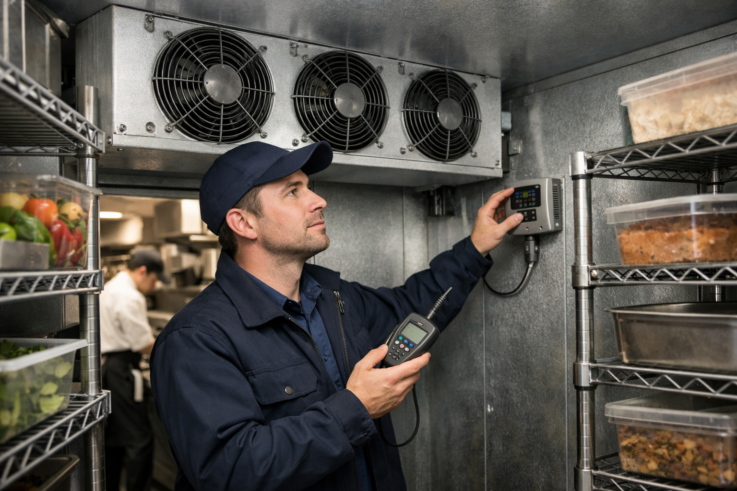
When Royal Cooling responds to a commercial refrigeration repair call, the goal is to identify the cause of failure, protect the equipment from further damage, and help the business make a practical decision. A professional inspection typically includes both the refrigerated box and the mechanical refrigeration equipment.
Typical diagnostic steps
- Temperature verification: The technician compares the displayed temperature with independent readings and checks product-area conditions.
- Airflow inspection: Evaporator fans, return air, supply air, shelving layout, blocked coils, and product loading are reviewed.
- Condenser coil check: Dirty outdoor or indoor condenser coils can increase head pressure and reduce cooling performance.
- Evaporator coil inspection: Ice, frost patterns, dirt, and airflow restrictions can reveal defrost, fan, or refrigerant issues.
- Electrical testing: Contactors, relays, capacitors, controls, wiring, breakers, disconnects, and motor amperage are checked as needed.
- Refrigerant circuit evaluation: Pressures, temperatures, superheat/subcooling indicators, leak signs, and restrictions may be assessed.
- Compressor condition: The compressor is checked for operation, electrical health, noise, overheating, and cycling issues.
- Door and gasket review: Air leaks from worn gaskets, hinges, sweeps, or closers can overwhelm an otherwise functional system.
- Drain and condensate check: Clogged drains can create ice, water, sanitation concerns, and recurring service problems.
- Controls and sensor placement: A bad sensor or poor sensor location can cause inaccurate readings and improper cycling.
This process helps separate symptoms from causes. For example, adding refrigerant to a leaking system without locating the leak is not a reliable long-term solution. Replacing a thermostat will not solve a cooler that is warm because the evaporator coil is iced over. A qualified commercial refrigeration technician looks at the complete system, not just the most obvious symptom.
Repair vs. Replacement: When Does Replacement Make Sense?
Many Massachusetts business owners ask whether it is better to repair or replace a walk-in cooler. The answer depends on the age and condition of the equipment, the repair cost compared with remaining service life, energy performance, reliability, and operational risk. A single failed fan motor on an otherwise solid system is very different from repeated compressor failures on an old unit with panel damage and poor door seals.
| Situation | Repair May Make Sense When… | Replacement May Make Sense When… |
|---|---|---|
| Isolated component failure | The cooler is otherwise reliable and the failed part is accessible and replaceable. | Multiple related components are failing and the repair will not restore dependable operation. |
| Compressor problem | The system is relatively modern, clean, properly sized, and the cause of failure is understood. | The compressor failed on an older, inefficient, contaminated, or leak-prone system. |
| Refrigerant leak | The leak is accessible, repairable, and the rest of the system is in good condition. | The coil is severely corroded, leaks are recurring, or refrigerant and parts availability are concerns. |
| Door or box issues | Gaskets, hinges, closers, sweeps, or thresholds can be repaired to restore the seal. | Panels, insulation, floor, or structural sections are damaged enough to compromise performance. |
| Energy and reliability | The system has been maintained and meets business needs. | The cooler runs constantly, breaks down repeatedly, or cannot keep up with volume. |
| Business impact | Downtime is limited and repairs can restore confidence. | Frequent failures are risking product, labor schedules, catering orders, or customer experience. |
Replacement does not always mean replacing the entire box. In some cases, a business may replace the condensing unit, evaporator, controls, or door components while keeping a usable insulated enclosure. In other cases, especially with older or damaged boxes, full replacement may be more practical. Royal Cooling can evaluate the system and explain the options in plain language so you can make a budget-conscious decision.
When Should a Restaurant Call a Commercial Refrigeration Technician?
A restaurant, market, or commercial kitchen should call a technician as soon as a cooler shows signs that it cannot maintain safe, stable temperature. Waiting too long can make the repair more expensive and increase the risk of product loss. This is especially true during warm weather, high-volume service, or when the cooler stores high-value inventory.
Call for service promptly if you notice:
- The walk-in cooler temperature keeps climbing or will not recover after the door is closed.
- The compressor is running constantly, short cycling, or not starting.
- Evaporator fans are not spinning or airflow feels weak.
- Ice is forming on the coil, ceiling, drain, suction line, or around the door.
- The door will not seal, close, or latch properly.
- There is water on the floor, especially near stored product or electrical components.
- You smell hot electrical components or see tripped breakers.
- Product temperatures are inconsistent from one shelf or zone to another.
- The cooler has recently been repaired but the same symptom returned.
For urgent issues, emergency refrigeration repair can help reduce downtime and protect inventory. Royal Cooling can be reached at 781-899-4441. If the issue is not immediate, you can also request service through the contact page.
Emergency Refrigeration Repair: What to Do Before the Technician Arrives
If your walk-in cooler is running warm, take practical steps while you wait for professional service. Do not attempt sealed-system refrigeration repairs, electrical repairs, or refrigerant work unless you are properly trained and licensed. However, managers and staff can help reduce damage and give the technician useful information.
- Limit door openings: Keep the door closed as much as possible to slow temperature rise.
- Record temperatures: Note the time, air temperature, and product temperature if your procedures require it.
- Check for obvious airflow blockage: Move boxes away from evaporator fans and return air paths if safe to do so.
- Do not chip ice with sharp tools: You can puncture coils or refrigerant lines and create a larger repair.
- Listen for equipment operation: Note whether fans, compressor, or condensing unit appear to be running.
- Look for water or electrical hazards: Keep staff away from unsafe areas and tell the technician what you observed.
- Prepare access: Clear a path to the cooler, condensing unit, roof hatch, mechanical room, or electrical panel.
These steps are not a substitute for walk-in cooler repair, but they can reduce risk and help the technician diagnose the issue faster.
How Preventive Maintenance Can Lower Future Repair Costs
Many expensive walk-in cooler failures begin as small maintenance issues. A condenser coil gets dirty, pressure rises, the compressor runs hotter, electrical components weaken, and eventually the system fails during a busy shift. Preventive maintenance helps catch these issues before they become emergency calls.
Maintenance tasks that matter
- Clean condenser and evaporator coils as appropriate for the equipment and environment.
- Inspect fan motors, blades, guards, and airflow patterns.
- Check door gaskets, hinges, closers, sweeps, and latches.
- Verify temperature controls, sensors, and defrost operation.
- Inspect electrical connections, contactors, capacitors, and disconnects.
- Check drains, pans, and condensate lines for clogs or icing.
- Review refrigerant performance indicators and look for oil stains or leak signs.
- Confirm that shelving and product storage are not blocking airflow.
For restaurants in Boston, commercial kitchens in Cambridge, markets in Quincy, convenience stores in Newton, hotels in Waltham, or grocery operations in Worcester County and Middlesex County, a planned maintenance approach can reduce surprises. Royal Cooling provides preventive refrigeration maintenance for walk-in coolers, walk-in freezer service, reach-in refrigerators, wine coolers, and related commercial refrigeration equipment.
Massachusetts Service Context: Local Buildings, Local Challenges
Commercial refrigeration in Massachusetts often involves building-specific challenges. Older urban storefronts in Boston and Cambridge may have tight access, rooftop equipment, basement mechanical areas, or shared electrical constraints. Suburban restaurants in Newton, Waltham, and Framingham may have larger kitchens but heavy weekend demand. Markets and supermarkets in Worcester, Lowell, Springfield, and surrounding counties may operate multiple cooler and freezer systems at once.
These conditions influence repair planning. A technician may need to evaluate equipment location, ventilation around the condensing unit, roof access, drain routing, electrical service, and how the cooler is used day to day. This local operating context is one reason it helps to work with a Massachusetts company experienced in commercial refrigeration systems, not a general handyman or residential-only contractor.
Royal Cooling supports businesses across its Massachusetts service area with commercial refrigeration, walk-in coolers, walk-in freezers, freezer repair, reach-in refrigerators, wine coolers, and maintenance. Whether you manage a restaurant in Suffolk County, a facility in Middlesex County, or a market in Worcester County, the goal is the same: restore dependable temperature control and reduce the chance of repeat failures.
How to Decide Your Next Step
If your cooler has a minor symptom and temperatures are stable, schedule a service visit before the issue worsens. If the cooler is warming quickly, product is at risk, or electrical issues are present, treat it as urgent. In either case, the most useful next step is an on-site diagnosis from a trained walk-in cooler technician.
Before calling, gather the model and serial number if accessible, the current temperature, the target setpoint, when the issue started, whether the system has had recent repairs, and any sounds, ice, water, or alarms you noticed. This information helps the dispatcher and technician understand the situation and prioritize the right tools and parts.
Need walk-in cooler repair in Massachusetts? Call Royal Cooling at 781-899-4441 or request service through /contact/. We service commercial refrigeration equipment for restaurants, markets, liquor stores, hotels, commercial kitchens, convenience stores, facility managers, and property managers across the Boston metro area and surrounding Massachusetts communities.
FAQ: Walk-In Cooler Repair Costs in Massachusetts
How much does walk-in cooler repair cost in Massachusetts?
Walk-in cooler repair cost in Massachusetts depends on the failed component, diagnostic time, parts, refrigerant work, accessibility, and urgency. A technician needs to inspect the system before giving an accurate repair quote.
What affects the price of repairing a walk-in cooler?
Major price factors include the type of failure, equipment age, refrigerant condition, compressor health, electrical issues, door or gasket problems, after-hours urgency, and whether the cooler has had regular maintenance.
Is it better to repair or replace a walk-in cooler?
Repair often makes sense for isolated issues on equipment that is otherwise reliable. Replacement may be better for old, inefficient, repeatedly failing systems, major compressor failures, severe leaks, damaged panels, or coolers that no longer meet business demand.
When should a restaurant call a commercial refrigeration technician for a cooler issue?
Call promptly if temperatures are rising, the compressor is not running correctly, ice is forming, fans are not moving air, water is leaking, the door will not seal, or product temperatures are inconsistent.
Can a dirty condenser coil make a walk-in cooler run warm?
Yes. A dirty condenser coil can reduce heat rejection, raise system pressure, increase compressor strain, and make the cooler struggle to maintain temperature. Coil cleaning is an important maintenance task.
Do you service walk-in freezers as well as walk-in coolers?
Yes. Royal Cooling provides commercial refrigeration service for walk-in coolers, walk-in freezers, reach-in refrigerators, wine coolers, freezer repair, and preventive maintenance for Massachusetts businesses.
Should staff try to defrost an iced-up evaporator coil?
Staff should not chip ice with sharp tools or open refrigeration components. Limit door openings, protect product according to your procedures, and call a commercial refrigeration technician to find the cause of the icing.
Does Royal Cooling serve businesses outside Boston?
Yes. Royal Cooling serves Massachusetts businesses across the Boston metro area and surrounding communities, including examples such as Worcester, Cambridge, Lowell, Springfield, Quincy, Newton, Waltham, and Framingham.
Schedule Walk-In Cooler Service in Massachusetts
A walk-in cooler problem rarely fixes itself. If your system is running warm, icing up, leaking water, short cycling, or putting inventory at risk, Royal Cooling can help diagnose the issue and explain practical repair or replacement options. Call 781-899-4441 or visit the contact page to request commercial refrigeration service in Massachusetts.