Walk-In Cooler vs. Reach-In Refrigerator: Which Commercial Refrigeraln
Short Answer: Walk-In Cooler vs. Reach-In Refrigerator
For most Massachusetts businesses, the choice comes down to volume and workflow: choose a reach-in refrigerator for small, frequently accessed food storage near prep stations, and choose a walk-in cooler for bulk inventory, large deliveries, or higher-volume restaurant refrigeration. Many restaurants, cafés, convenience stores, hotels, and grocery operators use both to balance capacity, speed, organization, and serviceability.
Choosing between a walk-in cooler vs reach-in refrigerator is not just an equipment decision. It affects how your staff receives deliveries, stores perishables, preps ingredients, meets temperature requirements, responds to a breakdown, and controls long-term operating costs. In Massachusetts, where businesses range from compact cafés in Cambridge and Boston to larger grocery, hotel, and food-service operations in Worcester, Lowell, Springfield, Quincy, Newton, Waltham, and Framingham, the right setup depends on storage volume, layout, access, maintenance needs, and future growth.
Royal Cooling helps Massachusetts businesses evaluate, service, and maintain commercial refrigeration equipment, including walk-in coolers, walk-in freezers, reach-in refrigerators, reach-in freezers, wine coolers, and related systems. This guide explains how to compare the options before you invest in new equipment, expand a kitchen, or decide whether an aging unit is worth repairing.
Walk-In Cooler vs. Reach-In Refrigerator: Quick Comparison
| Factor | Walk-In Cooler | Reach-In Refrigerator |
|---|---|---|
| Best use | Bulk food storage, deliveries, high-volume restaurant refrigeration, grocery and convenience inventory | Fast access near prep lines, bars, cafés, small kitchens, backup storage, grab-and-go items |
| Storage capacity | High; customizable shelving and floor area | Low to moderate; limited by cabinet size and door count |
| Space needed | Requires dedicated floor area, clearance, and service access | Fits into tighter kitchen layouts and can be moved or replaced more easily |
| Installation complexity | More involved; may require panels, refrigeration lines, drains, electrical coordination, and ventilation planning | Simpler; typically plug-in or remote-condensing depending on model |
| Workflow advantage | Receives large deliveries and centralizes inventory | Improves speed at prep, cook, bar, or service stations |
| Maintenance focus | Door gaskets, hinges, evaporator coil, condenser, drain line, defrost controls, box integrity | Condenser cleaning, door gaskets, fan motors, thermostats, controls, cabinet airflow |
| Common service need | Walk-in cooler service, walk-in cooler repair, temperature troubleshooting, refrigerant leak checks | Reach-in refrigerator service, compressor/fan diagnostics, thermostat and airflow checks |
| Best for future growth | Usually better if inventory volume is increasing | Better as a targeted add-on or station-specific solution |
How a Walk-In Cooler Fits a Massachusetts Food Business
A walk-in cooler is a refrigerated room designed for larger-scale food storage refrigeration. It may sit inside a commercial kitchen, in a back-of-house receiving area, or in a dedicated storage zone. The refrigeration system can be self-contained or remote, and the box typically includes insulated panels, an evaporator coil, fans, door hardware, controls, lighting, shelving, and drainage.
For Massachusetts restaurants, hotels, caterers, grocery stores, convenience stores, and institutional kitchens, a walk-in cooler is often the backbone of the refrigeration plan. It gives operators room for produce, dairy, proteins, prepared foods, beverages, and bulk inventory. If your team receives multiple large deliveries each week or struggles to rotate stock in reach-ins, a walk-in cooler may be the better fit.
Walk-ins are especially useful when a business needs clear inventory separation. For example, a restaurant in Boston may use a walk-in cooler for bulk produce, dairy, and proteins while keeping line items in reach-ins. A convenience store in Worcester County may use a walk-in for beverages and overflow storage. A hotel or banquet kitchen may need walk-in capacity because prep volume changes daily.
When a Walk-In Cooler Makes Sense
- You receive large deliveries that overwhelm reach-in cabinets.
- Your staff wastes time moving product between small refrigerators.
- You need organized storage for high-volume commercial kitchen refrigeration.
- Your menu requires many refrigerated ingredients, prepared items, or bulk containers.
- Your business is growing and replacement reach-ins would only be a short-term fix.
- You need better separation between raw ingredients, ready-to-eat items, beverages, and prep inventory.
How a Reach-In Refrigerator Fits a Small Commercial Kitchen
A reach-in refrigerator is a cabinet-style commercial refrigerator with one, two, or three doors. It is designed for convenient access rather than bulk storage. Reach-ins are common in restaurants, cafés, bars, bakeries, delis, liquor stores, break rooms, and prep areas. They can be placed near the line, under specific workflow zones, or behind a counter depending on the model and local layout.
When is a reach-in refrigerator enough for a small commercial kitchen? In many cases, it is enough when inventory turns quickly, deliveries are smaller, and the kitchen does not need to store large volumes on site. A café in Cambridge, a small deli in Quincy, or a compact bakery in Newton may be able to operate efficiently with one or more reach-ins if shelving is organized and the equipment is properly maintained.
Reach-ins are also useful as station-specific refrigeration. Even businesses with walk-in coolers often use reach-ins near prep lines because staff should not have to walk to the main cooler for every item. In this way, reach-ins support speed while the walk-in supports capacity.
When a Reach-In Refrigerator Is Enough
- Your menu is limited and inventory turns quickly.
- You receive smaller, more frequent deliveries.
- Your kitchen footprint is tight and does not allow a walk-in box.
- You need refrigeration close to a prep station, bar, coffee area, or service counter.
- You are starting with a small operation and want a lower-complexity refrigeration setup.
- You have a separate storage plan for frozen, dry, or bulk inventory.
Should a Massachusetts Restaurant Choose a Walk-In Cooler or Reach-In Refrigerator?
A Massachusetts restaurant should choose based on storage volume, menu complexity, building layout, delivery schedule, and repair risk. A full-service restaurant with prep-intensive menus usually needs a walk-in cooler plus reach-ins at key workstations. A small sandwich shop, café, or takeout kitchen may begin with reach-ins only, then add a walk-in as order volume grows.
Restaurant owners should also think about service access. A reach-in pushed tightly against a wall with a dirty condenser coil can run hot, short-cycle, or fail early. A walk-in cooler with a blocked evaporator, torn gasket, weak door closer, clogged drain, or failing fan motor can struggle to hold temperature during peak use. The best setup is not just the one that fits on paper; it is the one technicians can inspect, clean, and repair without disrupting operations more than necessary.
For existing restaurants in the Boston metro, Middlesex County, Suffolk County, and surrounding areas, the decision often comes during an expansion, equipment failure, or leasehold improvement. Before buying, consider whether your current symptoms point to undersized equipment or neglected maintenance. If reach-ins are constantly packed beyond airflow capacity, adding another cabinet may not solve the bigger problem. If a walk-in cooler is running warm because of a service issue, replacement may not be necessary until a qualified commercial refrigeration technician checks the system.
What Setup Is Best for a Convenience Store, Café, or Grocery Operator?
Convenience stores, cafés, and grocery operators often have different needs than restaurants. A convenience store may need walk-in beverage storage, display cases, reach-in merchandisers, and possibly a walk-in freezer. A café may need milk, cream, pastry ingredients, prepared sandwiches, and grab-and-go drinks within arm’s reach. A grocery or small market may need a mix of back-room storage and customer-facing cases.
For a convenience store, a walk-in cooler is often the better choice for beverage volume and stock rotation, with reach-in merchandisers or display cases used for customer access. For a café, reach-in refrigerators may be enough if the business has limited back-of-house storage and frequent deliveries. For a grocery or specialty food store, the most efficient system is usually a combination: walk-in cooler storage for back stock, reach-ins or display cases for sales areas, and preventive maintenance to reduce breakdown risk.
Businesses in areas such as Waltham, Framingham, Lowell, and Worcester should also consider delivery timing and building constraints. Older buildings may have limited electrical capacity, tight mechanical rooms, or limited ventilation. A professional HVAC contractor or commercial refrigeration technician can evaluate those conditions before you commit to a system that may be difficult to service later.
Can a Business Use Both Walk-In Coolers and Reach-In Refrigerators Efficiently?
Yes. In fact, many efficient commercial kitchens use both. The walk-in cooler acts as the central storage area, while reach-in refrigerators act as point-of-use equipment. This reduces door openings on the walk-in, supports faster prep, and helps staff keep high-demand items close to where they are used.
The key is inventory discipline. A reach-in should not become overflow storage for everything that does not fit in the walk-in. Overloading shelves blocks airflow, causes uneven temperatures, and makes the unit run harder. Similarly, a walk-in should not be treated as a general storage closet. Boxes that block evaporator fans or sit too close to walls can create warm spots and frost problems.
Efficient Combined Setup Example
- Walk-in cooler: bulk proteins, dairy, produce, prep containers, backup beverages, and delivery staging.
- Reach-in refrigerator near prep line: daily-use ingredients, sauces, garnishes, and high-turnover items.
- Reach-in behind bar or café counter: milk, cream, bottled beverages, fruit, and service items.
- Walk-in freezer or reach-in freezer: frozen foods depending on storage volume and menu needs.
- Preventive maintenance schedule: coil cleaning, gasket inspection, temperature verification, drain checks, and electrical inspection.
Capacity, Layout, and Service Access: What to Evaluate Before Buying
Before choosing commercial refrigeration equipment, look beyond the sticker price. The correct decision should consider how product moves through your business from receiving to storage to prep to service. A small kitchen with a high-volume menu may need more refrigeration than its square footage suggests. A larger kitchen with frequent deliveries may need less storage than expected if inventory turns quickly.
Start by asking these questions:
- How many refrigerated deliveries arrive each week?
- What is the largest delivery volume you must store safely?
- Do staff members lose time walking back and forth to the main storage area?
- Is there enough clearance around condensers for heat rejection?
- Can a technician reach panels, controls, drains, and coils for maintenance?
- Are door openings, hallways, basements, or loading areas limiting equipment size?
- Do you need future capacity for menu expansion, catering, or seasonal demand?
Service access is often overlooked. A reach-in refrigerator with no room for airflow can develop high head pressure, poor cooling, or compressor stress. A walk-in cooler installed without enough access to the condensing unit can make repairs more expensive and time-consuming. Proper planning helps avoid emergency refrigeration repair later.
Maintenance Differences: Walk-In Cooler Service vs. Reach-In Refrigerator Service
Both types of systems require routine care, but the focus areas differ. With reach-in refrigerator service, technicians commonly inspect condenser coils, evaporator fans, door gaskets, thermostats, temperature controls, compressors, start components, wiring, and cabinet airflow. Food debris and dust around the condenser can reduce heat rejection and make the unit run longer than necessary.
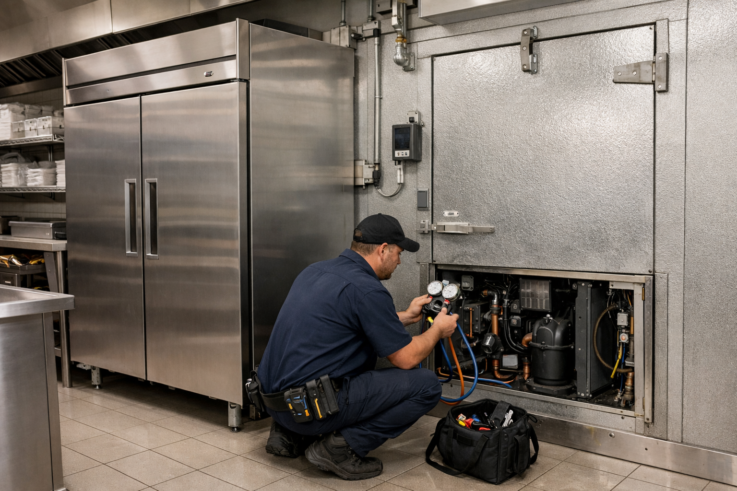
With walk-in cooler service, technicians look at the complete box and refrigeration circuit. That can include the evaporator coil, fan motors, drain line, door gaskets, hinges, closers, sweeps, defrost operation, refrigerant charge, electrical components, insulation condition, and condensing unit performance. They may also check for air infiltration, ice buildup, sweating panels, or standing water.
Preventive maintenance is especially important in Massachusetts because seasonal temperature swings can change refrigeration load. A unit that barely holds temperature during mild weather may struggle during humid summer conditions or heavy service periods. Regular maintenance helps identify weak components before they become a crisis.
Warning Signs Your Current Refrigeration Setup Is Not Working
If your business is trying to decide whether to upgrade from reach-ins to a walk-in cooler, or whether to replace aging equipment, watch for recurring symptoms. These issues may point to undersized equipment, poor airflow, failing components, or installation problems.
- Food temperatures drift upward during lunch, dinner, or delivery periods.
- Reach-in refrigerator doors are difficult to close because cabinets are overloaded.
- Staff must move products constantly to find space.
- Condensers run continuously or cycle rapidly.
- Ice forms on evaporator coils, door frames, or around walk-in cooler doors.
- There is water on the floor near a walk-in cooler, reach-in, or drain line.
- Door gaskets are torn, loose, brittle, or not sealing.
- Fans are noisy, weak, or not running.
- Temperature alarms occur after deliveries or overnight.
- Repairs are becoming frequent and downtime is affecting operations.
Some symptoms are maintenance-related, while others indicate that the system no longer fits the business. A commercial refrigeration technician can help determine whether you need cleaning, repair, control adjustment, refrigerant leak evaluation, door hardware replacement, or a broader equipment plan.
Repair vs. Replace: How to Think About the Decision
Repair may be the right choice when the equipment is generally in good condition, parts are available, and the issue is isolated. Examples include replacing a fan motor, thermostat, door gasket, door closer, start component, or clogged drain line. For a walk-in cooler, repair may also make sense if the box is structurally sound and the refrigeration system can be restored reliably.
Replacement may be worth considering when the equipment is severely corroded, repeatedly failing, unable to maintain temperature under normal load, inefficient for your current volume, or difficult to service. If a reach-in refrigerator is too small for your daily storage needs, repeated repairs may not solve the operational problem. If a walk-in cooler has panel deterioration, chronic air leaks, major floor problems, or an aging condensing system, a replacement plan may be more practical than repeated emergency calls.
The best repair-or-replace decision combines technical findings with business realities. Royal Cooling can inspect the equipment, explain what a technician checks, and help you compare repair feasibility with long-term reliability. If you operate in Boston, Worcester, Cambridge, Lowell, Springfield, Quincy, Newton, Waltham, Framingham, or nearby Massachusetts communities, you can start by reviewing service availability through our service area page.
Emergency Signs That Require Prompt Refrigeration Attention
Commercial refrigeration failures can quickly become expensive because product loss, service disruption, and safety concerns may occur before the equipment fully stops. Call for service promptly if you notice any of the following:
- A walk-in cooler, walk-in freezer, or reach-in refrigerator is not maintaining safe holding temperature.
- The compressor is extremely hot, short-cycling, or not starting.
- There is a burning smell, electrical buzzing, or tripped breaker that returns after reset.
- Evaporator fans are not running and product temperatures are rising.
- Ice buildup blocks airflow or prevents a walk-in freezer door from closing.
- Water is pooling around electrical components or creating slip hazards.
- Temperature alarms continue after doors have been closed and product load has stabilized.
Royal Cooling provides commercial refrigeration support for businesses that need troubleshooting, emergency refrigeration repair, preventive maintenance, walk-in cooler repair, freezer repair, walk-in freezer service, and reach-in refrigerator service. If your system is actively warming, avoid unnecessary door openings, document temperatures, move product according to your internal food safety procedures, and contact a qualified technician.
What a Commercial Refrigeration Technician Checks
When a technician evaluates a walk-in cooler vs reach-in refrigerator setup, the inspection is more than a quick temperature reading. Depending on the equipment and symptoms, a technician may check:
- Actual box or cabinet temperature compared with control settings.
- Product loading and airflow around shelves, fans, and return paths.
- Door gaskets, hinges, closers, latches, sweeps, and frame heaters where applicable.
- Evaporator coil condition, fan operation, frost patterns, and drain performance.
- Condenser coil cleanliness, fan operation, clearances, and ambient conditions.
- Compressor operation, electrical readings, start components, and safety controls.
- Refrigerant pressures, superheat/subcooling where appropriate, and possible leak indicators.
- Defrost controls, time clocks, sensors, heaters, and termination settings on applicable systems.
- Signs of water intrusion, insulation damage, corrosion, or cabinet deterioration.
This process helps separate equipment selection problems from service problems. A business may think it needs a new walk-in cooler when the actual issue is a failed evaporator fan or air leak. Another business may keep repairing reach-ins when the real need is a properly sized walk-in cooler and a preventive maintenance plan.
Planning Your Refrigeration Setup With Royal Cooling
The right commercial kitchen refrigeration plan should support your menu, staff workflow, storage volume, and maintenance budget. If you are opening a new restaurant, expanding a café, replacing aging units, or trying to reduce recurring refrigeration problems, Royal Cooling can help assess your current equipment and discuss practical options.
We work with businesses that rely on walk-in coolers, walk-in freezers, reach-in refrigerators, wine coolers, freezers, and other food storage refrigeration systems. Our team can help with equipment evaluation, repair, preventive refrigeration maintenance, and service planning across Massachusetts service areas including the Boston metro, Worcester County, Middlesex County, Suffolk County, and surrounding communities.
Need help choosing between a walk-in cooler and reach-in refrigerator? Call Royal Cooling at 781-899-4441 or send a request through our contact page. We can help you evaluate capacity, layout, maintenance needs, and service access before you commit to a refrigeration investment.
FAQ: Walk-In Cooler vs. Reach-In Refrigerator
Should a Massachusetts restaurant choose a walk-in cooler or reach-in refrigerator?
Most full-service restaurants benefit from both: a walk-in cooler for bulk storage and reach-in refrigerators for fast access near prep or service areas. Smaller restaurants with limited menus and frequent deliveries may be able to operate with reach-ins only.
When is a reach-in refrigerator enough for a small commercial kitchen?
A reach-in refrigerator is often enough when inventory volume is low, products turn quickly, deliveries are frequent, and staff only need refrigerated storage near a prep line, counter, bar, or café station.
What refrigeration setup is best for a convenience store or café?
A convenience store often needs walk-in cooler storage for beverages and back stock, plus display or reach-in units for customer access. A café may only need reach-in refrigerators if storage needs are modest and deliveries are frequent.
Can a business use both walk-in coolers and reach-in refrigerators efficiently?
Yes. A walk-in cooler can handle central bulk storage while reach-ins keep high-use ingredients close to staff. This improves workflow and reduces unnecessary walk-in door openings when inventory is organized properly.
What are signs that my commercial refrigeration equipment is undersized?
Common signs include overloaded reach-ins, blocked airflow, frequent temperature alarms, food storage crowding, staff wasting time moving product, and equipment struggling after deliveries or during peak service.
How often should walk-in coolers and reach-in refrigerators be maintained?
Maintenance frequency depends on equipment type, kitchen conditions, dust, grease, volume, and hours of operation. Many commercial systems benefit from scheduled preventive maintenance that includes coil cleaning, gasket checks, temperature verification, drain inspection, and electrical review.
Should I repair or replace an old reach-in refrigerator?
Repair may make sense for isolated issues such as gaskets, fans, controls, or start components. Replacement may be better if the unit is repeatedly failing, corroded, too small for your operation, or unable to maintain temperature under normal load.
Who should I call for walk-in cooler service in Massachusetts?
Call a qualified commercial refrigeration technician or HVAC contractor experienced with walk-in cooler service, reach-in refrigerator service, freezer repair, and preventive maintenance. Royal Cooling can be reached at 781-899-4441.
Final takeaway: the best choice is not always either a walk-in cooler or a reach-in refrigerator. For many Massachusetts businesses, the most reliable and efficient answer is the right combination, correctly sized, accessible for service, and maintained before small symptoms become emergency repairs.