Walk-In Freezer Icing Up: Causes, Fixes, and When to Call for Service
Short Answer: Why Is Your Walk-In Freezer Icing Up?
A walk-in freezer icing up usually means warm, humid air is entering the box, the defrost system is not clearing frost, airflow is restricted, or drainage/refrigeration controls are failing. For Massachusetts restaurants, grocery stores, liquor stores, hotels, and commercial kitchens, recurring ice buildup should be treated as a service issue before it causes temperature loss, product damage, door problems, or slip hazards.
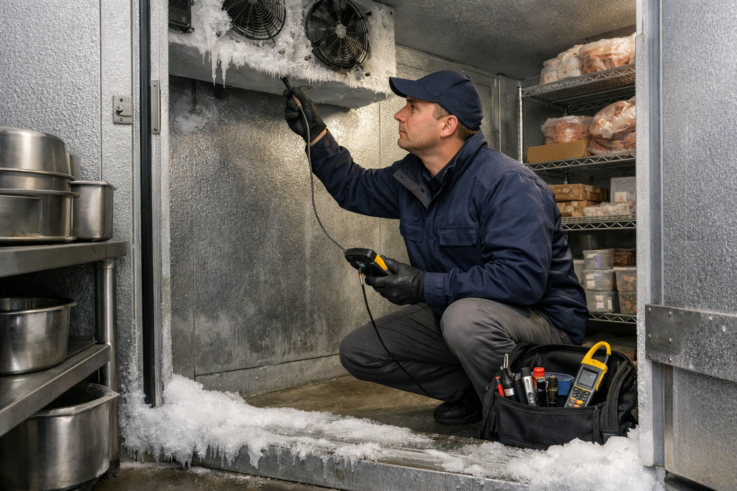
If you are seeing ice on the floor, walls, ceiling, evaporator coil, door frame, or around product racks, do not ignore it. Ice is not just an inconvenience. In a commercial freezer, it can point to a mechanical, electrical, airflow, or building-envelope problem that gets worse during humid summers, busy delivery windows, and high door-traffic service periods across Massachusetts.
Royal Cooling provides commercial refrigeration support for businesses that depend on walk-in freezers, walk-in coolers, reach-in refrigerators, wine coolers, and related equipment. If your freezer is icing up and product temperature is becoming unreliable, call 781-899-4441 or request service through the Royal Cooling contact page.
Why Ice Buildup Happens in Massachusetts Walk-In Freezers
Walk-in freezers are designed to hold subfreezing temperatures while removing heat and moisture from the refrigerated space. Every time a door opens, warm air enters. In Massachusetts, that air can be especially moisture-heavy during summer humidity in Boston, Cambridge, Quincy, Newton, Waltham, Framingham, Worcester, Lowell, Springfield, and surrounding communities. When humid air meets freezing surfaces, moisture turns into frost and ice.
A small amount of frost can appear during normal operation, especially near doors or evaporator coils. However, thick, recurring, or spreading ice buildup in a walk-in freezer is not normal. It may indicate a failed door gasket, worn hinges, a door closer that is not sealing, a drain line problem, a defrost timer issue, a heater failure, incorrect controls, restricted airflow, dirty coils, refrigerant problems, or an equipment sizing issue.
For restaurants and commercial kitchens, the problem often appears during rush periods when staff open the freezer repeatedly. For grocery stores, convenience stores, liquor stores, and hotels, icing can also follow large deliveries, blocked aisles, door propping, or merchandise stacked too close to the evaporator. The root cause can be operational, mechanical, or both.
Common Symptoms: What the Ice Location Can Tell You
The location of the ice can help narrow the likely cause. It does not replace a professional diagnosis, but it helps managers communicate clearly when scheduling walk-in freezer repair.
- Ice on the floor near the door: Often points to warm air infiltration, a bad sweep, poor threshold seal, condensation, or a drain issue. It can also become a slip hazard for employees.
- Ice on walls or ceiling: May indicate humid air entering through gaps, damaged panels, repeated door openings, insulation problems, or air leaks around penetrations.
- Evaporator coil frozen solid: Commonly related to defrost failure, fan problems, blocked airflow, low refrigerant, dirty coil surfaces, or control issues.
- Ice around the drain pan or drain line: Often caused by a clogged drain, failed drain heater, improper pitch, or frozen condensate line.
- Ice around the door frame: May be due to a worn gasket, misaligned door, failing frame heater, damaged closer, or heavy traffic.
- Temperature rising while ice increases: This is a more urgent commercial freezer troubleshooting sign because airflow and heat transfer may be impaired.
Cause Comparison Table: Common Icing Problems and What They Mean
| Symptom | Possible Cause | Business Risk | Recommended Action |
|---|---|---|---|
| Ice buildup in walk-in freezer near door | Failed gasket, door not closing, damaged threshold, frequent openings | Slip hazard, frost spread, compressor strain | Check door closure and call for gasket/door inspection if ice returns |
| Evaporator coil frozen over | Defrost timer, heater, termination control, fan issue, low refrigerant, dirty coil | Poor airflow, temperature rise, product loss risk | Call a commercial refrigeration technician; do not chip coil ice |
| Ice around drain pan or drain line | Clogged or frozen drain, failed drain heater, improper drain pitch | Standing water, floor ice, recurring freeze-ups | Schedule walk-in freezer service and drainage inspection |
| Ice on walls or ceiling | Air leak, panel issue, humidity infiltration, door left open, insulation problem | Structural moisture, increased energy use, unstable temperatures | Inspect for obvious gaps and arrange professional diagnosis |
| Freezer warm but icing continues | Airflow restriction, iced coil, refrigeration fault, control issue | High urgency inventory risk | Protect product and request emergency refrigeration repair |
Why Is My Walk-In Freezer Building Up Ice on the Floor or Walls?
Ice on the floor or walls usually means moisture is entering the freezer faster than the system can remove it. Common sources include a walk-in freezer door that does not seal, a torn gasket, a misaligned hinge, a door closer that no longer pulls the door shut, or staff propping the door open during deliveries. In a busy Boston metro restaurant or Cambridge commercial kitchen, even a few extra minutes of open-door time can introduce a large amount of humid air.
Floor ice can also come from a drain problem. During defrost, frost melts from the evaporator and should drain away. If the drain line is clogged, frozen, missing heat, or incorrectly pitched, meltwater can refreeze on the floor. This is a common reason a business calls for walk-in freezer repair after repeatedly mopping or scraping the same area.
Wall and ceiling ice may suggest air leaks around panels, penetrations, conduit, piping, or damaged seams. It can also occur when airflow patterns are disrupted by stacked boxes. Product stored too close to walls or the evaporator can trap cold air, create frost pockets, and reduce system performance.
Is Ice Buildup in a Walk-In Freezer an Emergency for a Restaurant?
Sometimes, yes. Ice buildup in a walk-in freezer becomes an emergency when it affects temperature, employee safety, door operation, or product protection. A thin layer of frost that appears after a busy delivery may not require an emergency call if temperatures remain stable and the door seals properly. But thick or fast-forming ice is different.
For restaurants, hotels, supermarkets, grocery stores, convenience stores, and commissary kitchens, freezer reliability is tied directly to inventory protection and food safety procedures. If the freezer cannot maintain the required temperature range, if the evaporator is blocked with ice, or if the door will not close because of frost, you should treat the situation as urgent and contact a qualified commercial refrigeration technician.
Call for emergency refrigeration repair if you notice rising box temperatures, alarms, softening product, heavy frost on the evaporator, ice preventing the door from sealing, water refreezing across a walking path, burning smells, repeated breaker trips, or a compressor running constantly without maintaining temperature. If you are unsure how urgent the problem is, call 781-899-4441 and describe the symptoms so the next step can be prioritized appropriately.
What Causes a Walk-In Freezer Evaporator Coil to Freeze Over?
The evaporator coil is where heat is removed from the freezer air. Air must move across the coil, frost must be cleared during defrost, and controls must start and end defrost at the right time. When something interrupts that process, the coil can become packed with ice.
Common causes include a failed defrost heater, bad defrost timer or control board, defective defrost termination sensor, inoperative evaporator fan, dirty coil, blocked return or discharge airflow, incorrect thermostat settings, refrigerant undercharge, expansion valve issue, or door air infiltration. A coil that freezes over repeatedly is not something to solve by scraping or using sharp tools. Puncturing a coil can create a refrigerant leak and turn a manageable repair into a larger problem.
A technician will typically look at the frost pattern, check fan operation, verify voltage and components, test defrost controls, inspect coil condition, measure temperatures and pressures, and evaluate whether the freezer is being loaded or used in a way that blocks airflow. Because several different faults can look similar from the outside, professional commercial freezer troubleshooting is the safest route when the evaporator is iced over.
Can a Walk-In Freezer Door Gasket Cause Icing Problems?
Yes. A walk-in freezer door gasket can absolutely cause icing problems. The gasket is the flexible seal around the door that helps keep warm air out. If it is torn, compressed, brittle, dirty, missing sections, or not contacting the frame evenly, humid air can leak into the freezer all day. That moisture can freeze around the frame, on the floor, on nearby walls, and eventually on the evaporator coil.
Door hardware matters too. A good gasket cannot compensate for a sagging door, damaged hinge, weak door closer, warped panel, broken latch, or uneven threshold. In Massachusetts businesses with high door traffic, especially restaurants and convenience stores, door components wear out faster than many owners expect. If you see frost tracing the outline of the door, feel air movement at the gasket, or need to push hard to latch the door, schedule walk-in freezer service before the icing spreads.
Safe Checks You Can Make Before Calling for Service
Business owners and managers can perform a few safe visual checks, but avoid dismantling refrigeration components unless you are trained and authorized. These steps can help reduce risk while you arrange service.
- Check the door: Make sure it fully closes, latches, and is not held open by racks, boxes, ice, or a damaged threshold.
- Look at the gasket: Check for tears, gaps, brittleness, loose sections, or frost forming in one specific area.
- Review staff habits: Limit open-door time, avoid propping the door open, and stage deliveries to reduce humidity entry.
- Check product loading: Keep boxes away from evaporator fans and maintain open paths for return and supply air.
- Confirm temperature readings: Compare the displayed temperature with your normal logs and any independent monitoring device you use.
- Remove loose floor ice safely: Address slip hazards carefully, but do not chip ice from coils, refrigerant lines, heaters, or electrical areas.
- Document symptoms: Note where ice appears, how quickly it returns, whether temperatures changed, and whether alarms occurred.
If the ice returns after basic operational corrections, it is time for professional walk-in freezer repair. Recurring ice is a symptom, not the root cause.
What a Commercial Refrigeration Technician Checks
When Royal Cooling evaluates a walk-in freezer icing up, the goal is to identify both the immediate failure and the reason it happened. A thorough service visit may include door and gasket inspection, hinge and latch adjustment checks, evaporator fan testing, defrost heater testing, drain pan and drain line inspection, coil condition review, thermostat and sensor verification, electrical measurements, refrigeration pressure and temperature checks, and airflow evaluation.
The technician may also look at the surrounding environment. Is the freezer near a hot kitchen line? Is a vestibule missing or ineffective? Are employees loading warm product directly into the freezer? Is the door opened constantly during peak service? Are products stacked above load lines? In Massachusetts, a system that performs well in dry winter weather may struggle when summer humidity and heavy use combine.
Good walk-in freezer service is not just about melting ice. It is about preventing the next freeze-up, protecting compressors and fans, improving energy performance, and keeping product temperatures reliable.
Repair vs. Replacement: When Does Icing Mean a Bigger Decision?
Most icing problems can be repaired if the box structure and refrigeration equipment are in serviceable condition. Common repairs include gasket replacement, door hardware adjustment, drain clearing, drain heater repair, defrost heater replacement, fan motor replacement, control repair, coil cleaning, leak repair, or refrigeration component correction.
Replacement becomes worth discussing when the walk-in box has failing insulation, damaged panels, chronic air leakage, severe door frame deterioration, repeated major component failures, obsolete controls, or an aging system that can no longer maintain temperatures efficiently. Businesses planning kitchen expansions, menu changes, higher storage volume, or equipment upgrades may also consider replacement rather than continuing to repair an undersized or heavily worn freezer.
A reputable HVAC contractor and commercial refrigeration technician should not push replacement automatically. The right recommendation depends on age, condition, repair history, parts availability, operating costs, and how critical the freezer is to your operation.
Preventive Maintenance Tips to Reduce Ice Buildup
Preventive maintenance is one of the best ways to reduce icing problems. For Massachusetts businesses with heavy freezer use, scheduled maintenance can catch worn gaskets, weakening fans, dirty coils, drain issues, and defrost problems before they become emergency refrigeration repair calls.
- Inspect door gaskets and hardware regularly, especially before humid summer months.
- Train staff to keep freezer doors closed and avoid using the freezer as a staging area during deliveries.
- Keep evaporator fan areas clear and avoid stacking product tight against walls or coils.
- Maintain temperature logs and investigate changes instead of waiting for alarms.
- Schedule coil, drain, and defrost system checks as part of preventive maintenance.
- Repair small door and gasket issues before they create widespread ice buildup in the walk-in freezer.
- Keep the area around condensing units clear so the refrigeration system can reject heat properly.
For multi-unit properties, restaurants with multiple walk-ins, supermarkets, and hotels, a preventive plan can also help standardize service records and reduce surprise downtime. Learn more about coverage and nearby communities on the Royal Cooling service area page.
Who Repairs Walk-In Freezers in Boston Metro Businesses?
Royal Cooling services commercial refrigeration equipment for Massachusetts businesses, including walk-in freezers, walk-in coolers, reach-in refrigerators, wine coolers, and related systems. Customers include restaurants, commercial kitchens, liquor stores, convenience stores, supermarkets, grocery stores, hotels, facility managers, property managers, and select homeowners with specialty refrigeration needs such as wine coolers or freezers.
Service-area examples include Boston, Worcester, Cambridge, Lowell, Springfield, Quincy, Newton, Waltham, Framingham, and surrounding Massachusetts communities, including parts of the Boston metro, Worcester County, Middlesex County, and Suffolk County. Royal Cooling does not need to be located in every city to support businesses across the region; scheduling depends on availability, urgency, equipment type, and service area coverage.
If your walk-in freezer is icing up, describe the symptoms when you call: where the ice is forming, whether temperatures are rising, whether the door seals, what equipment alarms show, and how long the issue has been happening. This helps the technician arrive prepared for the likely failure points.
When to Call Now Instead of Waiting
Call for service promptly if ice is returning after removal, the freezer temperature is climbing, the evaporator coil is packed with frost, the door will not close or seal, ice is forming on walking surfaces, product is softening, alarms are active, or the compressor seems to run continuously. Waiting can increase the risk of product loss, employee injury, and more expensive component damage.
For professional walk-in freezer repair, walk-in cooler repair, commercial freezer troubleshooting, and preventive refrigeration maintenance in Massachusetts, contact Royal Cooling at 781-899-4441 or use the online contact form. The sooner the cause is identified, the easier it is to restore dependable freezer operation.
FAQ: Walk-In Freezer Icing Up in Massachusetts
Why is my walk-in freezer building up ice on the floor or walls?
Ice on the floor or walls usually comes from warm, humid air entering through a leaking door, bad gasket, damaged threshold, frequent door openings, or air gaps. It can also come from a clogged or frozen drain that lets defrost water refreeze inside the box.
Is ice buildup in a walk-in freezer an emergency for a restaurant?
It can be. If ice is causing slip hazards, preventing the door from sealing, blocking the evaporator, triggering alarms, or causing temperatures to rise, call for emergency refrigeration repair. Product protection and employee safety should come first.
What causes a walk-in freezer evaporator coil to freeze over?
A frozen evaporator coil may be caused by failed defrost heaters, a bad defrost timer or control, fan problems, dirty coils, blocked airflow, refrigerant issues, or warm air infiltration. A technician should diagnose the exact cause before parts are replaced.
Can a walk-in freezer door gasket cause icing problems?
Yes. A torn, compressed, dirty, or misaligned gasket allows humid air to enter the freezer. That moisture freezes around the door, floor, walls, and sometimes the evaporator coil. Door hinges, closers, latches, and thresholds should be checked too.
Who repairs walk-in freezers in Boston metro businesses?
Royal Cooling provides commercial refrigeration service for Massachusetts businesses, including restaurants, grocery stores, convenience stores, hotels, liquor stores, and commercial kitchens in the Boston metro and surrounding service areas. Call 781-899-4441 to discuss your freezer issue.
Should my staff chip ice off the evaporator coil?
No. Chipping ice from an evaporator coil can damage refrigerant tubing, heaters, fins, wiring, or sensors. Staff can remove loose floor ice safely, but coil ice should be handled by a qualified commercial refrigeration technician.
How can I prevent ice buildup during humid Massachusetts summers?
Keep doors closed, repair gaskets quickly, avoid propping doors open during deliveries, maintain airflow around the evaporator, keep drains clear, monitor temperatures, and schedule preventive maintenance before peak humidity and busy service periods.
When should I repair versus replace a walk-in freezer?
Repair is often appropriate for gasket, drain, defrost, fan, control, and refrigeration component issues. Replacement may be considered when the box has failing insulation, chronic air leaks, major structural damage, repeated failures, or equipment that no longer fits the business load.
Final CTA: Protect Your Inventory Before Ice Becomes Downtime
A walk-in freezer icing up is a warning sign. Whether the issue is a door gasket, defrost failure, drain problem, airflow restriction, or refrigeration fault, early service can help protect inventory and reduce disruption. For walk-in freezer service in Massachusetts, call Royal Cooling at 781-899-4441 or schedule through the contact page.