Commercial Refrigeration Repair in Massachusetts: When to Call a Tech
Short answer: For commercial refrigeration repair in Massachusetts, call a qualified technician when a cooler or freezer cannot hold safe temperature, product is at risk, ice or water issues keep returning, electrical components trip breakers, or you suspect refrigerant, compressor, fan, or control failure. Staff can safely check power, setpoints, doors, airflow, and loading before requesting service.
Commercial refrigeration problems rarely happen at a convenient time. A restaurant line cooler starts warming during dinner in Boston. A walk-in freezer alarm goes off before a morning delivery in Worcester. A convenience store reach-in case in Framingham feels warmer than normal, but the display still has lights. In those moments, managers need a clear answer: can the team troubleshoot this safely in-house, or is it time to call a commercial refrigeration technician?
This guide is designed for Massachusetts restaurants, grocery stores, convenience stores, hotels, liquor stores, commercial kitchens, facility managers, property managers, and homeowners with specialty wine coolers or freezers. It explains what your staff can check without opening sealed systems or electrical panels, what symptoms point to a professional repair, and how to judge whether the issue is an emergency refrigeration repair situation. Royal Cooling provides commercial refrigeration service for equipment such as walk-in coolers, walk-in freezers, reach-in refrigerators, commercial freezers, wine coolers, and related HVAC-supported systems across the Boston metro area and Central Massachusetts.
If you already know the equipment is failing and need help, call Royal Cooling at 781-899-4441 or request service through the contact page. If you are still assessing the issue, use the steps below to make a safer, faster decision.
Why Fast Refrigeration Decisions Matter in Massachusetts Businesses
In a busy Massachusetts food-service or retail environment, refrigeration is not just another building system. It protects inventory, supports food-safety procedures, keeps beverage and wine products stable, and helps kitchens stay open. A warm cooler in a Cambridge cafe, a struggling walk-in freezer in a Worcester County school kitchen, or a failing beer cooler in a Waltham liquor store can affect operations quickly.
The difficulty is that many commercial refrigeration symptoms look minor at first. A door is not sealing tightly. A condenser area is blocked by storage. A thermostat has been bumped. A unit was loaded with warm product after a delivery. Those conditions may be correctable by trained staff. Other symptoms, however, indicate deeper problems such as failing evaporator fans, dirty coils, blocked drains, defrost control faults, compressor issues, refrigerant leaks, or electrical failures. Those are situations where professional restaurant refrigeration repair, commercial cooler repair, or commercial freezer repair is the safer choice.
The goal is not to make employees into refrigeration mechanics. The goal is to help your team recognize the boundary between safe basic checks and work that belongs to a licensed, trained technician.
What Staff Can Safely Check Before Calling a Technician
Before scheduling service, managers can often gather useful information. These checks can help rule out simple issues and give the technician better details if a call is needed. Staff should never bypass safety devices, open electrical compartments, cut refrigerant lines, add refrigerant, force a compressor to run, or dismantle major components.
1. Confirm the actual temperature
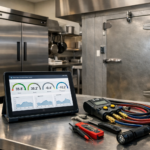
Use a reliable thermometer rather than guessing by touch. Check the equipment display, but also verify with an independent thermometer if available. Record the current temperature, the normal operating range, and whether the temperature is rising, falling, or fluctuating. For food businesses, follow your internal food-safety procedures for product evaluation and documentation.
2. Check that the unit has power
Look for obvious signs: lights, fans, digital displays, and alarm panels. If the unit is completely off, confirm that the plug is secure and the local disconnect has not been accidentally turned off. If a breaker has tripped, do not repeatedly reset it. One reset may help identify a nuisance trip, but repeated tripping can indicate an electrical or compressor problem that needs a technician.
3. Verify thermostat or controller settings
Staff may accidentally bump controls during cleaning or loading. Check the setpoint and compare it to your standard operating procedure. If the controller shows an error code, write it down or take a photo before clearing anything. Error codes can help a technician identify sensor, defrost, fan, or communication issues.
4. Inspect doors, gaskets, and closers
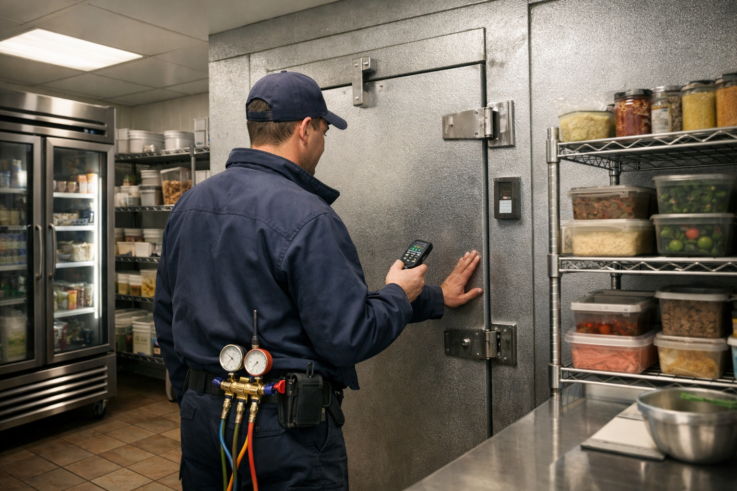
A walk-in cooler door that does not close fully can create warm temperatures, frost, condensation, and long run times. Check for torn gaskets, food containers blocking the door, damaged hinges, sticky closers, or ice preventing a freezer door from sealing. Do not chip ice aggressively with sharp tools; puncturing panels, drains, or lines can turn a small issue into a larger repair.
5. Look at airflow and product loading
Commercial refrigeration depends on airflow. Overpacked shelves, boxes against evaporator fans, blocked return paths, or product stacked too close to discharge air can cause uneven temperatures. Make sure fans are not blocked and product is not packed tightly against the back or ceiling of the box. If a delivery of warm product was just loaded, note the time and amount of product added.
6. Check the condenser area from the outside
Many commercial cooler and freezer problems start with poor heat rejection. If your condenser is accessible and safe to view, check whether boxes, dust, grease, leaves, snow, or debris are restricting airflow around it. Staff can clear loose storage items around the unit, but coil cleaning, fan repair, motor replacement, and electrical work should be handled by a qualified technician.
7. Listen and observe
Write down what you hear and see. Is the compressor humming and stopping? Are evaporator fans running? Is there clicking, buzzing, grinding, or silence? Is water pooling near the unit? Is frost forming only in one area? These details help Royal Cooling diagnose the problem more efficiently when you call.
When a Massachusetts Restaurant Should Call for Commercial Refrigeration Repair
A Massachusetts restaurant should call for commercial refrigeration repair Massachusetts service when equipment cannot maintain the required temperature, the problem returns after basic checks, or the issue involves electrical, refrigerant, compressor, defrost, fan, drain, or control components. Even if your staff finds an obvious symptom, the underlying cause may still require professional testing.
Call a technician for any of the following conditions:
- Temperatures are rising or unstable after doors, setpoints, power, and loading have been checked.
- The cooler or freezer is running constantly and still not reaching setpoint.
- The compressor short cycles, hums, overheats, or fails to start.
- Fans are not operating, are noisy, or appear to run intermittently.
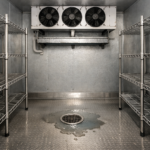
- Ice buildup returns after defrosting or appears around the evaporator, drain, door, or ceiling.
- Water is pooling inside the box, outside the case, or near electrical components.
- Breakers trip repeatedly or the unit shuts down unexpectedly.
- Refrigerant leak signs are present, such as oil stains, hissing, poor cooling, or repeated low-charge symptoms.
- Controls show error codes that do not clear or return after reset.
- Product is at risk and waiting could lead to spoilage or an interrupted service period.
These issues often require gauges, meters, temperature probes, airflow checks, electrical testing, leak detection, coil inspection, defrost diagnostics, and component evaluation. A trained HVAC contractor Massachusetts businesses rely on for refrigeration can diagnose the whole system rather than only the visible symptom.
How to Know if a Cooler or Freezer Problem Is an Emergency
Not every service call is an emergency, but commercial refrigeration can become urgent quickly. The difference depends on product risk, temperature trend, equipment redundancy, time of day, business volume, and the type of inventory being stored.
Treat the issue as an emergency refrigeration repair situation if product safety or business continuity is immediately at risk. Examples include a walk-in cooler in a Boston restaurant climbing during service, a walk-in freezer in a Quincy hotel kitchen thawing overnight, a supermarket case in Lowell affecting high-value inventory, or a wine cooler in Newton losing temperature control during a heat wave.
While waiting for a technician, keep doors closed as much as possible, minimize traffic into the box, document temperatures, follow your food-safety procedures, and move product to backup refrigeration if your operation has a safe option. Do not move product into an unverified space, and do not rely on temporary fixes that you cannot monitor.
Troubleshoot In-House vs. Call a Commercial Refrigeration Technician
| Symptom or situation | Safe staff check | When to call Royal Cooling |
|---|---|---|
| Unit seems warm but lights are on | Verify temperature with a thermometer, check setpoint, reduce door openings, and confirm recent loading. | Call if temperature keeps rising, will not recover, or product is at risk. |
| No power to cooler or freezer | Check plug, local switch, and whether other equipment has power. Record any alarm or outage details. | Call if breakers trip, the unit stays off, wiring smells hot, or there is no clear safe cause. |
| Door not sealing | Remove obstructions, check gasket condition, clean food debris from the seal, and confirm the closer works. | Call if the gasket is torn, hinges are damaged, the door is warped, or frost and temperature issues continue. |
| Ice or frost buildup | Check that doors close, gaskets seal, and staff are not leaving doors open during loading. | Call for recurring ice, frozen evaporator coils, blocked drains, defrost failure, or fan problems. |
| Water on floor | Look for spills, open containers, or condensation from doors being left open. | Call if water returns, drains appear blocked, pans overflow, or water is near electrical components. |
| Loud buzzing, grinding, or clicking | Document where the sound comes from and whether the unit is cooling. | Call promptly; motors, relays, compressors, and contactors should be inspected by a technician. |
| Repeated temperature alarms | Confirm alarm settings, door activity, and product loading patterns. | Call if alarms continue after normal conditions return or if sensors/controllers may be failing. |
What a Commercial Refrigeration Technician Checks
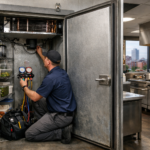
When Royal Cooling responds to a refrigeration issue, the technician looks beyond the first symptom. Commercial refrigeration is a system: air movement, refrigerant flow, electrical controls, heat rejection, box condition, doors, drains, defrost, and operating conditions all affect performance. A warm walk-in cooler may be caused by a dirty condenser, a failed fan motor, a refrigerant leak, a control fault, a stuck expansion valve, heavy door traffic, or several issues at once.
A professional diagnosis may include:
- Measuring box temperature, supply and return air, suction line temperature, and operating pressures where appropriate.
- Inspecting evaporator fans, condenser fans, motors, blades, guards, and airflow paths.
- Checking condenser and evaporator coil condition, including dirt, grease, frost, or physical blockage.
- Testing electrical components such as contactors, relays, capacitors, sensors, controllers, defrost timers, and wiring connections.
- Looking for refrigerant leak indicators and evaluating system charge only through proper procedures.
- Inspecting door gaskets, hinges, sweeps, closers, and thresholds for air infiltration.
- Checking condensate drains, pans, heaters, and drain lines for blockages or freeze-ups.
- Reviewing maintenance history, recent repairs, usage patterns, and environmental conditions.
This full-system approach is especially important for walk-in cooler repair, walk-in freezer service, reach-in refrigerator repair, wine cooler service, and commercial freezer repair. Replacing one obvious part without understanding why it failed can lead to repeat breakdowns.
Repair vs. Replace: How to Think About the Decision
Many Massachusetts businesses ask whether an older cooler, freezer, or reach-in should be repaired or replaced. The right answer depends on equipment age, condition, refrigerant type, repair history, energy use, cabinet condition, and business risk. A relatively minor fan, gasket, sensor, drain, or control repair may be the practical choice if the box and refrigeration system are otherwise sound. Replacement becomes more worth discussing when major components fail repeatedly, the cabinet is deteriorating, refrigerant issues are ongoing, or repair costs no longer make sense for the equipment’s expected remaining life.
For restaurants and stores in high-volume areas such as Boston, Cambridge, Worcester, Lowell, Quincy, Newton, Waltham, and Framingham, downtime also matters. A lower-cost repair that leaves the system unreliable may cost more in lost product, staff disruption, and emergency calls. Royal Cooling can help evaluate whether a repair, component replacement, preventive maintenance plan, or equipment upgrade is the better path for your facility.
Preventive Maintenance That Reduces Emergency Calls
The best time to deal with refrigeration problems is before a weekend rush, delivery day, holiday event, or summer heat wave. Preventive maintenance helps identify dirty coils, weak fan motors, failing door gaskets, loose electrical connections, clogged drains, sensor issues, and defrost problems before they become emergencies.
Facility teams can support maintenance by keeping condenser areas clear, training staff not to block evaporator airflow, checking door closures daily, logging temperatures, reporting unusual noise early, and cleaning food debris from gaskets. Professional maintenance adds the technical work that should not be done in-house, including coil cleaning where appropriate, electrical inspection, operational testing, drain evaluation, control checks, and system performance review.
For restaurants, hotels, supermarkets, convenience stores, liquor stores, and property managers, a planned maintenance routine can make refrigeration budgeting more predictable. It also gives your technician a baseline, so when something changes, diagnosis is faster.
Who Repairs Commercial Refrigerators Near Boston and Worcester?
Royal Cooling provides commercial refrigeration repair and service support for Massachusetts businesses across the Boston metro area and Central Massachusetts. Service-area examples include Boston, Worcester, Cambridge, Lowell, Springfield, Quincy, Newton, Waltham, and Framingham, along with communities in Worcester County, Middlesex County, and Suffolk County. We do not need to imply an office in every city to be a practical service option for businesses that need a qualified refrigeration technician in the region.
Customers call Royal Cooling for restaurant refrigeration repair, walk-in cooler repair, walk-in freezer service, reach-in refrigerator repair, wine cooler service, commercial freezer repair, and preventive refrigeration maintenance. We work with restaurants, commercial kitchens, grocery stores, convenience stores, liquor stores, hotels, facility managers, property managers, and select residential customers with specialty cooling equipment.
To confirm whether your location is within the current service area, visit the Royal Cooling service area page or call 781-899-4441. If the issue is urgent, be ready to share the equipment type, location, temperature readings, alarm messages, recent changes, and whether product is at risk.
What to Tell the Technician When You Call
A good service call starts with clear information. Before contacting Royal Cooling, gather the equipment type, brand and model if accessible, whether it is a walk-in cooler, walk-in freezer, reach-in, prep table, wine cooler, or display case, and what changed. Note current temperature, normal setpoint, how long the issue has been happening, whether the unit has power, and any sounds, ice, water, odors, alarms, or tripped breakers. If safe, take photos of the controller display, visible frost, door gasket damage, or blocked airflow.
This information does not replace professional diagnostics, but it helps prioritize the call and prepare for the likely tools and parts. For multi-site operators and facility managers, having this process standardized across locations in Massachusetts can reduce confusion and speed up decision-making.
Final Recommendation
If the problem is limited to a bumped setpoint, blocked door, recent warm delivery, or obstructed airflow, your staff may be able to correct it and monitor recovery. If temperatures remain unsafe, product is at risk, the unit loses power, ice or water problems return, breakers trip, fans or compressors act abnormal, or refrigerant and electrical issues are possible, call a professional.
Royal Cooling is ready to help Massachusetts businesses make the right call for commercial refrigeration repair, preventive maintenance, and equipment service. For help with a walk-in cooler, walk-in freezer, reach-in refrigerator, commercial freezer, wine cooler, or urgent refrigeration concern, call 781-899-4441 or use the Royal Cooling contact page.
FAQ: Commercial Refrigeration Repair in Massachusetts
When should a Massachusetts restaurant call for commercial refrigeration repair?
Call when temperatures are unsafe or rising, product is at risk, alarms continue, breakers trip, ice or water issues return, or fans, compressors, controls, drains, or refrigerant components may be involved.
What commercial refrigeration problems can staff safely check before calling a technician?
Staff can check temperature readings, power, setpoints, door closure, gaskets, blocked airflow, recent loading, obvious obstructions, and visible alarms. They should not open electrical panels, add refrigerant, or bypass controls.
How do I know if a cooler or freezer problem is an emergency?
It is an emergency if product safety, business operations, or high-value inventory is immediately at risk, especially when temperatures rise quickly, the unit is off, or there is no backup refrigeration.
Who repairs commercial refrigerators near Boston and Worcester?
Royal Cooling provides commercial refrigeration repair for Massachusetts businesses in the Boston metro area, Worcester County, Central Massachusetts, and nearby communities. Call 781-899-4441 to discuss your location and equipment.
Can Royal Cooling service walk-in coolers and walk-in freezers?
Yes. Royal Cooling services walk-in coolers, walk-in freezers, reach-in refrigerators, commercial freezers, wine coolers, and related commercial refrigeration equipment for businesses and facilities.
Should I repair or replace my commercial refrigerator?
Repair is often practical for isolated component issues on otherwise sound equipment. Replacement may be worth considering when major failures repeat, the cabinet is deteriorating, refrigerant issues persist, or downtime risk is too high.
How can preventive maintenance reduce refrigeration emergencies?
Preventive maintenance helps catch dirty coils, weak fans, failing gaskets, clogged drains, control issues, and electrical wear before they cause temperature loss, product risk, or urgent breakdowns.