Commercial Refrigeration Emergency Preparedness Checklist for MA Food
Commercial Refrigeration Emergency Preparedness for Massachusetts Food Businesses
Short answer: A strong commercial refrigeration emergency preparedness plan gives your team a written process before a cooler or freezer fails. Massachusetts restaurants, supermarkets, hotels, and commercial kitchens should document equipment details, monitor temperatures, assign staff responsibilities, prepare backup cold storage options, keep vendor contacts ready, and schedule preventive maintenance with a qualified commercial refrigeration technician.
When a walk-in cooler starts running warm during dinner service or a freezer alarm sounds after closing, the next few minutes can feel chaotic. Food businesses across Massachusetts depend on refrigeration every hour of the day, from restaurants in Boston and Cambridge to convenience stores in Worcester County, supermarkets in Middlesex County, hotel kitchens in Suffolk County, and liquor stores with wine coolers in Waltham, Newton, Quincy, Lowell, Framingham, and Springfield.
This guide is not another troubleshooting article about one specific symptom. Instead, it is a practical commercial refrigeration emergency preparedness checklist designed to help owners, managers, and facility teams make decisions before equipment fails. A plan can reduce confusion, support food spoilage prevention, help staff communicate clearly, and make emergency refrigeration repair calls more productive.
If your business needs help creating a preventive refrigeration maintenance plan or responding to urgent equipment trouble, Royal Cooling can be reached at 781-899-4441. You can also visit the contact page to request service information.
Why Refrigeration Emergencies Need a Written Plan
A refrigeration emergency is not always a dramatic equipment shutdown. It may start as a walk-in cooler that drifts a few degrees above setpoint, a reach-in refrigerator that runs constantly, a walk-in freezer with heavy frost near the evaporator, or a prep table that feels warm during a busy lunch rush. These early signs can develop into expensive disruption if nobody knows who should check the unit, where the temperature log is stored, or when to call a commercial refrigeration technician in Massachusetts.
Common causes of emergency refrigeration repair calls include dirty condenser coils, failed evaporator fans, worn door gaskets, clogged drains, control issues, refrigerant leaks, iced evaporator coils, failing compressors, electrical problems, and doors left open during deliveries. Some causes are mechanical. Others are operational, such as overloading shelves, blocking airflow, turning thermostats without approval, or ignoring a unit that has been short cycling for days.
A restaurant refrigeration emergency plan does not eliminate every breakdown. It does help your staff respond in a controlled way. The goal is to protect people, product, equipment, and business continuity while giving the technician accurate information when you call.
The Massachusetts Commercial Refrigeration Emergency Preparedness Checklist
Use this checklist for restaurants, commercial kitchens, grocery stores, convenience stores, hotels, schools, commissaries, liquor stores, and food production spaces across the Boston metro area, Worcester County, Middlesex County, Suffolk County, and surrounding Massachusetts communities.
- Create an equipment inventory: List every walk-in cooler, walk-in freezer, reach-in refrigerator, display case, prep table, ice machine, wine cooler, and freezer.
- Record model and location details: Include make, model, serial number, refrigerant type if visible on the nameplate, approximate age, and the room or department where the unit is located.
- Post emergency contacts: Keep Royal Cooling at 781-899-4441, facility contacts, managers, landlords, and utility contacts where staff can find them.
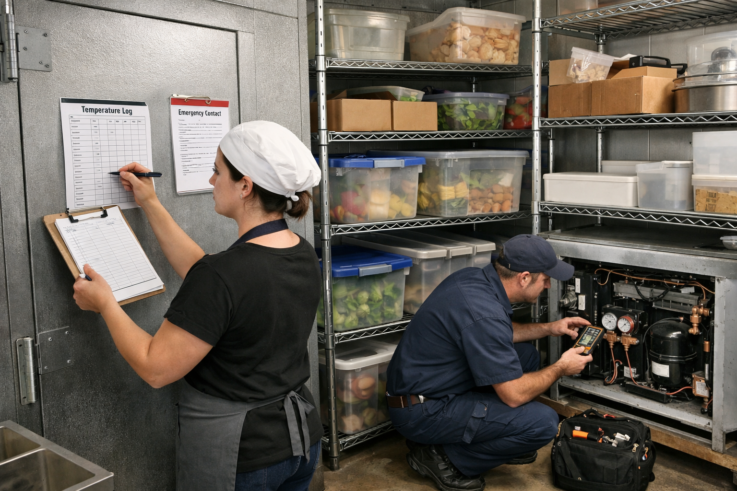
- Assign temperature checks: Decide who logs temperatures at opening, shift change, closing, and after large deliveries.
- Define escalation temperatures: Establish when staff should alert a manager, move product, or call for emergency refrigeration repair.
- Prepare a backup cooler plan: Know where product can be moved if a primary walk-in cooler or freezer cannot hold temperature.
- Train staff not to reset repeatedly: Resetting breakers, controls, or alarms without notes can hide the problem and delay diagnosis.
- Schedule preventive maintenance: Coil cleaning, door inspection, drain checks, electrical testing, and airflow review can reduce avoidable emergencies.
- Keep access clear: Technicians need safe access to evaporators, condensing units, electrical panels, rooftops, mechanical rooms, and outdoor equipment.
- Review the plan quarterly: Update contacts, staff roles, equipment changes, and backup storage options.
What Should a Massachusetts Restaurant Do Before a Refrigeration Emergency Happens?
Before a refrigeration emergency happens, a Massachusetts restaurant should decide who owns the response. In a small restaurant, that may be the owner or kitchen manager. In a larger operation, the responsibility may be shared between the executive chef, general manager, facilities team, and closing manager. The plan should be written, printed, and easy to find even when the point-of-sale system is down or the internet is unavailable.
Start by mapping the most critical equipment. For many restaurants, the walk-in cooler and walk-in freezer are highest priority because they hold large amounts of perishable inventory. Reach-in refrigerators, undercounter units, prep tables, bar coolers, and wine coolers may also be business-critical depending on your menu. Identify which units support daily service and which units store high-value product.
Next, set clear temperature monitoring procedures. Staff should understand normal setpoints, what temperature range is concerning, and what symptoms should be reported. Useful symptoms include longer run times, water on the floor, unusual vibration, clicking, burning smells, ice buildup, door gaskets pulling away, product that feels soft, and alarms that repeat after reset. These details matter when calling for walk-in cooler repair or walk-in freezer service.
Finally, build the vendor and access plan. If your condensing unit is on a roof in Boston, Cambridge, or Quincy, make sure roof access is available. If a freezer serves a hotel kitchen in Suffolk County, confirm after-hours security procedures. If a grocery store in Worcester or Lowell has multiple cases tied to a rack or remote condenser, staff should know which case numbers are affected. The more prepared you are, the faster the conversation with a commercial refrigeration technician can move from basic identification to diagnosis.
How Grocery Stores Reduce Food Loss During a Cooler or Freezer Breakdown
Grocery stores and supermarkets face a different level of exposure because one cooler or freezer problem can affect large quantities of product. Food spoilage prevention begins with temperature visibility. Digital monitoring, manual logs, case thermometers, and alarm systems all help, but only when employees know what to do with the information.
A good backup cooler plan for a grocery store should identify alternate storage areas by product type. For example, dairy, meat, frozen foods, produce, beverages, and prepared foods may each have different storage priorities. The plan should include which products can be moved first, where they can go, and who approves the move. Avoid improvising with blocked aisles, overfilled walk-ins, or stacked product that prevents airflow.
During a breakdown, staff should minimize door openings, avoid adding warm deliveries to an unstable box, and keep product organized for quick relocation if a manager decides to move it. Employees should document times, temperatures, alarms, visible symptoms, and actions taken. This record helps management make decisions and gives the technician a more complete picture of the event.
For supermarkets in Massachusetts communities such as Framingham, Waltham, Newton, or Springfield, preventive maintenance is especially important because systems often run long hours under heavy load. Cleaning condenser coils, checking fan motors, confirming defrost operation, inspecting electrical components, and verifying refrigerant charge are not just maintenance tasks; they are part of risk management.
What Information Should You Have Ready Before Calling an Emergency Refrigeration Technician?
When you call Royal Cooling or another qualified HVAC contractor for emergency refrigeration repair, having the right information ready can improve dispatch and diagnosis. You do not need to know exactly what failed. You do need to describe what you are seeing, where it is happening, and how urgent it is.
- Business name and address: Include city, loading instructions, parking notes, and any security access requirements.
- Contact person on site: Provide a direct phone number for the person who can meet the technician and authorize work.
- Equipment type: Walk-in cooler, walk-in freezer, reach-in refrigerator, prep table, wine cooler, display case, ice machine, or freezer.
- Unit location: Kitchen line, basement storage, rooftop condenser, loading dock, bar area, deli department, hotel banquet kitchen, or mechanical room.
- Current temperature and normal setpoint: Include the last normal reading and when the problem was first noticed.
- Symptoms: Warm product, ice buildup, no fans, loud compressor, short cycling, water leak, tripped breaker, alarm, error code, or door not sealing.
- Recent events: Power interruption, heavy delivery, door left open, cleaning, construction, thermostat adjustment, or recent service.
- Equipment nameplate: Make, model, serial number, and refrigerant type if accessible without moving equipment unsafely.
- Product risk: Approximate inventory value, critical menu items, or business impact if the unit remains down.
Do not remove panels, handle refrigerant components, or attempt electrical repairs unless you are trained and authorized. Instead, gather observations safely and call a commercial refrigeration technician in Massachusetts for diagnosis.
After-Hours Refrigeration Failures in Hotels and Commercial Kitchens
Hotels, banquet facilities, institutional kitchens, and commissaries often discover refrigeration problems outside normal office hours. A freezer alarm may sound at 2 a.m., a night auditor may notice water near a walk-in, or a breakfast prep employee may arrive to find a cooler above setpoint. After-hours planning is essential because the decision-maker may not be on site.
Your after-hours plan should list who can approve a service call, who can move product, who has keys or access cards, and who can meet a technician. It should also include equipment maps. In a hotel or large commercial kitchen, there may be multiple walk-ins, reach-ins, banquet coolers, bar coolers, and rooftop units. Labeling equipment clearly reduces confusion during an urgent call.
Staff should know which actions are appropriate before help arrives. In many cases, that means keeping doors closed, checking whether fans are operating, looking for obvious ice buildup, noting alarms, and confirming whether other equipment has power. It does not mean repeatedly resetting breakers, turning temperature controls to the coldest setting, chipping ice with sharp tools, or moving product into an already overloaded cooler.
Repair vs. Replace: Decision Factors During Refrigeration Planning
Emergency preparedness should include a realistic discussion of repair versus replacement. Not every breakdown means replacement, and not every unit is worth repeated repair. Planning ahead gives managers time to evaluate budget, age, reliability, product risk, and operational importance before a stressful failure.
| Situation | Repair May Make Sense When | Replacement May Be Worth Discussing When |
|---|---|---|
| Walk-in cooler running warm | The issue is a serviceable fan, coil, control, door gasket, drain, or maintenance-related airflow problem. | The box has repeated failures, poor insulation, major panel damage, or obsolete components. |
| Walk-in freezer service call | Defrost controls, heaters, fan motors, door heaters, or gaskets can be corrected economically. | The freezer has chronic icing, high energy use, failing structure, and recurring compressor problems. |
| Reach-in refrigerator failure | The unit is newer, parts are available, and the repair cost is reasonable compared with replacement. | The cabinet is old, corroded, inefficient, or has repeated sealed-system issues. |
| Wine cooler or specialty cooler | The product is high value and the system can be repaired with available parts. | Parts are unavailable, temperature control is unreliable, or the unit no longer meets storage needs. |
| Compressor problem | The rest of the system is in good condition and the cause of failure can be corrected. | The system is older, contaminated, leaking, or has a history of repeated major failures. |
A technician can help you understand the condition of the equipment, but the business decision also depends on inventory risk, downtime tolerance, energy use, and capital planning. For example, a small convenience store in Middlesex County may approach replacement differently than a large hotel kitchen in Boston or a supermarket in Worcester County.
What a Commercial Refrigeration Technician Checks During an Emergency Visit
Knowing what a technician checks helps your team prepare the area and understand the process. A qualified commercial refrigeration technician will typically begin with safety, access, and symptom verification. They may compare the controller reading with an independent thermometer, inspect the evaporator coil, confirm fan operation, check door seals, review airflow, and look for ice or water patterns.
Depending on the complaint, the technician may inspect the condensing unit, compressor, condenser coil, pressure controls, contactors, capacitors, relays, electrical connections, defrost timer or controller, drain line, heaters, thermostat, temperature sensor, and refrigerant circuit. For walk-in cooler repair, airflow and door infiltration are common focus areas. For walk-in freezer service, defrost operation and moisture intrusion are often important. For reach-in refrigerators and prep tables, dirty coils, weak fans, failed controls, and blocked airflow are frequent concerns.
The technician may also ask about recent deliveries, cleaning, power issues, and whether the problem occurs only overnight or during peak service. These questions are not small talk. They help separate equipment failure from load, access, and operating conditions.
Preventive Maintenance That Supports Emergency Preparedness
Preventive maintenance is one of the most effective ways to support commercial refrigeration emergency preparedness. It does not guarantee that equipment will never fail, but it can find developing problems before they become urgent. For Massachusetts businesses that operate through humid summers, cold winters, coastal air, rooftop exposure, and heavy kitchen loads, routine inspection is especially valuable.
Important preventive maintenance tasks include cleaning condenser coils, checking evaporator coils, verifying fan motors, inspecting belts where applicable, testing electrical components, checking amperage, confirming defrost cycles, clearing drains, inspecting gaskets and hinges, confirming door closers, reviewing temperature controls, and looking for refrigerant leak indicators. Staff can support this work by keeping equipment accessible, not blocking airflow, reporting symptoms early, and maintaining temperature logs.
If you operate multiple units in Boston metro, Worcester County, Middlesex County, or Suffolk County, consider creating a seasonal refrigeration calendar. Review your plan before summer heat, before holiday volume, before college or hotel event seasons, and after any major equipment change. Royal Cooling provides commercial refrigeration service for walk-in coolers, walk-in freezers, reach-in refrigerators, freezer repair, wine coolers, and preventive refrigeration maintenance. To learn more about coverage, visit the service area page.
Staff Training: The Step Most Businesses Forget
A written plan only works if employees understand it. Train opening managers, closing managers, chefs, department leads, hotel night staff, and facility personnel on the refrigeration emergency process. They should know where temperature logs are kept, how to identify each unit, who to call internally, and when to call for emergency refrigeration repair.
Training should also include what not to do. Staff should not prop walk-in doors open during a suspected warm condition. They should not block evaporator fans with boxes. They should not scrape ice from coils with knives. They should not move large amounts of warm product into a stable cooler without approval. They should not silence alarms without documenting the time and temperature.
For food spoilage prevention, management should establish decision rules in advance. Royal Cooling can help with equipment diagnosis and repair, but food safety decisions should follow your internal policy and applicable health requirements. Keep temperature records and product movement notes so managers can make informed decisions.
Quick-Use Emergency Refrigeration Readiness List
- Post Royal Cooling contact information: 781-899-4441.
- Label each walk-in cooler, walk-in freezer, reach-in refrigerator, and specialty cooler.
- Keep equipment model and serial numbers in a shared folder and printed binder.
- Log temperatures at defined times and after heavy deliveries.
- Identify backup cold storage and product relocation priorities.
- Keep doors closed when a unit is struggling unless product must be moved.
- Document symptoms, alarms, temperatures, and timeline before calling.
- Maintain safe technician access to rooftops, panels, and mechanical spaces.
- Review repair versus replacement risk for older critical units before they fail.
- Schedule preventive maintenance instead of waiting for repeat emergencies.
FAQ: Commercial Refrigeration Emergency Preparedness in Massachusetts
What should a Massachusetts restaurant do before a refrigeration emergency happens?
Create a written restaurant refrigeration emergency plan that lists equipment, normal setpoints, staff responsibilities, backup cooler options, vendor contacts, and escalation steps. Train staff to log temperatures, report symptoms early, keep doors closed during problems, and call a qualified technician when equipment cannot hold temperature.
How can grocery stores reduce food loss during a cooler or freezer breakdown?
Grocery stores can reduce food loss by monitoring temperatures, limiting door openings, moving product according to a preplanned priority list, avoiding overloaded backup coolers, documenting times and temperatures, and calling for emergency refrigeration repair as soon as a critical unit shows signs of failure.
What information should I have ready before calling an emergency refrigeration technician?
Have the business address, contact person, equipment type, unit location, current temperature, normal setpoint, symptoms, alarm codes, recent events, and make/model/serial number if safely available. This helps the technician understand urgency and prepare for diagnosis.
How should hotels and commercial kitchens prepare for after-hours refrigeration failures?
Hotels and commercial kitchens should assign after-hours approval authority, keep keys and access procedures available, label equipment, train night staff on temperature checks, and post emergency refrigeration repair contacts. Staff should document symptoms and avoid unsafe resets or repairs.
Does preventive maintenance stop all refrigeration emergencies?
No. Preventive maintenance cannot prevent every failure, but it can reduce avoidable breakdowns by identifying dirty coils, weak fans, failing electrical parts, drain issues, gasket problems, and defrost concerns before they interrupt operations.
When should I call for walk-in cooler repair instead of waiting?
Call when the cooler cannot maintain its normal temperature, product feels warm, fans are not running, the compressor is short cycling, ice is forming where it should not, water is leaking, alarms repeat, or the issue affects critical inventory or service.
Should an older commercial refrigerator be repaired or replaced?
It depends on age, repair history, part availability, cabinet condition, energy use, and the cost of downtime. A technician can diagnose the immediate failure, while the business should weigh long-term reliability and product risk.
Plan Before the Alarm Sounds
Refrigeration emergencies are easier to manage when the plan is already written. Whether you operate a restaurant in Boston, a grocery store in Worcester, a hotel kitchen in Cambridge, a convenience store in Lowell, or a commercial kitchen serving customers across Massachusetts, preparation can reduce confusion and help protect your operation.
Royal Cooling supports Massachusetts businesses with commercial refrigeration, walk-in coolers, walk-in freezers, reach-in refrigerators, wine coolers, freezer repair, preventive refrigeration maintenance, and emergency refrigeration repair. For help reviewing your equipment readiness or requesting service, call 781-899-4441 or visit the Royal Cooling contact page.